
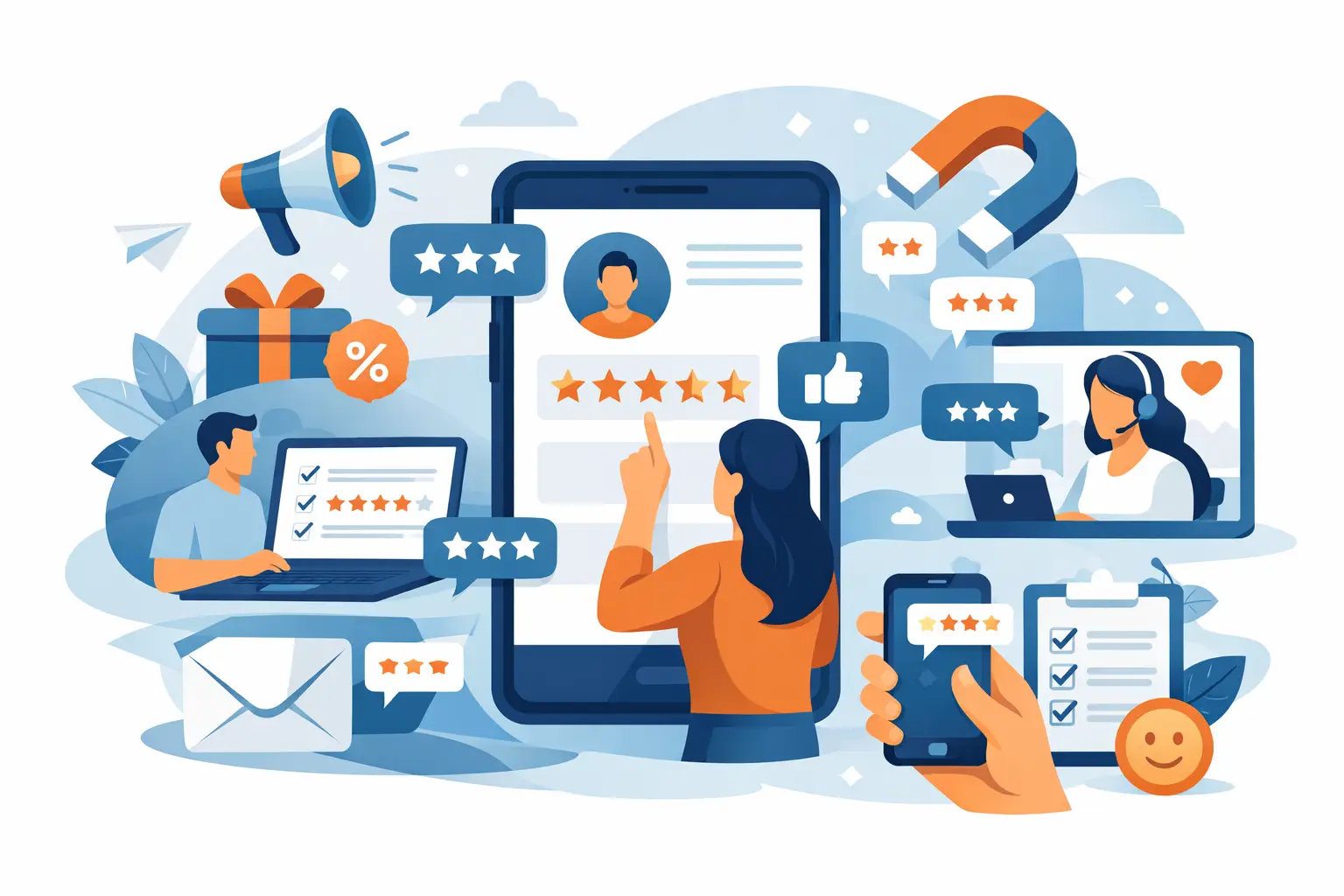
A satisfied customer leaves the premises, pays, smiles, and departs. If you don't ask for their review at that moment, they'll most likely never remember to do so. That's the problem and also the opportunity. When we talk about the Best ways to capture reviews, we're not talking about asking for favours. We're talking about designing a process that turns a good experience into more visibility, more confidence and more business in Google.
The best ways to capture reviews start with timing
Most businesses don't need to “ask for more”. They need to ask better. The volume of reviews usually doesn't depend solely on the quality of service. It depends on when it's requested, who does it, through which channel, and how easily the customer can respond.
If you manage a restaurant, a gym, a dealership or a retail chain, this has a direct impact on local customer acquisition. More reviews and a better average rating usually translate into more clicks, more calls, more visits and more conversions. However, not any system will do. What works in a hotel may not work as well in a workshop, and what works well in a single shop can break when scaling to twenty locations.
Ask for the review right after the experience
The best time isn't “when you have time”. It's when the experience is still fresh. If you wait 48 hours, the intention drops. If you do it at the point of sale or just after the service, the response rate goes up.
In hospitality, that moment often comes when paying. In the automotive industry, after the vehicle is delivered. In gyms, after a particularly well-rated class. In retail, when closing a sale with outstanding service. Immediacy reduces friction and increases conversion.
Here's an important nuance. If the customer has reported an issue, you shouldn't immediately push them towards Google. It's important to resolve it first. Getting more reviews isn't about blindly speeding things up, but about identifying the right moment.
2. Minimise the steps
Every extra click costs reviews. It seems obvious, but many businesses still send the customer to a website, then to a form, and then to Google. That journey kills intent.
If you want results, access needs to be direct. A QR code at the counter, an NFC card, a post-service SMS, or an email with a clear call to action work best when they take you to the right destination without any detours. The rule is simple: the less the client thinks, the more likely they are to leave a review..
NFC cards are particularly useful in physical businesses because they turn face-to-face moments into immediate action. Staff don't need to explain too much. The customer holds their phone nearby and reaches the review point in seconds. For chains or franchises, they also allow for standardisation of the process per location.
Train the team to ask for reviews without sounding pushy
A poor request generates rejection. A good request seems like a natural part of the service. The difference lies in the phrasing, context, and consistency.
A long speech isn't needed. Something direct and kind will suffice: if you've had a good experience, would you mind leaving us a review on Google? It helps us a great deal. The important thing is that the team understands that asking for reviews isn't an extra, but a local reputation driver..
However, not all employees pick up on it equally. Measuring which person, shift, or point of sale generates more reviews helps to identify real best practices. That's where a system with traceability adds operational value. You no longer depend on perceptions. You see data.
4. Automate reminders without losing context
Not all clients will respond on the first contact. That's why it's advisable to activate a second automated request, as long as it makes sense for the type of business.
A reminder via WhatsApp, SMS or email can recover reviews that would otherwise have been lost. But there's a condition. Automation must respect the context of the experience. It's not the same as a returning customer as an occasional visitor, nor a quick purchase as a stay of several days.
If the message is generic, it performs worse. If it incorporates the name of the establishment, the service provided and a tone consistent with the brand, it usually performs better. Automation does not replace strategy. It executes it with more consistency and less manual workload.
5. Activate physical collection points within the premises
Many businesses rely solely on the digital channel and waste in-store traffic. That's a mistake. If the customer is already in your space, you have a direct opportunity to capture their feedback.
Counters, tables, reception areas, cash registers, waiting areas or ticket offices can all become activation points. A well-placed stand, with clear instructions and immediate access, can generate a steady volume of reviews without any extra effort from the team.
The design of the customer journey is very important here. If the QR code is hidden, it doesn’t work. If the staff don’t mention it, that doesn’t work either. And if all the branches of a chain do it differently, the performance will be inconsistent. Point-of-sale acquisition needs method, not improvisation.
6. Respond to reviews to generate more reviews
Capturing and responding are not two separate processes. They are connected. When a potential client lands on your profile and sees that reviews are being responded to, they perceive attention, control and activity. That also encourages engagement.
In addition, Respond well improves the brand's reputational signal. Not just to Google, but also to those comparing options. In sectors with high local competition, that perception can tip the purchase decision.
The key is to do it with speed and consistency. In a business with a single branch, it can be resolved manually. In a network of branches, it doesn't scale. Automating responses with a configurable tone allows for maintaining an active presence without increasing operating time.. And if you also analyse the sentiment of the comments, you turn each review into a source of improvement.
7. Measure which channel and which location generate the most reviews
Asking for more isn't enough. You need to know what works. An SMS campaign can yield better results than email. One shop can convert twice as much as another with the same footfall. One employee can generate more positive reviews than the team average. Without measurement, all of that is lost.
This point is particularly critical in multi-site businesses. If you don't compare results between locations, you can't replicate what works or correct what is hindering performance. Benchmarking between locations makes review acquisition a manageable process..
It's also worth monitoring quality, not just volume. Increasing reviews with a poor underlying experience might inflate visibility, yes, but it could also skyrocket negative comments. Acquisition must be linked to actual operations. If there's a recurring problem with waiting times, cleanliness, or service, the reviews will expose it.
Turn customer voice into operational action
Reviews aren't just for improving the average score. They serve to detect patterns. If several customers mention staff friendliness, you know what to reinforce. If repeated complaints appear about queues, stock, or appointments, you have an operational problem with reputational impact.
For this reason, one of the best decisions is not just to gather more opinions, but to read them critically. The Semantic and sentiment analysis allows us to move from accumulating comments to making decisions. That changes the conversation. It's no longer just about “getting more stars”. It's about improving the experience and protecting revenue.
At this point, a platform like wiReply can fit naturally for businesses that need to centralise branches, automate responses, measure engagement by employee or location, and extract actionable insights without adding manual work for the team.
What you should avoid if you want to attract more and better
Errors continue to appear. Buying reviews, offering incentives in exchange for positive opinions, or only filtering happy customers may seem like a quick fix, but it introduces reputational and operational risk. Furthermore, it distorts the information you later use to make decisions.
It's also advisable to avoid impersonal messages and lengthy processes. If the customer perceives that you're asking for something that only benefits you, they'll respond less. If they understand that their opinion helps to improve things and the process takes seconds, they'll respond more.
Another common mistake is to leave all the responsibility to the venue manager. Review acquisition works best when it's integrated into the process, supported by technology, and monitored with clear metrics.
The best strategy is one that you can repeat at scale.
The best ways to capture reviews aren't the most creative. They are the ones that combine low friction, good timing, operational consistency and measurement. If you rely on a person remembering to ask for a review, you'll have spikes. If you make it a system, you'll have growth.
For a local, independent business, that might mean a well-placed QR code and a simple protocol. For a chain with multiple locations, it means automating, comparing sites, controlling responses, and using feedback as a business signal. The goal remains the same in both cases: transform customer experience into visible reputation and local advantage.
If your reviews arrive by chance, you're leaving results to luck. When the process is well-designed, Google notices, customers see it, and the team works with more focus. That's where reputation stops being a reactive problem and becomes a growth channel.