
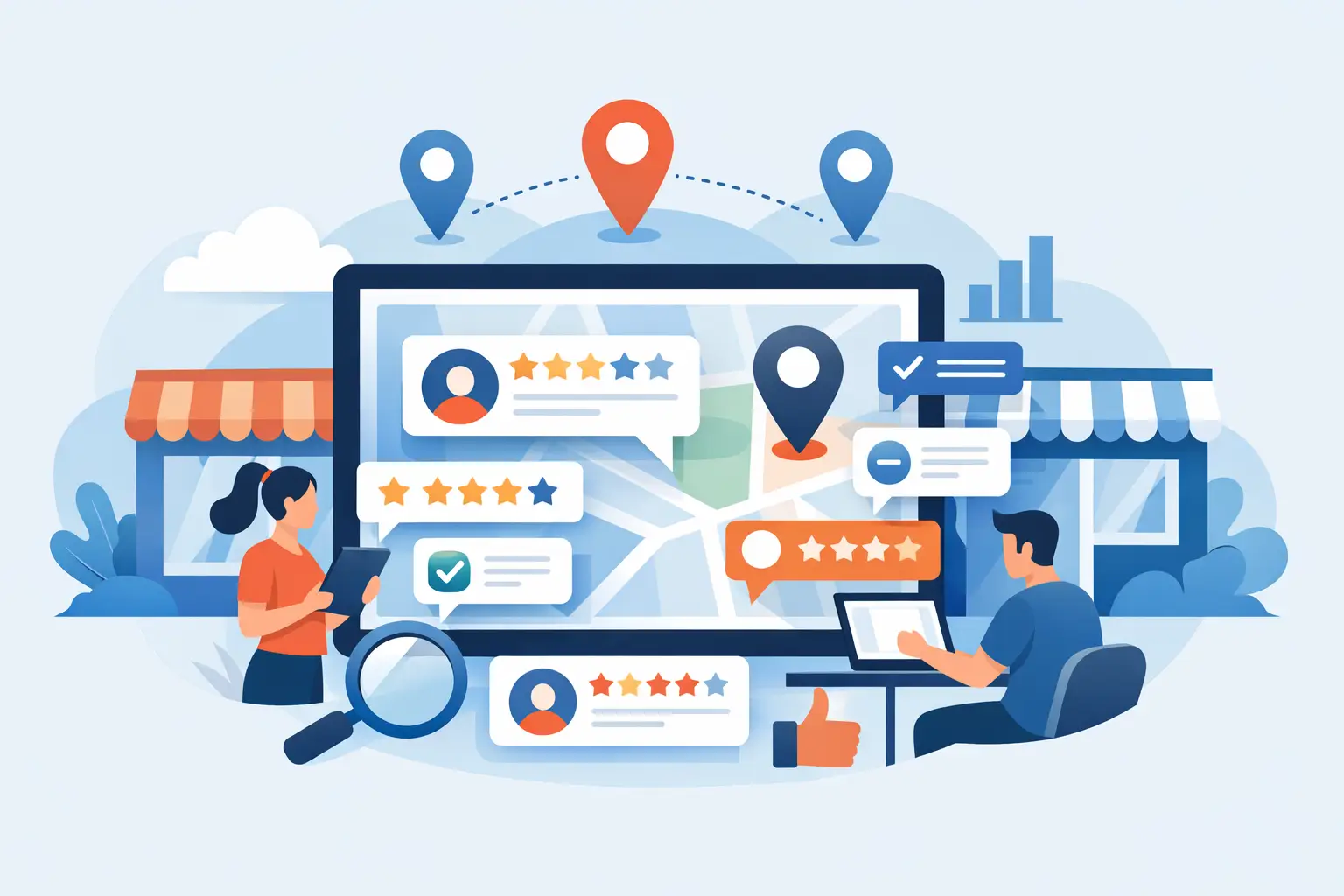
Whether you manage 5, 20, or 200 locations, you already know where things get complicated: not in getting individual reviews, but in responding well, quickly, and thoughtfully to each listing. That's where the challenge lies in managing multi-site Google reviews without losing control, overwhelming the team, or turning local reputation into an operational bottleneck.
Why does multi-location review management break so quickly?
In a business with various locations, reviews don't arrive with the same volume, nor with the same tone, nor do they demand the same response. an urban restaurant might receive dozens a day. a hotel might concentrate them seasonally. a dealership might have lower volume, but more commercial sensitivity. trying to treat everything the same usually ends badly.
The first problem is fragmentation. Each branch generates its own conversations, but the brand needs a common thread. The second is speed. Google rewards activity, and users do too. Responding late conveys a lack of attention. The third is consistency. When each manager responds as they see fit, the brand experience becomes fragmented.
To that is added a detail that many chains discover too late: reviews do not only affect the image. They also impact Local positioning, in click-through rate, visit decision, and conversion. Therefore, managing multi-location reviews on Google isn't an administrative task. It's a growth function.
How to manage multi-location reviews on Google with a scalable system
The difference between a reactive operation and an efficient strategy lies in the system. If you rely on reviewing files one by one, copying answers, and chasing internal stakeholders, the model stops working as soon as you open more locations or the volume increases.
The first step is to centralise. All reviews must enter a single management environment, with visibility by location, by region, by type of comment and by response status. Without this control layer, there is no realistic way to prioritise or measure performance.
The second is to define clear rules. Not all opinions require the same treatment. 5-star positive review It can be resolved with an automated and personalised response in a good tone. A criticism about cleanliness, waiting times, or staff treatment needs more context and sometimes internal escalation. The key is to classify before responding.
The third point is to work with target times. A chain doesn't need to respond to everything in two minutes, but it should set realistic operational commitments. For example, responding to positive reviews on the same day and negative feedback within a few hours. The important thing is not just the average timeframe, but avoiding long gaps that damage perception and visibility.
Centralisation, yes, but without losing the reality of each local branch.
One of the most common mistakes in multi-location businesses is wanting total control from head office without leaving any room for each point of sale. The result is usually slow and unconvincing. The opposite mistake is also common: delegating completely to each branch and losing brand consistency.
The effective point is in a hybrid model. Management defines tone, criteria, templates, alerts and escalation rules. Each local branch retains the capacity to provide context when the situation demands it. This way, speed is gained without sacrificing accuracy.
This balance is particularly important in sectors where experience is very local. In hospitality, retail, gyms or the automotive industry, the same brand can have very different review patterns depending on the area, team, footfall or customer profile. Managing from a single uniform logic saves little if the response ceases to sound relevant.
Automating responses doesn't mean responding worse
There are still teams that associate automation with cold or repetitive responses. The problem isn't automation. The problem is automating poorly. If the system detects language, sentiment, theme, rating, and local context, the response can maintain brand consistency and still sound useful.
Well-applied automation resolves the biggest hidden cost of multi-site reputation management: the manual time spent on repetitive tasks. Responding to hundreds of positive reviews with full human supervision doesn't add proportional value. Instead, using artificial intelligence to generate responses aligned with brand tone frees up time for what does require judgement: incidents, complaint patterns, and improvement opportunities.
There is an important caveat here. It is not always advisable to automate the 100% response process in every case. In the case of negative reviews, comments with legal implications, safety concerns or specific allegations, human review is required. Automation brings speed and scale. Operational judgement remains essential.
The part that generates the most impact, turning reviews into operational data.
Responding is fine. Learning from what is responded, much better. In multi-site operations, reviews are a continuous source of information about real customer experience. If they are only used for replying, their value is wasted.
Advanced management begins when each opinion stops being a loose piece of text and starts to be classified by themes. Attention, cleanliness, waiting time, product, price, facilities, availability, staff interaction. From there, the chain can detect which location is falling in satisfaction, which region is improving, which problem is recurring, and which teams are generating the most positive comments.
This changes the internal dialogue. It is no longer a question of “there are quite a few complaints”, but rather “32% of the complaints received in this area over the last month mention waiting times”. That level of insight enables us to take action. It also helps us compare branches using a more useful criterion than just the average rating on its own.
In companies with many locations, internal benchmarking is especially valuable. Not to point out the lowest-scoring branch, but to identify replicable practices. If one branch increases reviews, responds faster, and improves sentiment, it's worth understanding why. Often, the learning isn't in marketing, but in in-store execution.
How to organise roles and workflows without slowing down operations
A multi-site review strategy fails when no one knows what they're supposed to do. That's why it's best to separate functions very clearly. The central team should define policy, tone, supervision, reporting, and rules. Local managers should get involved when there's operational context or a need to resolve a specific issue. The customer service or customer experience team can handle sensitive or repeated cases.
No need to build a heavy structure. Improvisation must be avoided. If a negative review about mistreatment appears on a business's profile, the system must allow it to be viewed, categorised, responded to, and if necessary, have follow-up initiated. If everything ends up as an isolated email or an internal chat message, traceability is lost.
It is also advisable to measure more than just the number of responses. Useful metrics include average response time, response rate, sentiment evolution, critical issues by location, growth in new reviews, and the relationship between reputation and local performance. This perspective connects marketing, operations, and business.
Generate more reviews, but with a method.
Better management also means generating more recent review volume. A profile with few reviews or old activity loses traction against more active competitors. But asking for reviews without a system often yields inconsistent results.
The most effective approach is to integrate it at the point of sale and make it easy. If the customer has had a good experience, the moment of application creativity of the message. The less friction, the higher the conversion rate. In multi-site environments, it's also important to know which location, which employee, or which channel is generating the most feedback. That traceability helps to replicate what works.
Not all branches will have the same rhythm. And that's okay. An airport, a shopping centre, and a neighbourhood shop don't behave the same way. The important thing is to work with realistic objectives per branch, not with a generic average for the entire network.
What should brands with multiple locations avoid
There are recurring errors. The first is responding with identical messages on all the pages. It saves time but damages credibility. The second is ignoring 3-star reviews, when they often contain very useful information. The third is treating negative reviews as a communication problem, when they are often an operational symptom.
It's also advisable to avoid complete dependence on the local manager. If a manager changes, goes on holiday, or prioritises other tasks, management is interrupted. The system must continue to function even if people change. That's the difference between a handcrafted process and a scalable operation.
At this point, platforms like wiReply make sense for chains and local businesses with significant volume, as they allow for the centralisation of listings, automated responses with configurable tones, sentiment analysis, and comparison of locations without burdening the team.
What a company gains when it does well
When multisite management is in order, the impact is felt on several fronts simultaneously. It improves brand perception, increases responsiveness, problems are detected sooner, and local SEO gains consistency. But there's a less visible and very valuable effect: reputation ceases to be a constant emergency.
That changes the way we operate. The team no longer chases after random opinions. It works with priorities, automation and data. And when that happens, reviews stop being noise. They become a real lever for attracting more customers, protecting the brand and improving each location with information that comes directly from the buyer.
If your network still manages opinions one by one, item by item, the problem isn't the current volume. It's the cost of continued growth with a system that doesn't scale.