
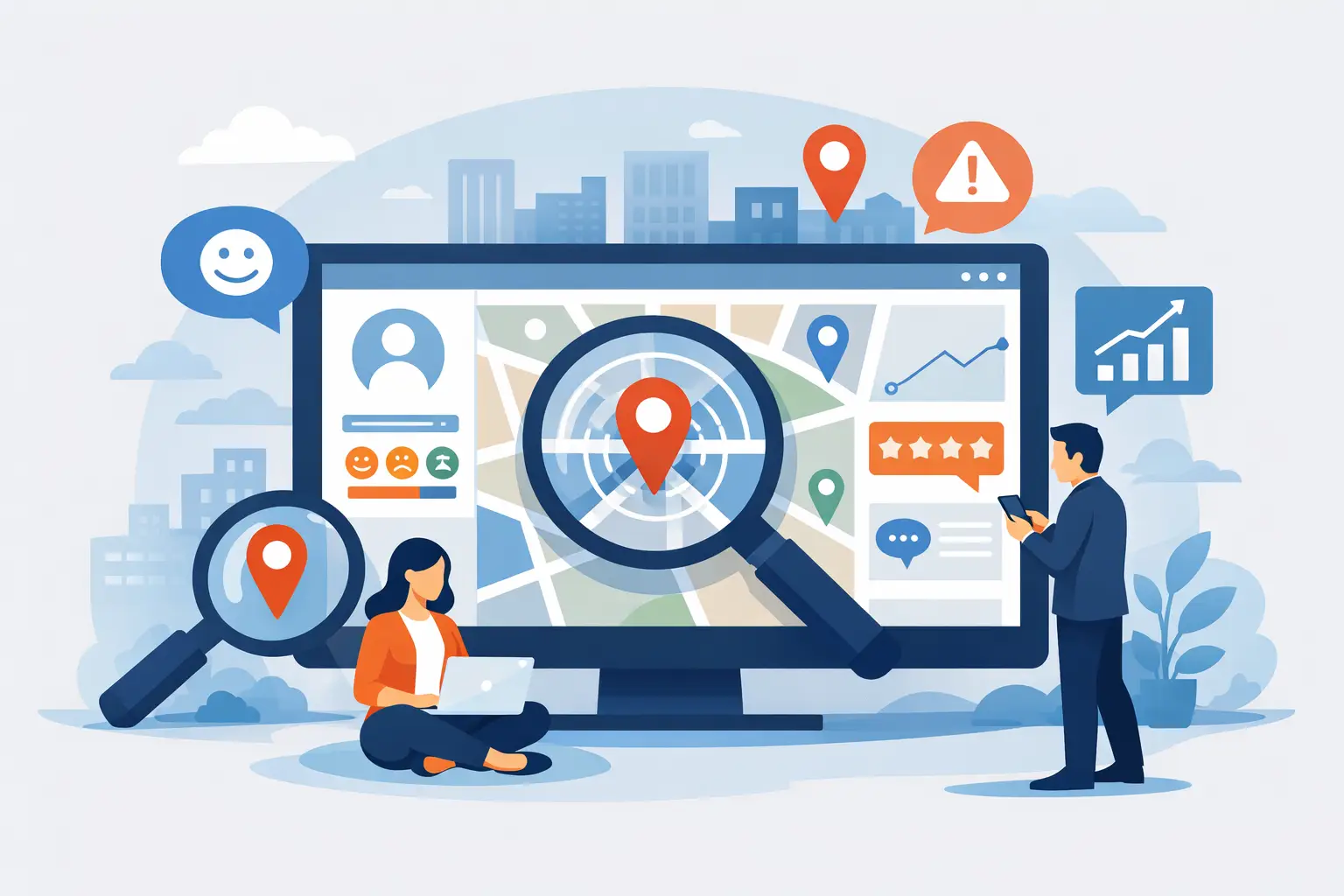
At 9:12 AM, a one-star review comes in for one of your locations. By 9:40 AM, dozens of potential customers have already seen it. If no one picks it up until the end of the day, the damage is already done. That's why real-time local reputation monitoring isn't a minor operational improvement. It's a direct way to protect sales, correct issues, and maintain control over how you're discovered on Google Maps.
For a local business, and even more so for a chain or franchise network, digital reputation is no longer managed in weekly blocks. It is managed by signals. Every new review, every change in the average, every peak in negative sentiment, and every location with poorer performance demands rapid analysis. What makes the difference is not just responding. It's knowing what is happening, where, how often, and what impact it can have on local customer acquisition.
Monitoring local reputation in real-time
It's not just about receiving an alert when a review comes in. That view falls short. Real-time monitoring means capturing, classifying, and prioritising reputational signals as they appear, turning them into concrete actions.
In practice, it means seeing new comments without delay, identifying whether the comment is about waiting times, service, cleanliness, stock, or price, detecting whether the tone is positive, neutral, or critical, and knowing if the issue affects an isolated location or recurs in multiple ones. It also involves measuring whether responses are being given within the timeframe the customer expects and whether the reputational trend is improving or worsening by area, manager, or point of sale.
The difference between looking at reviews and monitoring reputation lies in the context. An isolated review might seem like an incident. Ten similar comments across three different locations point to an operational problem.
Why it matters more than it seems
Google doesn't just display stars. It displays trust. And that trust influences clicks, calls, directions, bookings, and physical visits. When a profile accumulates recent comments, agile responses, and a stable rating, it conveys control. When unanswered criticisms or repeated complaint patterns appear, it conveys friction.
Here's an important nuance. Not all negative reviews are a serious threat. Some can even help reinforce credibility if responded to well. The real problem arises when the organisation reacts late, doesn't see patterns, or relies on manual processes that don't scale.
For a company with just one location, the risk is usually losing visibility or conversions at key moments. For a brand with multiple sites, the risk is multiplied. There may be branches dragging down the average, teams not following the same response criteria, or incidents repeating for weeks before reaching operations.
What signs are worth continuously monitoring
The most visible metric is the average score, but it's not the only one that matters. In fact, managing it alone often leads to poor decisions. Useful monitoring combines volume, velocity, and context.
The first sign is the entry of new reviews. It seems basic, but many companies still review them late. The second is the response time. Replying late not only worsens customer perception. It also leaves room for that opinion to influence the decisions of other users. The third is the Added feeling. If the volume remains stable, but the tone deteriorates, there is an early warning.
Then there are operational signals. Comments relating to customer service, product issues, cleanliness, waiting times, or meeting expectations. These are particularly valuable because they connect reputation with execution. And, for multi-site businesses, there are two further variables: comparison between locations and the detection of deviations. If one location plummets sharply compared to the rest, you don't need any more data. You need to act.
The problem with doing it manually
Reviewing entries one by one works until it stops working. As soon as there are multiple locations, several managers or a constant volume of reviews, the system breaks. Time is wasted, tasks are duplicated, and responses are late.
Furthermore, manual review rarely offers a comprehensive reading. It allows for comments to be seen, but not for patterns to be quickly interpreted. It is difficult to detect if a problem is isolated or structural, if it affects one region more than another, or if new reviews generated in-store are being captured where they should be.
There is also a hidden cost. When marketing, operations, and customer support work with different data, reputation stops being a system for improvement and becomes just another inbox.
How to monitor local reputation in real-time without increasing operational load
An effective approach combines automation, prioritisation criteria and useful analytics. There's no need to overcomplicate it. It needs to be well-designed.
Firstly, centralise all your location reviews into a single environment. If each manager is looking at a different source, there's no real control. Secondly, set up alerts by priority, not just volume. A high-impact negative review, a sudden drop in the average, or a comment mentioning a sensitive issue should be escalated before a routine comment.
Third, classify the content of the reviews by topic. This is where artificial intelligence adds practical value. Reading hundreds of comments is slow. Grouping them by recurring themes allows you to see what is truly affecting the customer experience. Fourth, automate responses where it makes sense, but with clear rules. Not all reviews need a bespoke response, but it's also not advisable to respond to everything with unfeeling templates.
Fifth, connect reputation with operational decisions. If a location repeatedly receives complaints about waiting times, the data shouldn't stay with marketing. It needs to reach whoever can correct shifts, processes, or staffing.
What changes when there are multiple locations?
In a multi-site network, speed matters, but consistency matters even more. It's not enough to know that 40 new reviews have come in today. You need to know which branches are improving, which are declining, which manager is generating the most positive reviews, and where criticisms are piling up for the same reason.
Here, internal benchmarking is key. Comparing locations allows for the identification of replicable best practices and the detection of deviations before they become chronic. A branch with better review conversion, faster response times, and more positive sentiment doesn't just have a good reputation; it has a method that can be scaled.
Governance also changes. Some brands require centralised responses to ensure tone and compliance. Others prefer a hybrid model, with corporate automation and local oversight. There is no single formula. It depends on volume, sector, and the degree of autonomy of each point of sale.
Cases where real-time makes a clear difference
In the hospitality industry, a poor service sequence during peak hours can result in several negative reviews within a few hours. If detected immediately, a manager can correct it before the second shift. In retail, a poorly communicated promotion or a stock issue generates immediate frustration. If this repeats across multiple stores, your reputation will tell you before many internal reports do.
In the automotive and garage sector, feedback typically focuses on lead times, transparency, and customer service. These are very sensitive factors for building trust. In gyms, cleanliness, staff interaction, and peak hour saturation carry significant weight. Hotels and tourism, a single incident can affect future bookings if the response is not timely.
In all these sectors, the value of real time is not just in responding quickly. It's in reducing the distance between what the customer experiences and what the company knows.
What should a useful tool offer
You don't need more dashboards. You need clarity. A good solution for monitoring local reputation in real-time should show actionable alerts, sentiment reading, semantic classification of comments, comparison between locations, and traceability of who is generating new reviews and where.
It should also allow for automated responses with tone control, because speed without brand consistency creates another problem. And it must facilitate collaboration between teams. If operations doesn't see the patterns, if marketing doesn't measure impact, and if management can't compare locations, the technology falls short.
At this point, platforms like wiReply fit well into organisations that need to scale without adding manual work, because they bring together automation, reputational analysis, and comparative insight in a single system.
The most common mistake when starting
Many companies try to solve this with ad hoc notifications and reactive responses. That gives the impression of activity, but not of control. The key isn't answering everything faster. It's distinguishing what warrants immediate attention, what pattern demands intervention, and which location needs closer monitoring.
Nor is it advisable to pursue artificial perfection. A credible reputation isn't one that avoids all criticism. It's one that demonstrates responsiveness, learning, and consistency.
If your business relies on being found, chosen, and trusted before anyone steps through the door, local reputation can't be reviewed when there's time. It has to be read as it's happening. That's where it stops being a nice-to-have indicator and becomes a real growth lever.