
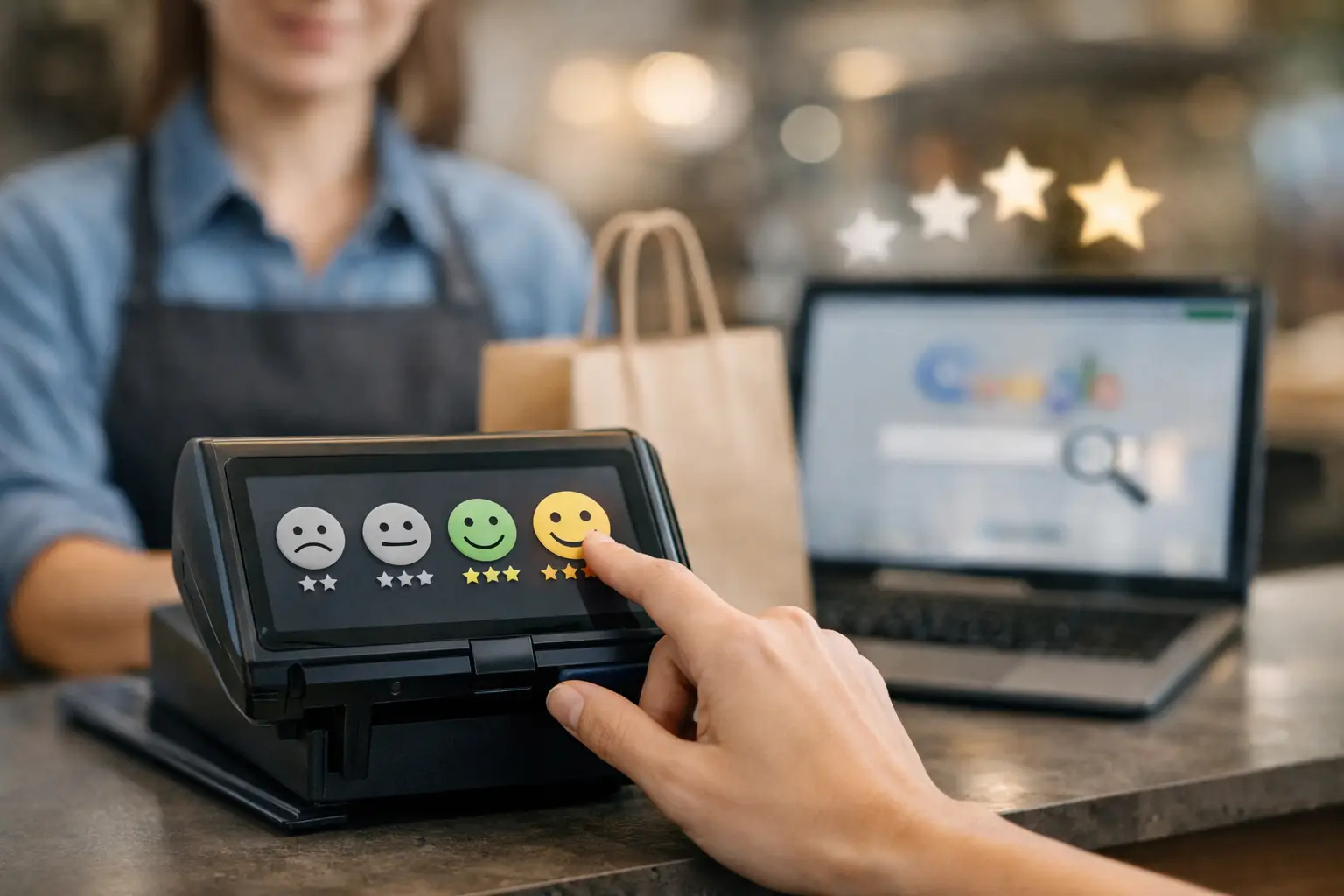
The payment moment holds an advantage that few local businesses leverage well: the customer has already experienced it, has the service fresh in their mind, and is face-to-face with a member of your team. Knowing how to generate reviews at the till isn't about mechanically asking everyone for a review. It's about turning that instant into a simple, natural, and measurable process that increases the visibility of each location on Google.
In sectors such as restaurants, retail, gyms, hotels, and automotive, a good experience can be lost if the customer leaves without a trace. A review published at the right time reinforces the confidence of future customers, provides signals of local relevance, and leaves useful information about what works at the point of sale. The aim is not to pressure. It is to reduce friction so that leaving a review is as easy as paying.
Why is the box the best place to ask for reviews
The checkout is a decisive point of contact. The customer has finished their purchase, booking, meal, or service. If the service has been correct, their predisposition to collaborate is usually greater than hours later, when they receive a message amongst dozens of notifications. Furthermore, the team can detect if the interaction has been positive before making the invitation.
This doesn't mean only selecting satisfied customers. Google expects businesses to ask for reviews honestly, without filtering opinions or offering rewards in return. The difference lies in the context: if there has been an unresolved issue, it is appropriate to listen, resolve it, and not turn the request for a review into an uncomfortable insistence. A solid reputational strategy protects the customer experience before volume at any cost.
When the process is integrated into till operations, it no longer relies on an employee remembering a phrase or the manager chasing results at the end of the month. Each site can follow the same criteria, maintain brand tone, and measure which teams, time slots, or actions generate the most engagement.
How to generate feedback from the till without inconveniencing the customer
The best request lasts a few seconds and comes after a signal of satisfaction. A spontaneous comment, a friendly goodbye, or positive feedback on the service are good moments. The phrase should be direct: “It helps us a lot to know your opinion on Google. You can do it here if you like.” No long speeches, no insistence, and no asking for a specific score.
The key is that the link to the Google listing is instantly available. A visible QR code next to the payment terminal can work, but simply printing it and expecting results isn't enough. It must take the customer directly to the correct business's review flow. If a chain has multiple locations, a generic QR code or a poorly configured landing page can send traffic to the wrong listing and cause the opportunity to be missed.
Personalised NFC tags are especially useful when speed is a priority. The customer holds their mobile phone near, accesses the profile, and can leave their review without manually searching for the business on Google Maps. It's a simple gesture, but it eliminates critical steps: typing the establishment's name, choosing from similar results, and locating the review button.
The location of the support also plays a part. In a fast-food restaurant, it might be next to the payment. In a hotel, it might be given at check-out. In a garage, it will often make sense after explaining the work that has been done and handing over the vehicle. In a gym, the reception might invite feedback after resolving an enquiry or after a particularly valued class. The channel is the same, but the timing must be adapted to the experience.
The script should be natural and consistent.
Giving the team complete freedom often leads to inconsistent results. Some employees don't ask for reviews due to a lack of time, others use messages that are too long, and some may unintentionally convey pressure. A brief script allows for standardising the request without it becoming an artificial conversation.
A useful formula is to thank, contextualise, and facilitate action. For example: “Thank you for coming. If you have a minute, your review on Google helps us to improve and to be found by more people.” The employee should not wait while the customer writes, nor should they check what they post. The review belongs to the customer and their spontaneity should be preserved.
It's also worth defining when not to ask for it. If there's a queue, if the customer is in a hurry, if a complaint has been made, or if the team is resolving a problem, the priority is to provide good service. Forcing the request in these scenarios can damage the relationship and create the opposite effect.
Convert the request into an operational process
Generating reviews from a box works when managed as an operations process, not a one-off campaign. The person in charge must decide which touchpoints will be used, what support each location will have, how the team will be trained, and which metrics will be reviewed. This avoids isolated actions that generate a peak in opinions one week and disappear the following month.
The first step is to assign unique access per location. If there are multiple counters, employees, or service areas, you can work with distinct identifiers to know the origin of each new review. This traceability allows you to know if an NFC card, a counter display, or a specific action is working. Without data, it's easy to attribute results to gut feelings and repeat unprofitable investments.
The second step is to train the team on the 'why', not just the phrasing. When an employee understands that reviews influence the choice of a restaurant, clinic or dealership, the request gains meaning. Training should include examples of best practices, situations where it's not advisable to ask for an opinion, and clear responses to customer doubts.
The third step is to review performance by location. Not all establishments have the same ticket volume or the same type of customer relationship. Comparing the number of new reviews with estimated traffic, turnover, or the channel used helps to identify real opportunities. A shop with many transactions and few reviews may need better QR visibility. A location with good volume but repeated comments about waiting times needs to act on its operations, not just celebrate growth.
Measuring quantity is not enough
A mature strategy observes how many reviews are coming in, but also what they say. The average score is useful, although it doesn't explain the experience on its own. Sentiment analysis and recurring themes allow detect patternsExcellent attention, waiting times, cleanliness, stock, product quality, reception treatment or billing problems.
For a multi-branch company, this reading should be done per location and in aggregate. If several establishments receive negative mentions about the same process, there is likely a common operational cause. If a single point of sale stands out for its positive comments about staff, it can become a benchmark for training other teams. Reviews cease to be a shop window and become a source of decisions.
wiReply allows you to centralise this process: generating reviews from the point of sale, traceability by employee or location, analysis of comments and assisted response with artificial intelligence. The result is more control for operations and marketing, without transferring unnecessary manual effort to each branch manager.
Errors that reduce box office takings
The most frequent error is using a QR code that leads to a generic page, the company website, or an incorrect listing. Each additional click reduces conversion. Access must be immediate and periodically checked from different mobile phones.
The lack of visibility also fails. A small code behind a sign full of messages does not attract attention. The support must be clear, clean and located where the customer already looks during payment. The proposal must simply explain the benefit: sharing an opinion helps the business to improve and to be found by more people.
Another problem is requesting reviews only when an audit, a launch, or a valuation drop occurs. Customers perceive a stable dynamic better than a sudden, massive request. Consistency protects the profile against fluctuations and generates a more faithful representation of the daily experience.
Finally, it is important not to confuse internal motivation with review incentives. The team may pursue process adoption or quality of care objectives, but the customer should not receive discounts, gifts, or advantages for leaving a review. The reputation that generates long-term business is the one that retains credibility.
A review starts with the service, not the QR code
Technology speeds things up, but it can't replace good experience. A well-placed QR code can multiply the ease of giving feedback; it can't fix excessive waiting times, poor delivery, or a lack of care in customer service. That's why every new review should trigger two actions: Thank you for participating and review the information it provides.
Start with a point of sale, a simple message and a clear measurement. When the team sees that asking for feedback doesn't add complexity and that the results translate into visibility and concrete improvements, the till will stop being the end of a transaction. It will be the start of a reputational relationship that can be managed, measured and improved every day.