
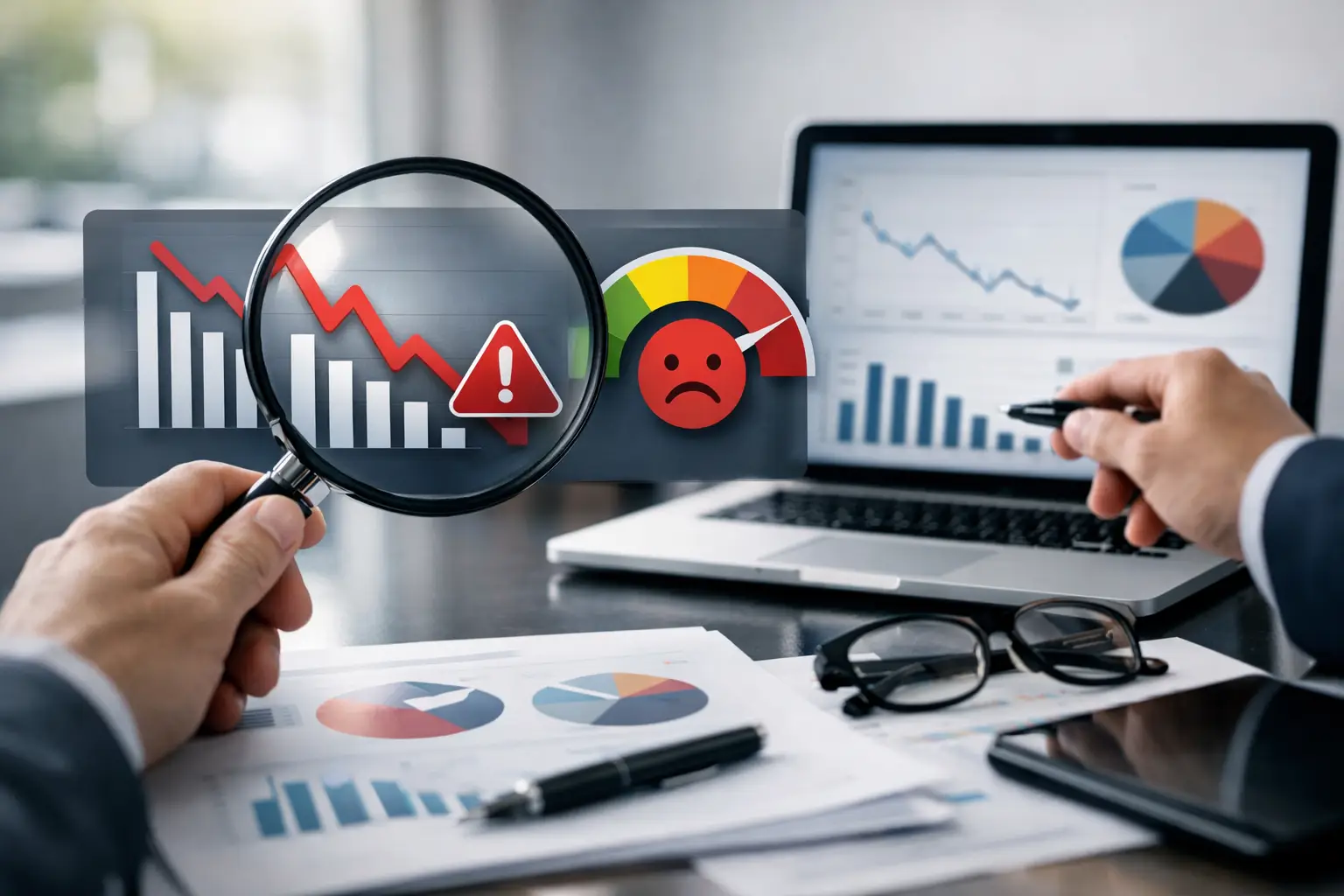
A two-tenths drop in the average rating may seem minor. For a local business, it can be the first sign of fewer clicks, fewer calls and fewer visits from Google Maps. Understanding which KPIs indicate reputational risk makes it possible to act before negative reviews pile up, affect the purchasing decision and turn into an operational problem.
Reputation is not measured solely by the number of stars. An average of 4.5 can hide a venue with very negative recent reviews, slow response times or comments repeating the same flaw. The risk appears when the data starts to lose consistency: satisfaction drops, sentiment worsens or a location falls behind the network's performance.
For marketing, operations and customer experience managers, the goal is not to monitor a Google listing in isolation. It is to spot patterns, prioritise the sales outlets that require intervention and check whether the actions taken improve customer perception.
Reputational risk starts with the trend, not the average
The average rating remains a useful indicator because it directly influences the user's first impression. However, it is an outcome KPI. When it drops, the damage has already been done. That is why it must be analysed alongside its trend over short periods, such as the last 30, 60 or 90 days.
A restaurant that maintains a historical average of 4.4 stars may seem stable. But if its last 40 reviews have an average of 3.6, there is a clear negative trend. The overall score will take time to reflect it, while potential clients will already be reading recent comments about waits, order mistakes or poor service.
Recent scoring reveals current experience. Historical scoring explains brand legacy. Both are necessary, but they must not be confused.
KPI 1. Recent average rating and rate of deterioration
The first indicator is the average star rating of new reviews, compared to the historical average and the previous period. Rather than focusing solely on the final figure, it is advisable to measure the rate of decline: how much it has fallen and over what period of time.
A sustained drop over several weeks requires immediate attention. A one-off fall, on the other hand, may be due to a specific issue, a restructure, a change of team or a surge in demand. Context matters. Not all variations require the same response.
In a multi-site chain, this KPI must be compared branch by branch. If five establishments maintain a stable recent rating and one drops rapidly, the problem is likely local: shift management, stock, cleanliness, training or operational capacity. Internal comparison avoids treating as a brand problem what is a specific failure of a single location.
KPI 2. Percentage of negative reviews and concentration of criticism
Counting one- and two-star reviews is basic, but the percentage of the total provides a more accurate reading. A venue with ten negative reviews a month does not have the same level of risk if it receives 50 reviews as it does if it receives 500.
Concentration also matters. Several negative reviews published within a few days usually indicate an active incident. It could be a poorly executed campaign, a breakdown, staff shortages or an unmet expectation. If the volume normalises quickly, the alert can be closed. If it persists, it must be escalated to operations.
The metric gains value when segmented by category. Receiving criticism about price is not the same as about hygiene, customer service, safety, billing or accessibility. Some issues have a greater reputational and commercial impact, especially in hospitality, healthcare, automotive or tourism.
KPI 3. Sentiment and recurring themes in comments
Stars tell you how much a customer has valued their experience. Sentiment and topic analysis explain why. This difference is decisive for taking useful action.
A business can receive three-star reviews with kind comments about the product and constant criticism regarding slowness. It can also get four stars from satisfied customers who warn of recurring booking issues. If you only look at the score, those signals go unnoticed.
The most actionable KPI combines the proportion of negative sentiment with the frequency of each topic. When words and concepts such as “waiting”, “dirty”, “they don't answer”, “double charge” or “poor service” repeatedly increase, there is an operational risk behind the reputation.
It is not enough to classify comments as positive or negative. You have to assign owners. Customer service issues may fall to the store team. Product issues, to purchasing or quality. Booking issues, to the digital channel. Turning free text into operational data reduce the time between the complaint and the correction.
KPI 4. Time and response rate to critical reviews
An unanswered negative review doesn't always cause a loss of trust. But a sequence of ignored criticisms conveys a lack of control. The average time of Reply to reviews from one to three stars is, therefore, a reputational risk and service quality KPI.
The appropriate benchmark depends on the sector. A hotel, restaurant or gym with daily interaction should aim to respond in under 24 to 48 hours. In businesses with a lower volume, the timeframe can be longer, but it must be consistent. What is damaging is not just taking a long time, but responding inconsistently across locations.
It is also important to measure the response rate: what percentage of critical reviews receive a reply. Responding to 95 per cent may seem sufficient, but that remaining 5 per cent may account for the most serious cases. That is why it is advisable to categorise unanswered reviews by sentiment intensity and by topic.
Automation allows speed and consistency to be maintained, provided that supervision exists. Responses must acknowledge the issue, use the brand's tone and offer a next step when necessary. A generic template sent to all customers may be fast, but it does not always protect the reputation.
KPI 5: Review volume and profile freshness
Fewer new reviews do not automatically imply a reputational crisis. It could be due to seasonality, lower traffic, a change in opening hours or a temporary drop in activity. Even so, a sustained decline in the reduce volume the business's ability to compensate for negative experiences and maintain an up-to-date image.
Recency matters because users place particular trust in recent reviews. A profile with a high rating but few reviews in recent months can lose relevance compared to competitors that constantly generate new feedback.
This KPI should be analysed alongside transaction volume or visitor numbers. If a shop receives the same amount of traffic but generates 40 % fewer reviews, there may be a problem with the request process, the team’s motivation or the overall customer experience. If both visits and reviews are falling, the diagnosis is different.
KPI 6. Reputation gap against competitors and between venues
Reputation is relative. A 4.2 can be a good score in an area with competitors on 3.9, but a disadvantage if nearby businesses maintain a 4.6 with more recent reviews. Measuring the gap in rating, volume and pace of new reviews helps to understand the risk to local visibility.
In franchise networks or chain stores, internal comparison is just as relevant. A persistent difference between locations often reveals transferable opportunities for improvement. One establishment might excel in speed of service, incident management or the way it requests reviews. Another may require support before the issue affects the entire brand.
Benchmarking is not for chasing a figure without context. It is for identifying realistic standards and detecting deviations that affect bookings, calls, routes and conversions from the Google listing.
How to turn KPIs into an early warning system
The common mistake is to review reviews once a month and produce a report when a visible drop already exists. An effective system defines thresholds and people responsible. For example, an alert can be triggered if the recent rating drops by more than 0.3 points, if the percentage of one- and two-star reviews exceeds the usual average, or if a negative topic repeats more than a certain number of times in a week.
Afterwards, each alert needs a concrete decision: reply to the customer, review an incident, train the team, adjust a process or investigate a potential fraud case. Measuring without assigning an action only generates more data and no improvement.
wiReply allows you to centralise these metrics, compare locations and read the sentiment of the reviews so that teams do not have to rely on manual checks. The advantage is not receiving more information, but knowing where to act first and with what evidence.
A solid reputation is not built by answering every review when there is time. It is built by spotting early warning signs, fixing the root of the problem and verifying that the experience improves at every point of sale. When KPIs are connected to operations, Google Maps stops being a passive shop window and becomes a measurable channel for local growth.