
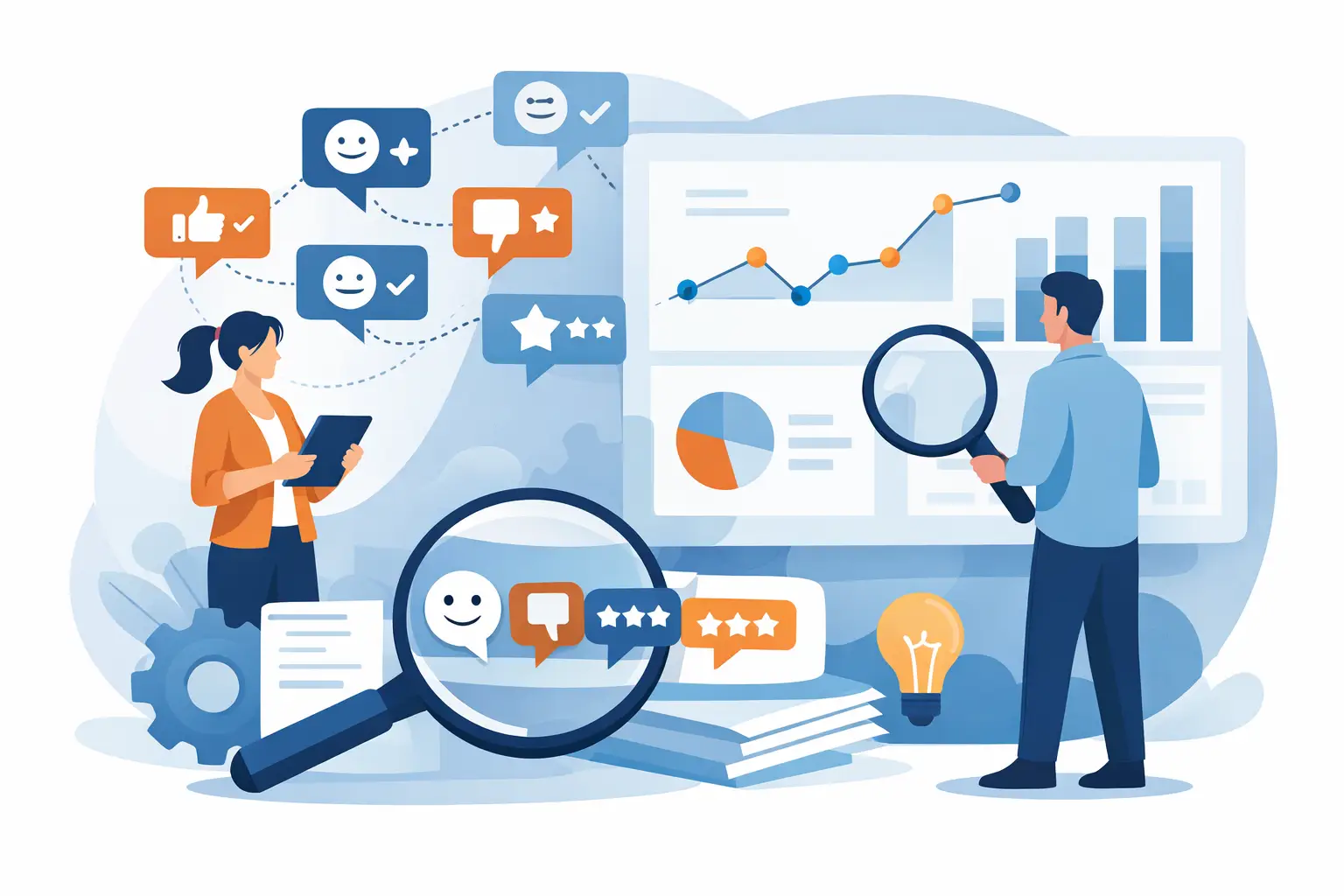
A single review might seem anecdotal. Ten reviews repeating the same complaint no longer are. Detect customer feedback patterns It's not just for understanding what people think: it's for correcting operational failures, protecting your reputation on Google, and making decisions with less intuition and more evidence.
For a local business or a chain with multiple locations, this is the point where things make a difference. If a restaurant receives feedback about long waits, if a gym accumulates mentions about cleanliness, or if a shop repeatedly praises staff at a specific branch, that's a signal. The problem isn't a lack of data. The problem is not turning it into action.
To detect patterns in customer comments means to identify recurring themes, topics, sentiments, or keywords within the feedback that customers provide. This helps businesses understand common issues, popular features, areas for improvement, and overall customer satisfaction.
We are not talking about reading opinions one by one and forming general impressions. We are talking about Identify recurring themes, measure their frequency, understand their context and see how they affect the average rating, the volume of reviews and the performance of each location.
A pattern can be negative, such as several reviews mentioning delays at the checkout. It can be positive, such as customers always highlighting an employee's attention. And it can also be mixed, which is where the most useful part often lies: good product experience but a poor perception of waiting times; good location but inconsistent service depending on the shift.
That reading changes how reputation is managed. You no longer respond just out of courtesy. We respond to detect causes, prioritise improvements, and protect revenue.
Why does this analysis impact reputation and business?
Reviews are not a secondary channel. For many local businesses, they are a direct part of the purchasing process. They influence clicks, visits, bookings, and trust. Therefore, when you analyse patterns, you are not just listening. You are working on an operational source that affects performance.
If you detect that a branch is receiving constant criticism for its service during peak hours, you can reinforce staff or review processes. If several locations in a chain have similar comments about stockouts, it's probably not an issue with a specific store, but rather with coordination or stock. The real value lies in connecting the customer's voice with internal decisions..
Furthermore, there's a clear reputational effect. When a brand responds quickly, corrects sooner, and demonstrates consistency, public perception improves. And when that improvement is sustained, Google's profile also reflects it with better ratings and more trust for new customers.
How to spot patterns in customer comments without wasting time
The most common mistake is doing it manually when the volume no longer allows it. Reading all the reviews for one or two locations might be feasible. Doing it for ten, twenty or fifty locations, however, is not. That's when delays, inconsistent responses and invisible problems start to appear.
The efficient way to work involves combining automation, thematic classification, and semantic analysis. It's not enough to group random words. You have to understand intent. A customer could write “they took a long time to serve me,” “eternal queue,” or “the wait was desperate.” These are different phrases, but they point to the same pattern.
That's why a good analysis system should detect mentions related to:
- customer service
- waiting times
- cleaning
- Price
- Product or service
- Specific incidents by location
- Employee performance
And it must do so with context. A criticism of the product is not the same as a criticism of the management of the establishment.. Nor is a single mention the same as a growing trend over three weeks.
What data is worth cross-referencing to find useful signals?
The comment alone adds value, but it falls short if you don't cross-reference it with other variables. For the analysis to be actionable, it's advisable to link each pattern with the score, location, date, and, where applicable, the shift or employee.
This crossing allows you to see what's really going on. For example, you might discover that the negative reviews they don't focus on a whole location, but rather on Saturday afternoons. Or that praise for the service skyrockets when a specific manager is on the till. That's no longer abstract reputation. It's precision operational management..
In multi-site businesses, internal benchmarking is particularly useful. If a franchise has twenty outlets and only three receive recurring criticism for disarray or slow service, you're not dealing with a general brand issue. You're dealing with a localised deviation. And that speeds up correction.
Frequent patterns worth monitoring in local businesses
Each sector has its own focal points, but there are signals that appear time and time again. In restaurants, the most sensitive mentions are usually about service, waiting times, cleanliness and value for money. In hotels, attentiveness, room condition, breakfast and the check-in process carry a lot of weight. In automotive, transparency, delivery times and commercial dealings stand out. In retail, product availability and in-store service are key.
The important thing is not to make a generic list, but to identify which issues have the greatest impact on your customer's purchasing decision. A comment about loud music might be secondary in a burger joint, but critical in a hotel. A ten-minute wait might be acceptable in a clinic with appointments, but it can ruin the experience in a convenience store.
The relevant pattern is the one affecting your conversion, your operation, or your local reputation.. The rest is noise.
The limit of manual analysis
Many teams start well and then get bogged down. In the beginning, someone reviews feedback, notes themes, and shares conclusions. It works for a while. Then the reviews increase, the venues multiply, and the process stops scaling.
There are three problems that arise. The first is subjectivity: two people can interpret the same review differently. The second is the slowness: by the time you detect the pattern, it has already been affecting the rating for weeks. The third is the lack of traceability: you know there's a problem, but you can't measure whether it's getting worse or better.
That's why, for marketing, operations, or customer experience teams, automation isn't a luxury. It's a way to maintain control. Less manual loading, more consistency and faster decisions.
What should a tool for detecting truth patterns offer?
Not all platforms are for the same purpose. If the goal is to respond to reviews, almost any will do. If the goal is to detect patterns in customer comments and turn them into decisions, you need more depth.
A useful tool should automatically classify topics, analyse sentiment beyond just positive or negative, and compare results across locations. It should also make it easier to read trends, as a snapshot is of little help. What's of interest is knowing if a pattern is growing, if it appears in various locations, or if it's being corrected after a specific action.
Furthermore, the automated response has to coexist with analysis. It's not enough to reply quickly. You have to reply well and, at the same time, Extracting operational intelligence from each comment. That's the point where a specialised platform adds more value.
In that context, solutions like wiReply allow for centralised management, automated responses with configurable tone, and semantic reading of reviews to detect recurring signals by location, category, or team. For businesses with high volume, this cuts down on time and improves internal visibility.
How to move from the detected pattern to action
Detecting the pattern is only half the job. The other half is triggering an internal response. If several reviews mention a lack of friendliness, it doesn't always mean an attitude problem. It could be team saturation, poor planning, or a lack of protocol during peak demand. Interpreting the pattern well avoids superficial solutions..
The recommendation is to prioritise by impact. First, the topics affecting the average score and local conversion. Then, those that are repeated across several sites. And finally, those that can be resolved quickly and generate a visible improvement within a few weeks.
When the analysis is well-constructed, you can also measure whether the action is working. If you change a hotel check-in process or reinforce staff during a specific period, you should see a progressive drop in those mentions. If that doesn't happen, the problem wasn't properly diagnosed.
What a brand gains when it listens methodically
The advantage is not just reputational. It is also operational and commercial. A business that detects patterns earlier reduces incidents, improves experience, and responds more judiciously. A chain that compares locations understands where there are deviations and where there are replicable best practices. And a marketing team that connects reviews with local positioning works with more evidence and fewer assumptions.
Furthermore, there's a less visible, but very relevant benefit: internal alignment. When operations, customer care, and marketing read the same signal and share the same evidence, it costs less to make decisions. The review ceases to be a standalone comment and becomes a business insight..
If you manage one or more locations, you don't need more opinions. You need to read the ones you already have more effectively. That's where a stronger reputation, a more refined operation, and more frictionless local growth begins.