
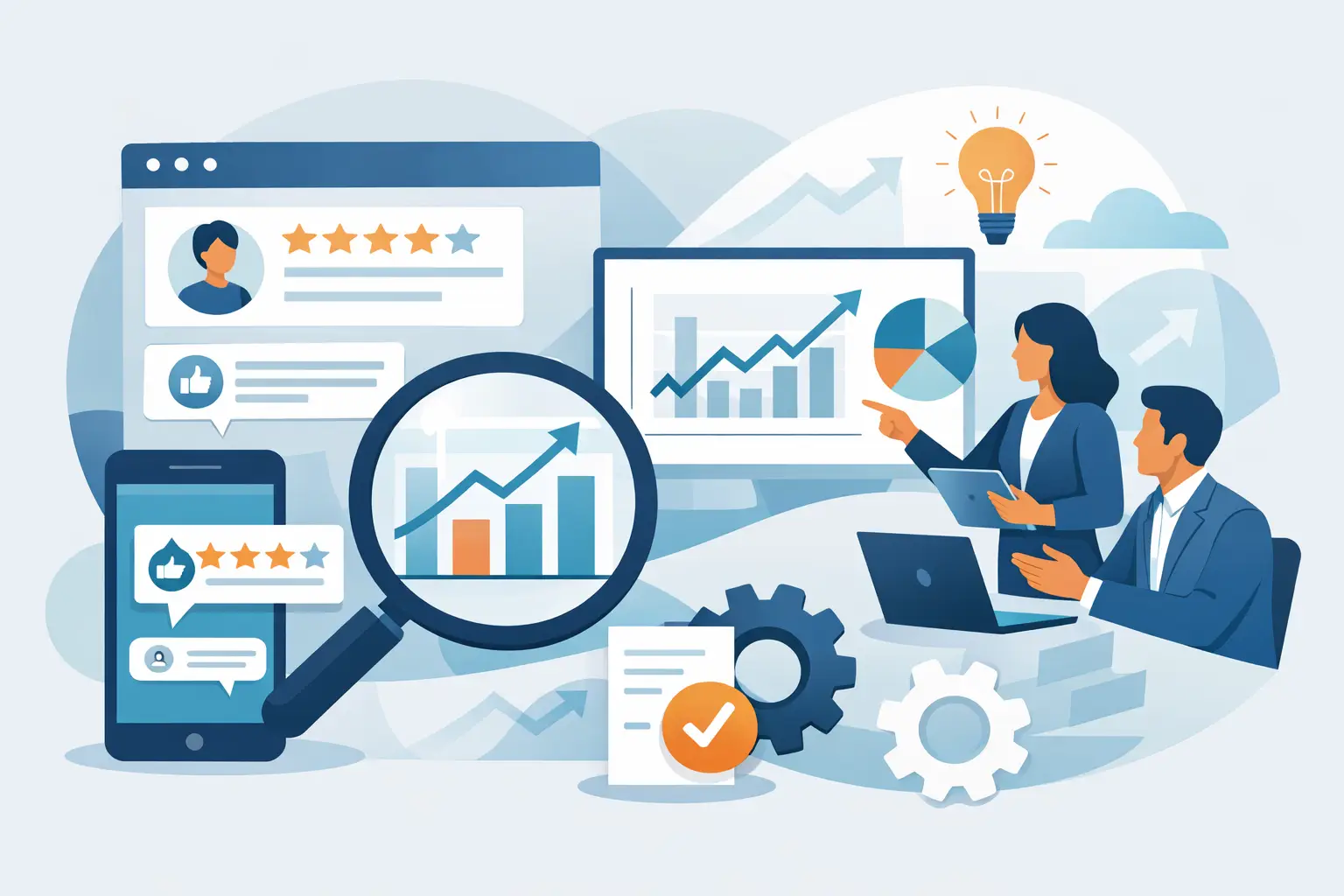
A one-star review that mentions waiting times, one four-star review that speaks well of the staff but criticises cleanliness, and several five-star reviews repeating “quick” are not just casual remarks. They are operational signals. When a company learns to read Here are some examples of operational insights derived from customer reviews: * **Identification of recurring product defects:** "Multiple customers are complaining about the same part of the product breaking after a short period. This suggests a manufacturing or design flaw that needs immediate attention." (Operational Insight: Product quality issue; Action: Investigate manufacturing/design, potentially recall or redesign.) * **Bottlenecks in the delivery process:** "A significant number of reviews mention long delays in receiving their orders, often citing 'out for delivery' for several days. This indicates a potential inefficiency or bottleneck in our logistics and delivery network." (Operational Insight: Delivery delays; Action: Analyse courier performance, route optimisation, warehouse processing times.) * **Inconsistency in customer service quality:** "While some customers praise our support staff's helpfulness, others describe unhelpful or rude interactions. This points to a need for more consistent customer service training and performance monitoring." (Operational Insight: Variable customer service; Action: Standardise training, implement quality checks, provide feedback to agents.) * **Issues with the online ordering experience:** "Several users report difficulty navigating the website or completing the checkout process, with comments about confusing buttons or slow loading times. This suggests flaws in our user interface (UI) or backend performance." (Operational Insight: Poor online experience; Action: Website usability testing, performance optimisation, UI/UX improvements.) * **Inventory management problems leading to stockouts:** "Customers frequently express disappointment about items being out of stock, even when their order was confirmed. This highlights potential issues with our inventory forecasting or real-time stock tracking." (Operational Insight: Stockouts; Action: Improve demand forecasting, implement better inventory management systems.) * **Problems with the returns process:** "A growing number of reviews describe the returns process as slow, complicated, or with unclear instructions. This is negatively impacting customer satisfaction and potentially increasing return handling costs." (Operational Insight: Inefficient returns; Action: Streamline returns procedure, improve communication, simplify policy.) * **Need for better product documentation or instructions:** "Customers often ask for clarification on how to use certain features or express confusion about the setup process, despite the provided manual. This indicates that our product documentation is not sufficiently clear or comprehensive." (Operational Insight: Inadequate documentation; Action: Revise manuals, create video tutorials, add FAQs.) * **Opportunities to improve packaging:** "Some reviews mention packages arriving damaged, or packaging that is difficult to open or creates excessive waste. This suggests our packaging methods need review for durability and customer convenience." (Operational Insight: Packaging issues; Action: Evaluate packaging materials, test shipping robustness, consider eco-friendly alternatives.), Stop managing your reputation blindly and start making decisions that have a real impact on service, sales, and local visibility.
For a local business or a chain with multiple locations, this change is key. Reviews are no longer just for replying politely or protecting the average score on Google. They are for identifying bottlenecks, comparing locations, correcting processes, and measuring whether an improvement is truly noticed in the customer experience. That's where operations and reputation intersect.
What are operational insights from reviews
An operational insight isn't an isolated comment. It's a repeated, useful, and actionable pattern that emerges from customer feedback and points to a problem or opportunity within the business. The difference is important. A customer saying their coffee was cold might be an isolated incident. Twenty customers in two weeks talking about cold drinks within a specific timeframe is already an operational insight.
The value lies in moving from manual reading to structured interpretation. It's not about reading more reviews, but about better understanding what they're saying collectively.. And, above all, what decision does that message demand.
In sectors such as catering, retail, automotive, Tourism or gyms, Reviews usually focus on information about times, customer service, cleanliness, stock levels, maintenance, service delivery, and consistency between shifts or branches. In other words, precisely the variables that most affect the day-to-day business.
Examples of operational insights from reviews, with real impact
Long waits during peak hours
If negative reviews frequently mention words like “queue”, “took”, “wait” or “slow”, there's a clear clue. There may be an issue with staff planning, checkout processes, or operational capacity at specific times.
The insight isn't just “customers complain about the wait.” The useful insight would be this: The Gran Vía branch is facing criticism for waiting times between 2:00 PM and 3:30 PM, particularly on weekdays.. This allows for action. You can reinforce shifts, simplify orders, review workflows, or compare with another location that handles the same period better.
There's an important nuance here. Sometimes the actual wait isn't excessive, but the perception is because there's a lack of communication. In that case, the solution isn't always to hire more staff. It can be about managing expectations in the dining room, at reception, or at the counter.
Good product, bad service
This is one of the most common patterns. Reviews that rate the main product or service highly, but penalise the human experience. In a restaurant, it appears as “the food was good, but the service was curt”. In a garage, as “the repair was fine, but they didn't explain anything to me”. In a gym, as “good facilities, but the reception staff were unfriendly”.
This highlights a customer service consistency issue. When the product holds up but the experience deteriorates, the reputational risk is high, because the final perception depends a lot on the treatment.
Operationally, this insight can be translated into training, review of onboarding protocols, improvement of sales scripts or analysis by employees and shifts. If this is also cross-referenced with the traceability of reviews by point of sale or team, the level of accuracy increases significantly.
3. Cleaning as a local conversion factor
Cleaning may seem basic. But in local reviews, it carries enormous weight because it affects immediate trust. In hotels, clinics, beauty salons, gyms and restaurants, a few negative mentions about bathrooms, tables, changing rooms or common areas can have more of an impact than you might think.
What is relevant here is not just the number of criticisms. It's the speed at which they are repeated and the type of area they target. If the mentions are concentrated on “dirty toilets” or “neglected changing rooms”, the problem is not general. It's about control at a specific point in the customer's journey.
This insight allows for assigning responsible parties, adjusting review frequencies, and checking if the change reduces negative mentions in the following weeks. The review thus becomes an external, useful and inexpensive operational indicator.
4. Out of stock or product unavailable
In retail and food, many reviews don't criticise the product itself, but rather the frustration of not finding it. Phrases like “they never have it”, “I came for this and it wasn't there”, or “they advertise one thing which then isn't available” show a gap between marketing, restocking, and customer expectation.
This affects the experience, but also the commercial performance. If a shop generates local traffic and loses conversions due to recurring stockouts, reviews are warning about it sooner than many internal reports.
The useful insight here would be to identify categories, locations, and days with the most mentions. Perhaps the problem isn't global. Perhaps it's just one shop, one product family, or poor campaign coordination that is the issue. Without semantic reading of reviews, that pattern takes much longer to emerge.
5. Differences between branches of the same brand
For chains and franchises, this is one of the most powerful uses. Two establishments with the same brand, offering, and system can have very different perceptions. One receives reviews for speed and friendliness. Another, for disorganisation and poor coordination. The average star rating might seem similar, but the operational details are not.
Reviews allow us to identify which branches are best delivering the brand proposition and which are causing friction. Not just to rectify. But also to replicate best practices. Benchmarking between locations It doesn't mean competing for the best grade out of context. It means understanding why a centre converts its experience into visible satisfaction better.
Sometimes the difference lies in the local leadership. Other times, it's about the volume of demand, the team's experience, or the type of clientele. That's why it's best to avoid jumping to conclusions. Reputational data needs operational context.
How to turn opinions into actionable decisions
The most common error is Reply to all reviews and stay there. That protects the image, yes. But it doesn't extract value. To work well with this type of information, you need a system.
The first step is Group mentions by topic. Wait, deal, cleanliness, price, stock, facilities, noise, parking or appointment management. Without that classification, everything remains impressions.
The second step is to prioritise by impact. Not all issues carry the same weight. Ten reviews criticising a minor detail aren't always more important than four that affect conversion or trust. Context is key.
Next, we need to segment. By location, by time of day, by period, by customer type or by service. That's where the useful patterns emerge. It's not enough to know there are complaints. You need to know where, when and about exactly which part of the operation.
Finally, the cycle must be closed. If a process is changed, it must be measured whether mentions decrease, sentiment improves, and ratings evolve. Without follow-up, there is no learning. Only reaction.
Which sectors benefit most from these insights
In restaurants, reviews often reveal timings, consistent quality, service, and cleanliness. For hotels, check-in, room condition, rest, and service are very important. In the automotive sector, transparency, deadlines, and workshop communication feature strongly. In retail, stock, service, and checkout speed are paramount. For gyms, maintenance, crowding, and reception experience are key.
Each sector has its own reputational indicators. The interesting thing is that reviews allow us to see them from the customer's perspective, not from the organisational chart. This reduces internal biases and speeds up the detection of real problems..
The role of automation in this analysis
When a business receives few reviews per month, manual reading can still be effective. However, in a company with multiple locations, high volume, or the need for quick responses, this method quickly breaks down. It's time-consuming, depends on specific individuals, and misses patterns.
Automation allows for a quick response, maintain brand consistency while extracting themes, sentiment, and evolution by location. That's the relevant leap. AI doesn't replace operational judgment. It accelerates it.
Platforms such as wiReply they are designed precisely for that: converting a constant stream of reviews into a useful layer of analysis for local marketing, operations, and customer experience. The advantage isn't just in saving time. It's in gaining control.
What you shouldn't do when interpreting reviews
There are three common mistakes. The first is making decisions based on a single extreme opinion. The second is only looking at the average score, which oversimplifies things. The third is conflating reputation with operational performance without separating variables.
It's also worth remembering that not all reviews represent the same thing. Some customers are more vocal than others. There are high-tension moments where opinions are expressed more. And there are sectors where a high volume of positive reviews doesn't come naturally unless customer acquisition is well managed. That's why the analysis needs to be continuous, not a one-off.
The best decisions don't come from reading a glowing review or a harsh critique. They come from identifying recurring patterns, relating them to the business context, and acting quickly. That's where reputation stops being an image KPI and becomes a management tool..
If reviews are already mentioning your timings, your attentiveness, your cleanliness or your consistency across locations, the question isn't whether you should respond to them. The real question is how much business you are leaving on the table by not turning them into a true operational source.