
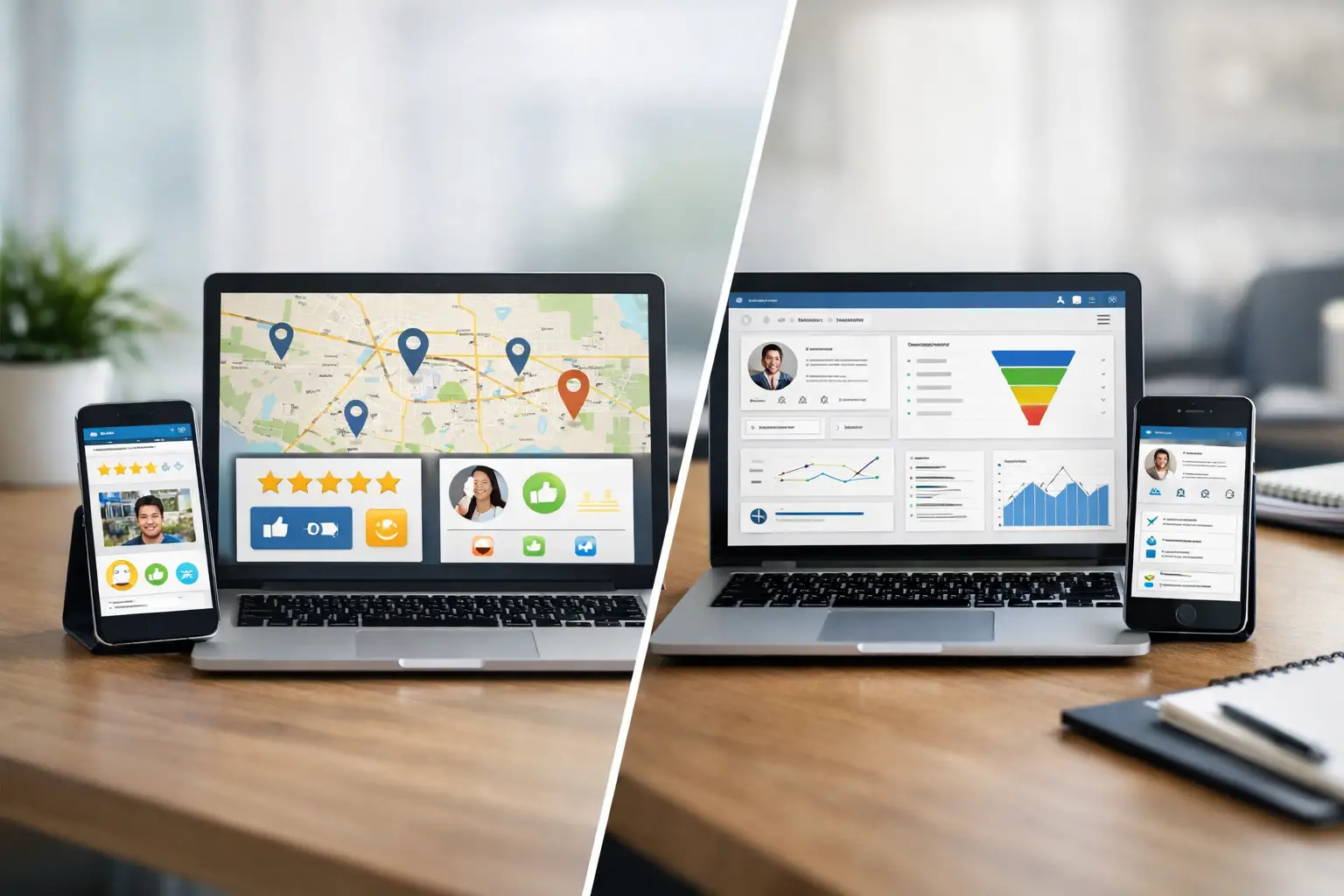
A one-star review on Google doesn't wait for the sales team to turn it into a lead. It affects the decision of someone looking for a restaurant, a workshop, or a gym nearby. Therefore, comparing local reputation software vs CRM isn't about choosing between two equivalent tools. Each solves a different part of the business.
A CRM organises business relationships. Local reputation software manages how each location is perceived on Google Maps and what the company can learn from that public conversation. When a chain conflates these two roles, they often end up with well-classified contacts and unanswered reviews, or isolated responses without data to correct operational failures.
The correct decision depends on your objective. If you need to track opportunities, quotes, renovations, and business activity, CRM is essential. If you need to protect local visibility, respond rapidly, increase reviews, and compare the performance of dozens of locations, you need a platform specialised in local reputation.
What a CRM does and what it doesn't solve
The CRM centralises customer and prospect data. It allows you to view the history of calls, emails, meetings, purchases, and pending tasks. It is a key component for businesses with long sales cycles, sales teams, or services that require individual follow-up.
For example, a dealership can record in its CRM that a person requested information about a vehicle, received an offer, and has a scheduled test drive. A hotel can use it to manage corporate contacts, groups, and repeat customers. The value lies in ordering business processes and reducing lost opportunities.
However, CRMs are not typically designed to manage the reputation of each Google Business Profile listing. They do not natively analyse whether customers mention waiting times, cleanliness, staff treatment, or stock issues in a review. Nor do they compare average ratings between establishments, identify recurring themes by city, or allow for controlling the tone of public responses at scale.
Some CRMs allow you to create fields or automations to record a rating. This can be useful, but it doesn't replace a reputational operation. Manually entering comments, copying links, or assigning responses to each manager creates friction. And friction arrives right where it hurts the most: in multi-site businesses with tens or hundreds of reviews every week.
What local reputation software offers
Local reputation software works on the channel that influences proximity acquisition: Google Maps and business listings. Its function is not to store contacts, but to manage the customer's public voice and convert it into concrete actions.
This starts with centralising reviews from all locations. The operations manager stops logging into each profile one by one. Marketing gets a global overview. Regional managers can review their establishments' performance without requesting screenshots or consolidating spreadsheets.
The response automation It changes the speed of reaction. A specialised platform can generate responses that are consistent with brand tone, differentiate between a compliment, criticism about service, or a serious incident, and set clear rules for cases requiring human review. It's not about responding for the sake of responding. It's about maintaining a presence, thanking for feedback, and demonstrating that the company is listening.
The Semantic analysis It adds a layer that a simple star rating doesn't offer. Two locations might average 4.3, but for completely different reasons. One might receive praise for its team and criticism for the wait. Another might excel in speed but accumulate comments about hygiene or product. The score shows the result. The language of the reviews explains the cause.
On a platform like wiReply, those comments can be transformed into operational data: most frequent themes, sentiment evolution, comparisons between locations, and alert detection. This way, reputation, marketing, and operations all work with the same customer signal.
Localised reputation software vs CRM, the operational difference
The main difference is in the unit of work. CRM revolves around a person or an opportunity. Local reputation software revolves around a location, its visibility, and the feedback it receives publicly.
In a CRM, the usual question is: where is this opportunity at? In a reputation tool, the question is: what is happening at this location, how is it affecting its rating, and what should we correct?
It also changes the pace. Business activity can evolve over weeks or months. A negative review demands attention much sooner, especially if it describes a recurring problem or if the volume of opinions is high. Speed does not eliminate the need for judgment, but it prevents a reasonable criticism from being left unanswered for days.
Lastly, change the metric. A CRM measures conversion, pipeline, closed sales, commercial activity or recurrence. Local reputation measures review volume, average rating, response time, sentiment, critical themes, performance by location and competitive evolution. They are complementary indicators, not interchangeable.
When a CRM might be sufficient
For a business with a single location, few reviews, and a complex business process, a CRM can cover part of the need. This is the case for a local B2B company, a clinic with private consultation-based acquisition, or an industrial supplier with little exposure to reviews.
It may also be sufficient when Google is not a relevant source of traffic, calls, or bookings. If clients arrive almost exclusively through commercial agreements, professional recommendations, or tenders, public reputation carries less weight in the purchase process.
Even so, it's worth not turning the CRM into a forced solution. If reviews increase or new branches open, the Manual tasks They multiply quickly. What seemed controllable in a single establishment becomes inconsistent in five.
When does a specialised platform become necessary
The need becomes clear when reviews directly influence visits, bookings, calls, or directions on Google Maps. Restaurants, hotels, gyms, workshops, shops, leisure centres, and franchises live this reality every day. Your customer isn't just comparing price or distance. They're comparing trust signals.
It's also a priority when there are multiple locations. Each site can have different equipment, schedules, standards, and problems. Without a centralised view, management detects valuation declines late and cannot distinguish between an isolated incident and a structural pattern.
The specialised platform gains even more value if the company wants to boost traceable review generation. NFC cards, access codes, or point-of-sale campaigns allow feedback to be requested at the right moment. If the result can also be attributed to a branch or employee, the company can replicate good practices without solely rewarding intuition.
It's not about soliciting reviews at any cost. The strategy must be simple for the customer, respectful and consistent. The aim is to better represent the real experience of each establishment. More authentic reviews give future customers more context and reduce the disproportionate impact of isolated incidents.
Integration is better than substitution
In most companies, the choice shouldn’t be CRM *or* local reputation. It should be CRM for the business relationship and reputation software for local presence and performance. Each system brings distinct data to a more complete customer strategy.
A CRM can record that a customer has purchased multiple times. The reputation platform can reveal that, in a specific area, buyers particularly value speed of delivery. Together, they help to understand both the individual relationship and the shared perception of hundreds of customers.
The key is to avoid duplication. There's no need to dump every review into the CRM or turn reputation software into a sales system. Define which team consults each piece of data, which alerts require intervention, and which indicators are reviewed by store, region, and chain.
How to choose without paying for features you won't use
Start with the operational problem, not a list of features. If the challenge is responding promptly, prioritise configurable automation and approval control. If the problem is that each branch works differently, look for centralisation, permissions, and comparisons. If management needs to know why a rating is falling, demand sentiment analysis and recurring themes, not just star charts.
Also review scalability. A solution suitable for three branches may be insufficient for thirty. It must allow the brand tone to be maintained, identify incidents by location, and reduce manual tasks as the network grows. Real efficiency appears when adding a new location does not require administrative work to be scaled up proportionally.
The CRM will continue to be the place for managing opportunities. Local reputation should have its own system, its own indicators, and clear responsibles. When every review receives attention and every pattern reaches the right team, Google stops being a passive showcase and becomes a constant source of improvement for each location.