
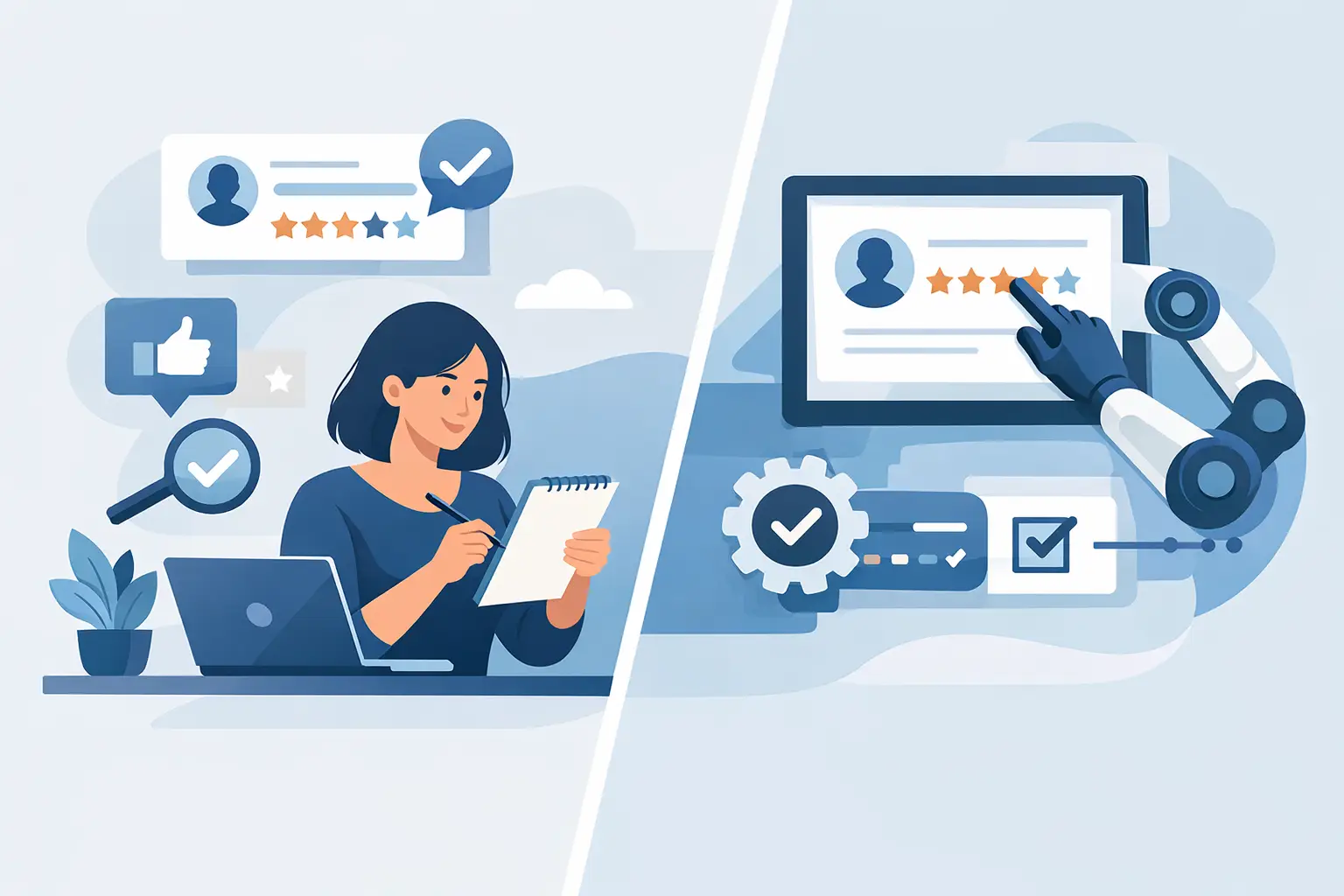
An unanswered review is not just a pending conversation. It's a public signal that affects trust, clicks, and visiting decisions. When a company starts to grow, the comparison between Manual reviews vs automated reviews it stops being an operational issue and becomes a business decision: How to respond faster, consistently, and without losing control.
For a local business receiving few reviews per month, responding manually might seem sufficient. For a chain, a franchise, or a business with multiple locations, this model soon breaks down. Bottlenecks appear, differences in tone between branches, late responses, and missed local visibility. This is where it pays to analyse the system critically, not intuitively.
Manual reviews vs automated reviews, the real difference
The difference isn't just in who writes the answer. It's in the ability to sustain an efficient reputational operation.
Manual management is based on a person reviewing each review, interpreting the context, and writing a response from scratch or using basic templates. It has a clear advantage: it allows for a high degree of human intervention in sensitive or complex cases. The problem is that it also depends on available time, team discipline, and each person maintaining the same standard.
Automated management works differently. It detects new reviews, applies rules, generates AI-powered responses, and maintains a brand-set tone. If implemented well, it doesn't eliminate human judgment. It redistributes it. Automate the repetitive and reserve manual attention for what truly needs review..
That's why the debate shouldn't be automation yes or no. The useful question is another: What part of the volume warrants human intervention and what part can be resolved with speed and consistency.
When manual response still makes sense
There are contexts where a manual approach works well. An independent restaurant with few weekly reviews, a boutique hotel offering highly personalised attention, or a business where the owner responds directly can benefit from that more direct contact.
It is also reasonable to maintain human intervention in reviews with sensitive claims, serious accusations, security incidents, or situations that require verifying internal data before responding. In these cases, haste can work against you.
But even here there is an important nuance. Manual doesn't always mean better. Many answers written in haste by overloaded teams end up being generic, late, or unhelpful. If the customer perceives an empty response, reputational value disappears, even if it was written by a person.
Where does automation win
Automation stands out when there's volume, multiple locations, or a need for centralised control. It's common in the restaurant, retail, gym, automotive, and tourism sectors, or in chains with a strong local presence. In these environments, responding to each query manually consumes hours that the team should be dedicating to operations, sales, or customer experience.
The main advantage here isn't just saving time. It's the systematic response capability. If all 4 and 5-star reviews receive a prompt, on-brand, and contextually relevant response, the company gains public consistency. If negative feedback is also detected and escalated according to severity, the risk is reduced.
Another key point is speed. Google values the activity on the tab, and users too. Responding quickly conveys genuine care. When a business takes days or weeks, the opportunity to influence customer perception has already passed.
The blind spot of the manual model: scale and variability
Many businesses believe they can still manage reviews internally until three clear signs appear. The first is the accumulated delay. The second, the lack of homogeneity between locations. The third, the impossibility of drawing useful conclusions from hundreds of comments.
That's the limit of manual work. It's not just time-consuming to respond. It's also time-consuming to detect patterns. If a complaint about waiting times, checkout service, or cleanliness is repeated at several points of sale, an individual response won't resolve the underlying issue. Aggregated analysis is needed.
That's why, when analysing the comparison of Manual reviews vs automated reviews, the criterion should not stop at the wording. It must include Scalability, traceability, and analytical capability.
What good automation truly brings
Automation isn't about dispensing impersonal answers. It's about defining a controlled system. One that allows for the configuration of tone, rules, exceptions, and review levels.
A mature solution can adapt its response based on its assessment, detect recurring themes, differentiate between a congratulatory message and an operational complaint, and even identify which centres are generating the most reputational incidents. This completely changes the use of reviews. They cease to be just a showcase and become Actionable data to improve local operations.
Furthermore, automation brings something that carries a lot of weight in multi-site businesses: Brand consistency. It doesn't matter if a customer gives their opinion in Madrid, Valencia or Seville. The company maintains the same standard of response, the same level of speed and the same public criteria.
The risk of automating badly
Not all automation adds value. If the system repeats identical phrases, doesn't understand context, or responds with an inappropriate tone in a serious incident, reputational damage can be greater than not responding at all.
Therefore, it is advisable to avoid two extremes. One is to respond to everything manually even though the volume no longer allows it. The other is to automate without supervision or configuration. Useful automation needs rules, tone training, and clear exceptions.
The best practice is usually a hybrid approach. Simple, recurring reviews are responded to automatically. More sensitive ones are escalated for human review. This protects quality without reverting to the initial bottleneck.
Which model is suitable according to the type of business
If you manage a single location with few reviews and a very personal offering, manual responses can still work, provided there is the discipline to reply quickly and well. If you manage multiple centres, high local traffic, or peaks in reviews during campaigns, you need another model.
In chains and franchises, the problem isn't just who is accountable. It is How to maintain control without stifling teams. There, automation allows for the centralisation of criteria and, at the same time, provides visibility to each location. It also makes it easier to compare performance between sites and detect which ones generate More reviews and see where more negative signs appear.
For sectors such as hospitality and gyms, where volume can be high and purchasing decisions are heavily reliant on Google Maps, this approach has a direct impact on reputation and conversion. In the automotive or retail industries, moreover, it helps to organise information and prevent missed customer service opportunities at key moments.
Manual or automated: measure this before deciding
Before choosing, it's worth looking at four variables: volume of reviews, average response time, number of locations, and internal capacity to maintain consistent quality. If the volume grows and the response time deteriorates, the manual model starts to cost more than it appears.
It also matters to measure the less visible part. Are patterns being detected per centre? Is there traceability of who generates new reviews? Can the customer's voice be linked to operational decisions? If the answer is no, reputation management is falling short.
At this point, platforms such as wiReply they fit particularly well because they don't just respond. They centralise, automate, read sentiment and convert reviews into actionable insights for decision-making.. That jump is what marks the difference between managing opinions and managing local performance.
The correct decision is not the most artisanal, it's the most sustainable.
Many teams still hold the idea that manual responses demonstrate more care. On a small scale, this might be true. On a large scale, it typically means delays, inequality between locations, and a lack of visibility. Quality doesn't depend on everything going through human hands, but on the system working.
The comparison between Manual reviews vs automated reviews There isn't a universal winner. It depends on volume, business model, and the level of control you need. But there's a difficult-to-ignore reality: when reviews influence traffic, bookings and sales, Reputational management cannot rely solely on the team's spare time..
If your local operation already demands speed, consistency, and intelligent feedback reading, automation is no longer a convenience. It becomes infrastructure. And when reputation is managed as infrastructure, the business responds better, learns faster, and grows with less friction.
The best decision is usually the one that allows you to answer today without losing control of tomorrow.