
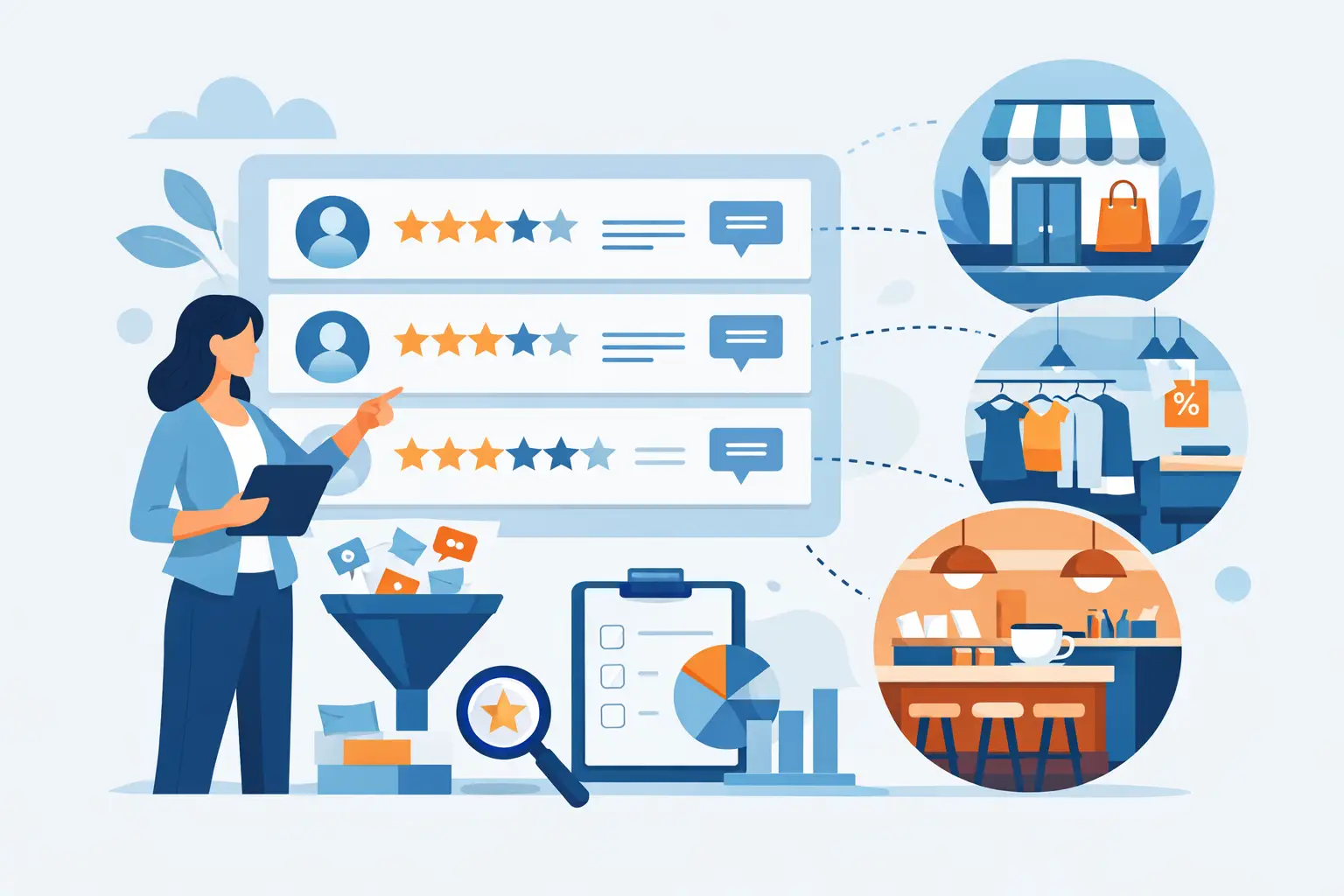
When a chain has 5, 20, or 200 locations, the problem isn't just getting more reviews. The real challenge is how to organise reviews by point of sale without losing context, without mixing incidents, and without turning local reputation into an operational chaos. If all reviews end up in the same inbox, responses are late, analysis is poor, and decisions are made blindly.
There's a difference between managing reviews and using them well. A location-based system allows you to see which outlet generates the most satisfaction, which has a recurring problem, and where it is best to act first.. For a multi-site business, this impacts Google Maps, conversion, and customer experience.
Why organising reviews by point of sale changes the outcome
A negative review for a city centre hotel doesn't carry the same weight as a negative review for an airport hotel. Nor does a drop in rating in a flagship store have the same effect as it would in a low-volume branch. Grouping all opinions as if they were equal distorts reality..
Organising reviews by point of sale allows for operational logic. Each location has its own volume, team, service level, critical time slot, and its own patterns. When this information is properly separated, what was previously hidden emerges: shifts with more incidents, employees who generate better ratings, locations that need support, and others that are already functioning as an internal benchmark.
It also improves speed. If each review is assigned to the correct establishment, the right person can respond sooner. And in local reputation, Speed matters as much as the content of the answer.
How to organise reviews by point of sale without complicating operations
The most common mistake is thinking that creating a spreadsheet and adding columns is enough. It works at first. Then it stops scaling. As soon as the volume increases, duplicates, inconsistent labels, and uncomparable data appear.
The most efficient way to organise this work is to build a simple, yet strict, structure. Each review must be linked, at a minimum, to its location, date, channel, rating, topic, and response status. If one of those fields is missing, the subsequent analysis loses value.
1. Assign each review to a real location, not a generic brand
It seems obvious, but many companies still review opinions by brand and not by establishment. This makes it impossible to know where the problem lies. The unit of analysis must be the point of sale. Not the brand. Not the region. Not the corporate account.
If a customer mentions waiting, treatment or cleanliness, that information has value because it occurred in a specific place. Local traceability turns an opinion into actionable data.
2. Define a short and useful taxonomy
There's no need to tag everything. You need to tag what helps with decision-making. Categories should be used to detect operational patterns, not to fill nice dashboards. In catering, it might make sense to separate service, food, waiting times, and cleanliness. In automotive, commercial attention, delivery, workshop, and after-sales. In retail, stock, checkout, customer service, and returns.
If the classification is too broad, no one uses it well. If it's too limited, it doesn't provide reading material. The key is to create a few categories that are very clear and consistent across all locations..
3. Separate response, analysis, and escalation
Responding to a review isn't analysing it. And analysing it isn't escalating an incident. If it all happens within the same workflow, the team ends up mixing tasks and losing focus.
The most practical approach is for each opinion to have three independent states: response published, insight detected, and internal action open or closed. This avoids a common problem: believing a review is already managed just because someone replied on Google.
4. Compare local places with context, not just with stars.
A point of sale with 4.4 out of 1,200 reviews may be performing better than another with 4.8 out of 40. It is also possible for a venue to improve its rating, but worsen in key areas such as waiting times or customer service at peak demand. Look only at the average stars leads to poor decisions.
Useful comparison combines volume, evolution, sentiment, recurring themes, and response speed. That's where a specialised platform pulls ahead of manual management.
What sort of data should you look at in each outlet?
Not all businesses need the same level of depth, but there is a common core that is worth reviewing. The average mark is just the beginning. What really helps to manage better is understanding why it goes up or down, which topics appear more frequently, and what differences exist between similar locations.
An operations director usually needs a comparative overview between locations. A marketing manager needs a view of local reputation and positioning. A shop or restaurant manager needs specific incidents and immediate areas for improvement. Therefore, the organisation of reviews must serve several profiles simultaneously.
The most useful indicators usually include the evolution of valuations over a period, the volume of new reviews, the response rate and time, the most frequently repeated positive and negative themes, and the sentiment associated with each point of sale. When these data are read by establishment, decision-making is accelerated.
The role of automation in location management
From a certain volume onwards, manually ordering reviews ceases to be efficient. Not due to a lack of criteria, but a lack of time. If a chain receives tens or hundreds of opinions a week, it needs to automate classification, initial responses, and pattern detection.
There's an important nuance here. Automating doesn't mean responding the same way in all locations. It means creating rules to maintain speed, consistency, and control, without losing local context. Useful automation respects point-of-sale identity and brand policy at the same time..
a platform like wiReply allows you to centralise reviews from Google Business Profile, assign them to the correct department, automate responses with a configurable tone, and extract semantic reading to detect recurring issues. This reduces manual workload and, above all, transforms reputation into a source of operational data.
How to avoid common mistakes when organising reviews by point of sale
The first mistake is centralising too much. When everything depends on a corporate team, the response gains control, but loses agility and detail. The second is decentralising without method. Then each branch responds in its own way, without common criteria and without a global vision.
The balance is usually found in a hybrid model. The central entity defines rules, tone, categories, and alerts. The local entity provides context, monitoring, and operational capability. That model maintains brand consistency without sacrificing local speed..
Another common failure is not connecting reviews with operations. If a point of sale receives recurring feedback about queues, timings, or staff treatment, that information should not remain with marketing. It needs to reach operations, training, or store management. If that step isn't taken, the opinions just become noise.
It is also advisable to avoid unfair comparisons between different locations. You cannot measure a shop with high tourist traffic the same way as a neighbourhood establishment, nor a weekend restaurant the same as an office one. Compare, yes, but with equivalent segments.
Practical Application in Supply Chains and Local Businesses
In the hospitality industry, organising reviews by point of sale quickly highlights which establishment has a service time issue and which is creating a better dining room experience. In retail, it helps differentiate whether criticism comes from stock, service, or the checkout process. In automotive, it clearly separates sales, workshop, and delivery. In gyms, it reveals whether the problem lies with cleanliness, classes, customer service, or peak operating hours.
The pattern is repeated across all sectors with a physical presence. When the review is linked to the exact place where the experience occurred, it becomes useful for improving the actual business.. And this has a direct effect on reputation, visits, and local conversion.
Furthermore, sorting reviews well makes it easier to identify which sales points are generating more new opinions and why. Sometimes the difference isn't in the quality of the service, but in the execution in the dining room or at the till: who asks for the review, at what moment and with what support. There, tools such as Personalised NFC cards they add traceability and allow us to measure which employee or location is driving better uptake.
Organise well to grow better
Knowing how to organise reviews by point of sale is not an administrative task. It is a performance decision. When each opinion is well classified, compared and connected with the correct location, the company gains visibility, speed and judgment to act.
Reviews are no longer just social proof. They are a layer of operational intelligence that shows what's happening at each location, what's working, and what needs correcting before it impacts local rankings or revenue. If you manage multiple locations, sorting reviews by point of sale isn't optional. It's the most direct way to turn reputation into a competitive advantage..
Start with a simple structure, keep the classification consistent, and demand useful reading, not just reporting. When that happens, each review stops being an isolated opinion and becomes a clear signal to grow with more control.