
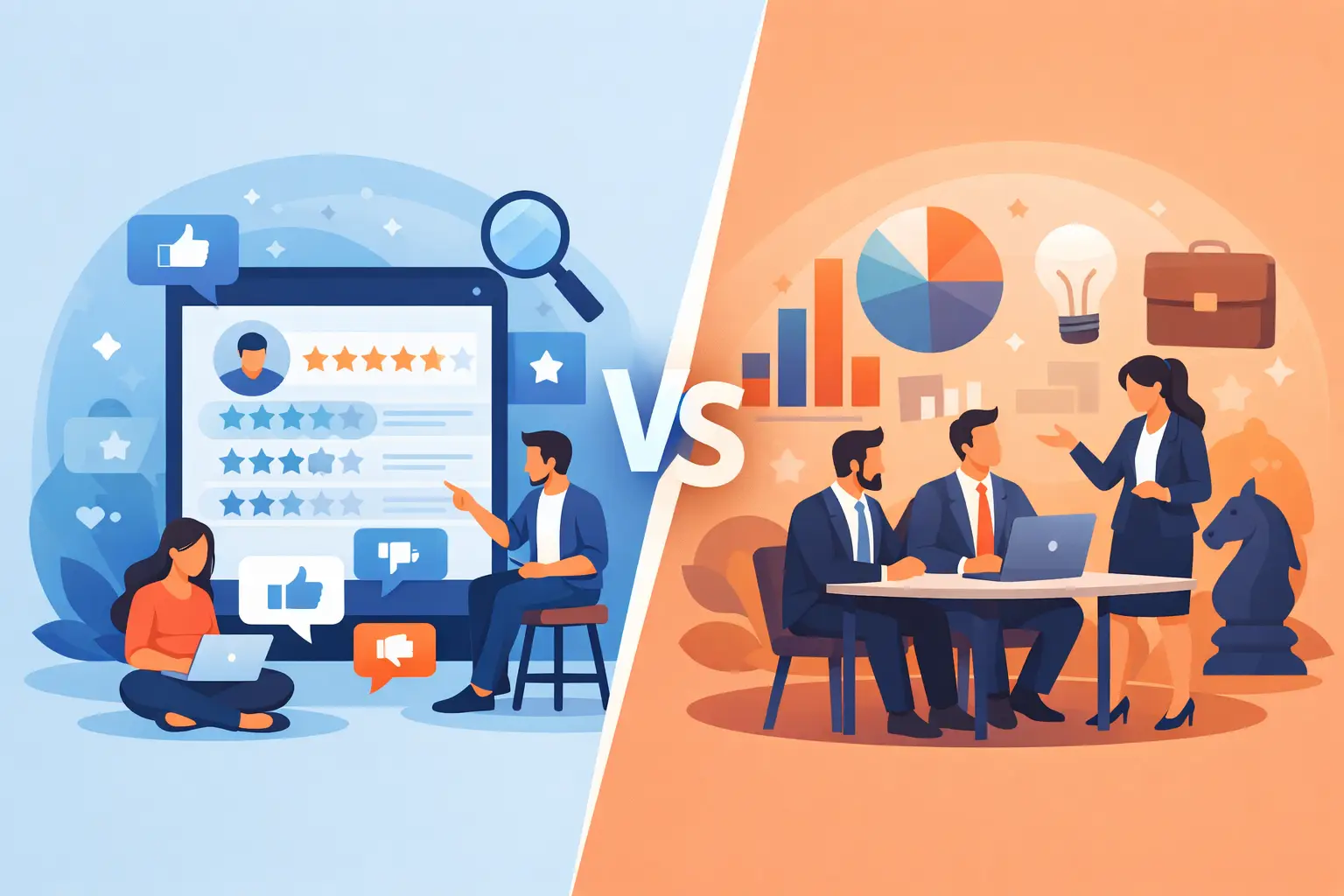
If you manage one or more locations, the decision between a review platform and an agency isn't aesthetic, it's operational. It's apparent in response times, brand consistency, scalability, and, most importantly, in how much business you are able to protect and generate from it. Google Maps. When reviews affect visits, bookings and conversions, choosing badly is expensive.
The real comparison isn't about “service” versus “technology”. It's about control versus dependency, speed versus friction, and useful data versus late reports. For a small local business, an agency can cover a specific need. For a chain, a franchise or a business with a high volume of reviews, the criteria change quickly.
Review platform vs agency, the fundamental difference
An agency usually works on a campaign, hourly, or closed-reach basis. It defines a strategy, executes tasks, and reports results. It can provide expertise, creativity, and support, especially if the reputation problem is part of a broader marketing challenge.
A review platform works differently. It centralises daily operations, automates responses, structures workflows, detects patterns, and allows for real-time action. It doesn't replace strategy when needed, but it does eliminate a large part of the most time-consuming and least value-adding manual work.
The key difference lies in the model. The agency operates *for* you. The platform makes your operation work better. If your primary challenge is responding faster, maintaining brand tone, scaling across locations, and turning feedback into decisions, the platform is usually a better fit.
When an agency makes sense
There are scenarios where an agency remains a good option. For example, when a brand needs to redefine its positioning, manage a complex reputational crisis, or coordinate communications, content, and paid media actions alongside reviews.
It can also make sense for businesses with very low volume, a single location and no need for continuous analysis. If you receive few opinions per month and are only looking for external support to keep the channel clear, an agency can solve the problem with a simple model.
Now, that approach has clear limits. Each new location adds coordination. Each change in tone requires validation. Each peak in reviews strains timelines. And each insight depends on someone reading it, interpreting it, and turning it into action.
When a platform wins by speed and scale
In multi-site businesses, operations are paramount. It's not enough to respond; you must respond well, quickly, and consistently across all points of sale. A platform offers an advantage here that's hard to match with manual work.
Automation allows stable response times to be maintained, even when volumes increase. Centralised management prevents each branch from improvising. And configuration by rules, locations or review typologies reduces errors and speeds up execution.
Furthermore, a well-designed platform doesn't just publish answers. It turns each opinion into a signal. Which local establishment accumulates the most mentions of queues? Which shop receives better ratings for service? Which employee generates the most reviews? Which negative pattern is repeated in a specific area? This analytical layer changes the utility of reputation: it ceases to be just image and becomes a source of operational improvement.
Visible cost and hidden cost
When comparing a review platform versus an agency, the monthly fee doesn't tell the whole story. You need to look at the total cost of operation.
With an agency, you pay for external talent and dedication. This can be cost-effective if you need specialised judgement on an occasional basis. However, when the task is repetitive and constant, the model becomes more expensive. Every review, every adjustment, every new location, and every exception adds time and cost.
With a platform, a large part of the savings appears in avoided internal hours. Less burden for marketing. Less dependence on operations. Fewer manual reviews. Fewer delays. If it also incorporates artificial intelligence to respond with configurable tone and approval rules, performance improves without losing control.
The important nuance is this: not all platforms generate the same return. If they just add reviews onto a pretty dashboard, the impact is limited. The real value appears when they automate responses, help to generate new reviews, and offer actionable analytics by location, team, or category.
Brand control and consistency
An agency can maintain a good level of editorial quality, but it doesn't always have the speed or context of each point of sale. This translates into correct answers, although sometimes generic or disconnected from daily operations.
A platform allows you to set tone, criteria, and workflows. You can define dynamic templates, adapt messages by location, escalate only sensitive cases, and maintain a consistent voice without sacrificing personalisation. For franchises and chains, this isn't a detail. It's a necessity.
Consistency also matters in internal compliance. When several people respond from different centres, the risk of irregular messages grows. Centralising and automating reduces this variability and protects the brand.
Generating reviews, not just managing them
Here, many agencies fall short. They usually focus on responding, moderating, or reporting. But reputational growth also depends on consistently increasing the volume of quality reviews.
A platform can integrate point-of-sale data capture mechanisms, automated campaigns, or systems traceable by employee and location. This allows you to know not only how many reviews are received, but also where they are being generated from and which teams are driving the best results.
For sectors such as restaurants, hotels, automotive, or gyms, this difference is direct. More recent and well-managed reviews reinforce local visibility, credibility, and conversion rates. It's not enough to just put out fires. You need to build volume and frequency.
Actionable data versus retrospective reporting
An agency typically delivers reports. A platform delivers continuous visibility. That difference changes the type of decisions you can make.
If today you detect that a location is accumulating negative comments about cleanliness or waiting times, you can correct it tomorrow. If the data reaches the end of the month in a presentation, you have already lost reviews, customers and local positioning.
semantic reading and the sentiment analysis they allow you to go beyond the average score. You can understand why reputation rises or falls, in which segments, in which locations, and for what reasons. For customer experience and operations teams, this turns customer voice into a lever for concrete improvement.
So, review platform versus agency, which to choose
It depends on your structure, your volume and the type of problem you want to solve. If you need external strategy, creative support or reputational management within a broader marketing service, an agency can add value. If your challenge is operational, recurring and distributed across multiple locations, a platform is usually the more efficient option.
There's also a middle ground. Some brands keep an agency for specific projects and support the day-to-day on a platform. It's a reasonable combination when strategy and execution are well separated.
The useful question isn't which option “is better” in the abstract. It's which one gives you more control, more speed, and more capacity to grow without multiplying manual workload. For a company with local ambition and multiple locations, the answer usually leans towards specialised technology.
What should a local business demand before deciding
Before signing with an agency or hiring a tool, it's worth reviewing five points: real-time response time, scalability by location, customisation quality, insight generation, and impact traceability.
If you can't measure which location is improving, which pattern is repeating, or which action is increasing reviews, you're managing reputation with little visibility. And if you rely on manual processes to respond to every opinion, you're limiting your growth with a task that can already be automated with control.
This is why, when a chain or local business with volume compares options, the focus should shift from “who will do it for me” to “which system allows me to operate better.” This is where solutions like wiReply fit in clearly: they automate responses, centralise management, and turn reviews into decisions that improve local performance.
Reputation is no longer managed like a shop window. It's managed like an operational layer. And the sooner you treat it as such, the sooner you'll start to notice the effect where it matters most: in visibility, in experience, and on the bottom line.