
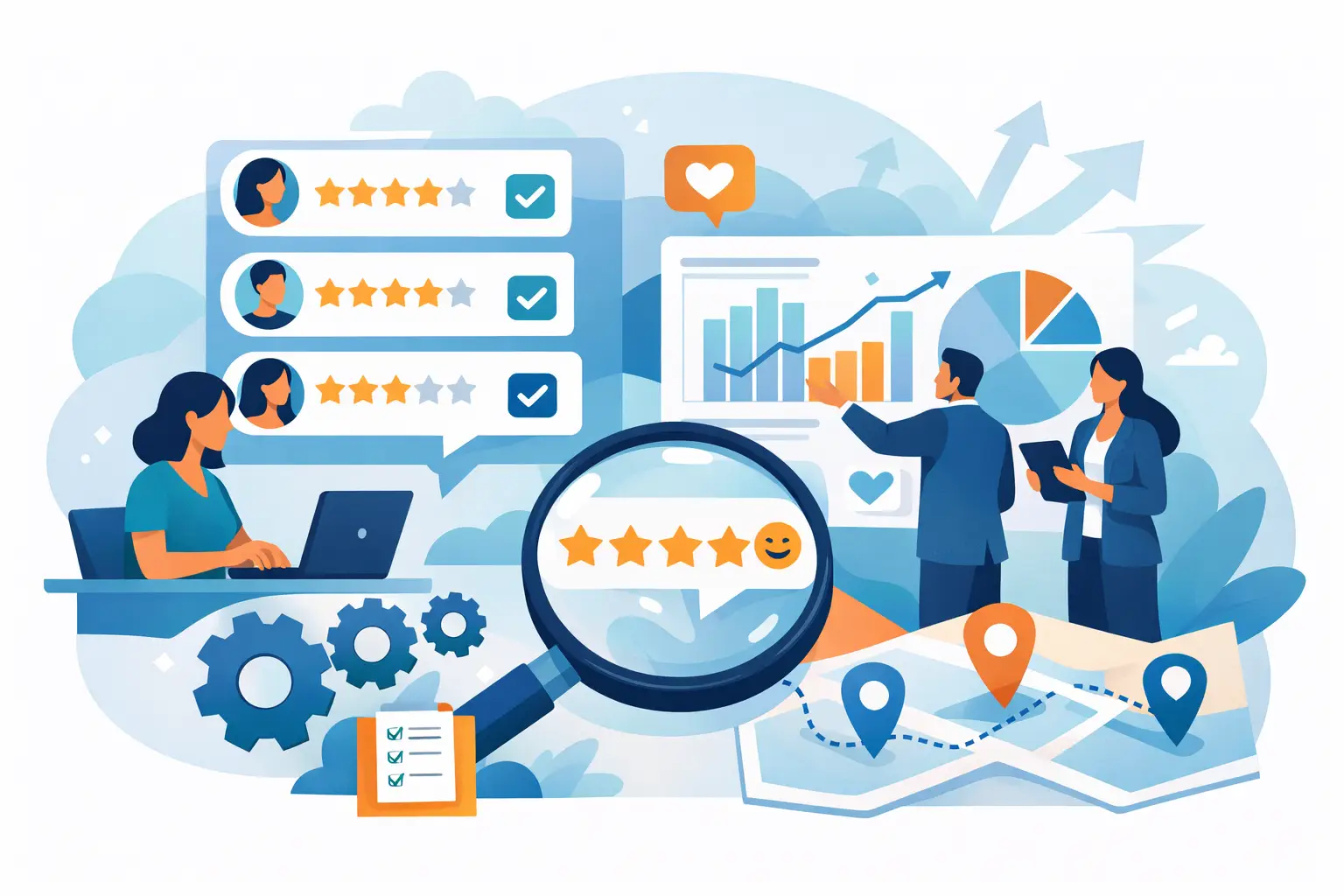
A bad review doesn't always reflect on reputation. Sometimes it speaks of poorly covered shifts, out-of-control waiting times, or a recurring issue at the till, in the kitchen or at reception. That's the difference between responding to opinions and understanding them. How to use reviews for operations. When read as operational data, they cease to be noise and become a direct source of improvement.
For a local business or a chain, this change has a real impact. Reviews are no longer just for protecting brand image. They are used to detect failures by time slot, compare locations, measure consistency, and prioritise actions with criteria. And the more locations are managed, the more necessary it is to move from manual responses to structured analysis.
Using reviews for operations means leveraging customer feedback to improve how a business functions. This can involve: * **Identifying pain points:** Reviews can highlight areas where customers are experiencing difficulties or dissatisfaction, such as slow service, poor product quality, or confusing processes. * **Improving products and services:** Feedback can provide valuable insights into what customers like and dislike about existing offerings, guiding product development and service enhancements. * **Optimising customer service:** Reviews often comment on the quality of customer support, giving businesses information on areas that need staff training or process adjustments. * **Enhancing user experience (UX):** For digital products or services, reviews can point out usability issues or areas where the user journey can be made smoother. * **Streamlining processes:** By understanding how customers interact with a business, reviews can help identify inefficiencies in internal workflows and suggest improvements. * **Making strategic decisions:** Aggregated review data can provide trends and patterns that inform broader business strategies, such as market position, pricing, or expansion. * **Gauging staff performance:** Customer comments on staff interactions can offer feedback on performance, helping with team management and training. In essence, it's about using the voice of the customer as a data source to make informed decisions and drive continuous improvement across all aspects of the business's operations.
Using reviews in operations is about turning scattered feedback into concrete decisions. It’s not just about looking at the average score, but identifying which processes are affecting the customer experience and how often.
If several locations mention long waits, there's probably not a marketing problem. There's a capacity, planning, or execution problem. If a hotel receives criticism about check-in on certain days, the operations team already has a signal. If a gym accumulates comments about cleanliness at the end of the afternoon, the issue isn't reputational, it's operational.
The review is the customer's voice in business language. When properly interpreted, it helps answer questions affecting performance: what is failing, where it is failing, when it occurs, how often it repeats, and which location needs attention first.
How to use reviews for operations without wasting time
The biggest mistake is to treat every review as an isolated case. That consumes time and doesn't scale. What works is to create a simple system: capture, classification, analysis, and action.
First, all reviews need to be centralised by location. Without this foundation, comparing results between points of sale is slow and unreliable. After that, it's advisable to tag the comments by operational themes. The most common ones are usually customer service, waiting times, cleanliness, stock, product quality, payment issues, or appointment management.
Here, automation makes the difference. When a platform detects semantic patterns And sentiment, the team stops reading one by one to start working with trends. This reduces manual work and speeds up decisions. Moreover, it allows us to separate the urgent from the structural. A specific complaint needs a response. A repeated pattern needs intervention.
Not all businesses should analyse the same variables. In the restaurant sector, service, product temperature and speed carry a lot of weight. In the automotive industry, delivery, clarity of budget and after-sales service are important. In retail, stock, queues and in-store attention tend to appear. The correct approach always depends on the operational model.
From opinion to operational impact
The useful leap is not in answering better, but in translating the review into a probable cause. If a customer writes that “no one was attending”, perhaps the problem is a lack of staff, poor task allocation, or poorly managed traffic peaks. If they say “the experience was chaotic”, it's worth going down another level and reviewing timings, handoffs, or training.
That's why reviews should be read in context. A single negative opinion doesn't always justify a change. But ten similar mentions in two weeks do. Recurrence is the signal that converts perception into operational data.
This point is key for operations and franchise teams. It is not enough to know that a location has a worse rating. It is necessary to understand which variable is driving that fall and whether the problem is local, regional, or a general process. This difference avoids reactive decisions and improves resource allocation.
Which metrics are worth looking at
The average score matters, but it falls short. To use reviews with operational impact, it's advisable to observe the evolution by topic, the frequency of incidents, the sentiment by category, and the response speed. It's also useful to measure which locations generate more new reviews and if there is a relationship between volume, satisfaction, and commercial performance.
Another particularly useful metric is the dispersion between locations. If a chain has a correct average but with strong differences between locations, there is a consistency problem. And consistency, in multi-site businesses, is an operational rather than reputational issue.
It is also advisable to cross-reference reviews with internal variables. For example, occupancy, shifts, campaigns, holidays, or staff rotation. It will not always be possible to do this with the same level of detail, but even a basic review allows for the detection of very valuable correlations. Reviews gain power when they are connected to the actual operation..
What changes when you automate analysis
Reading one hundred reviews a month is feasible. Reading thousands in dozens of locations is not. At that point, automation stops being a convenience and becomes an operational necessity.
Automation doesn't mean losing judgment, it means gaining speed, order, and traceability. A well-configured system can categorise comments, detect recurring themes, alert to spikes in negativity, and compare locations in real-time. Furthermore, it allows for maintaining brand-consistent responses without burdening the team with repetitive tasks.
For a chain, this resolves a common problem: each outlet responds as best it can, with different criteria and no shared learning. With centralised management, the team gains control. They can see what's happening overall and what's occurring at a specific point of sale.
Tools like wiReply fit in precisely there, because they don't just limit themselves to responding to reviews. Convert comments into actionable operational signals, allow you to compare locations, sentiment analysis and scale management without multiplying manual hours. That's the real change: moving from fire-fighting to data-driven management.
Common mistakes when using reviews for operations
One of the most common pitfalls is acting solely on negative reviews. Positive ones also contain useful information. If a venue consistently receives mentions for speed or good service, that selling point is demonstrating good practice that can be replicated.
Another error is not segmenting by location. In multi-site businesses, mixing everything into a single reading hides concrete problems. The global average may appear healthy while one location loses reputation and local traffic due to a very localised incident.
Even those who respond quickly but don't close the internal loop fail. If a review always mentions the same flaw and no one corrects the process, the public response becomes mere window dressing. Customers notice this, and Google also reflects this trend over time.
Lastly, many businesses collect few reviews and then try to draw overly broad conclusions. Volume matters. If there isn't an active strategy to generate reviews from the point of sale, the analysis will be limited. This is why increasing review capture is also an operational decision, not just a marketing one.
Clear use cases by sector
In restaurants, reviews help detect whether the problem lies in the kitchen, service, or delivery. In hotels, they allow you to read about issues with cleaning, check-in, breakfast, or maintenance. In retail, they show stock failures, queues, or attention by store. In the automotive sector, they reveal incidents in delivery times, technical explanations, or commercial follow-up. In gyms, they usually highlight cleaning, room saturation, or staff interaction.
The logic is the same across all sectors: Listen to patterns, prioritise by impact and act by local. What changes is the type of signal that carries the most weight in the experience.
How to implement a useful system in a few weeks
You don't need a long project to get off to a good start. The first step is to define what operational themes will be monitored. Then, centralise all reviews and set up a reading structure by location, by period and by category. From there, it is advisable to set up alerts for recurring issues and a weekly review routine between operations, marketing and area management.
When this routine works, reviews stop being stuck with customer service and become part of the business's dashboard. That integration is what generates real impact. Less intuition. More evidence. Less late reaction. More ability to correct before the problem affects sales, bookings, or traffic on Google Maps.
Not all decisions will come from a review, of course. There are contexts, biases and isolated cases. But when the volume is sufficient and the analysis is consistent, the signal is very valuable. Reviews don't replace operations. They make them more visible..
Whoever understands this stops seeing Google as a shop window and starts using it as a source of operational intelligence. That's where reviews stop being just about reputation and start driving business.