
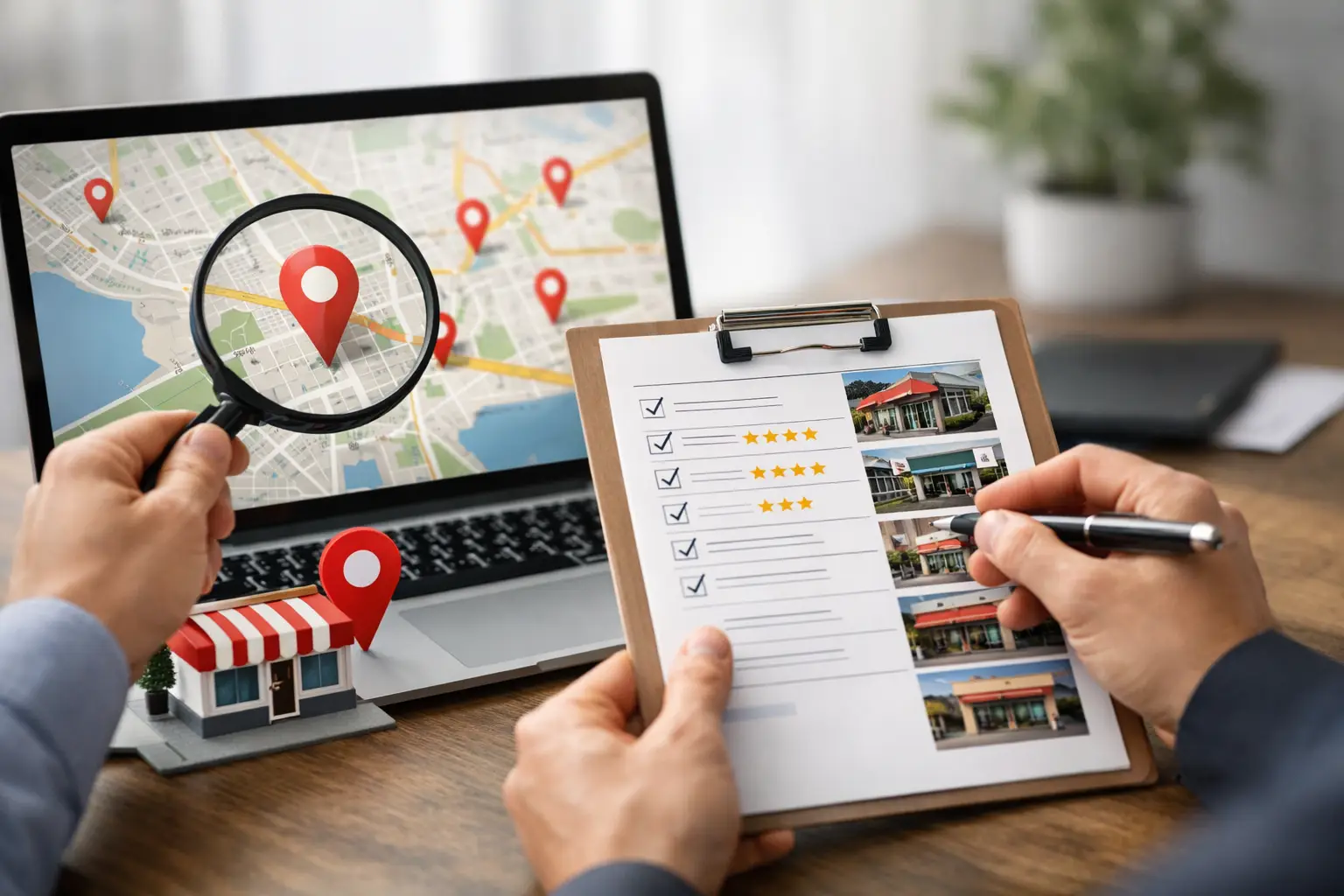
A local listing audit isn't about checking if the Google schedule is correct and moving on to the next location. It's an operational review of everything that influences the visibility, trust, and conversion of each location on Google Maps. For a restaurant, clinic, garage, or retail chain, an outdated listing can result in missed calls, no-shows, and customers ending up choosing a competitor.
The problem is multiplied when there are multiple sites. Incorrect data on one record may be an isolated incident, but the same error repeated across 30 locations reveals a lack of control. An audit allows for the detection of these patterns, prioritisation of corrections, and the transformation of local presence into a measurable system.
A local listings audit analyses the accuracy, completeness, and consistency of your business information across various online directories and platforms. This includes details such as your business name, address, phone number, website, opening hours, and services offered.
The Google Business Profile listing is one of the main points of contact between a physical business and a person with purchase intent. Before booking a table, asking for directions, or visiting a shop, the customer sees basic information, photographs, ratings, and responses to reviews. It all happens in a matter of seconds.
Therefore, an effective review must go beyond visible information. It is necessary to check the consistency of the data, the activity of the listing, the quality of the reputation, and how each location competes within its area of influence.
Essential data and brand consistency
Trading name, main category, secondary categories, address, telephone, website, opening hours and attributes must reflect the reality of each point of sale. It seems basic, but errors are frequent: special opening hours not updated, telephone numbers that divert to a central with no follow-up, generic categories or duplicate addresses.
It is also important to review consistency between locations. A franchise should not describe its services differently in each city unless there is an operational reason. Maintaining a common structure facilitates management and reinforces brand recognition, without erasing the local particularities that help each listing to be relevant.
Visual content and conversion capability
Photos are not a decorative element. They influence the decision to visit, book, or call. An audit checks if the images represent the current premises, showcase relevant products or services, and convey a recognisable experience. Old, dark, or repeated photographs reduce confidence, especially in sectors such as hospitality, tourism, gyms, and automotive.
The review should also cover the posts, products, services and FAQs available on the listing. Not all features carry the same weight for every business. A hotel needs to provide detailed information about its facilities and services. A garage should provide categories, a telephone number and opening hours. A shop may need to highlight promotions, products and accessibility.
Reviews, response and sentiment
The average rating matters, but it does not explain everything. A listing with a high rating and old reviews may be less persuasive than one with a steady stream of recent reviews. The audit should measure the frequency of new reviews, response times, the coverage of responses, and the distribution of positive, neutral and negative ratings.
The next step is to analyse recurring themes in the comments. If customers mention waiting times, stock shortages, cleanliness, staff behaviour or booking issues, this information should not be confined to the reputation department. It must be passed on to the operations team. Reviews are a direct source of information about the actual experience at each venue.
How to do a useful local listings audit
The value of an audit depends on its ability to turn findings into action. A lengthy report containing dozens of observations is of no use if the team does not know what to address first, who is responsible and how progress will be measured.
The first step is to build an inventory of locations and check which listings are claimed, which have the correct access, and if there are any duplicates. For multi-location businesses, this phase avoids one of the most costly errors: working on unverified listings while another listing with incorrect information continues to appear in the results.
Afterwards, each location needs to be evaluated using common criteria. The comparison should include data quality, categories, visual content, review volume and rating, response speed, sentiment themes, and recent evolution. A common framework allows us to see which venues are below standard and which can serve as internal benchmarks.
The third step is to compare yourself with actual local competitors. It is not enough to look at national chains in the same category. The relevant competitor is the business that appears alongside the listing when someone searches for a service in that area. Analysing its reputation, activity and content helps you understand what level of presence that market demands.
Finally, you need to set priorities. Correcting an incorrect opening time or an incorrectly entered address usually has an immediate impact. Improving your photos can boost conversion rates. Responding quickly to negative reviews helps maintain trust. Designing a campaign to generate more reviews takes more time, but can have a lasting effect on visibility and social proof.
Errors that hamper local performance
One of the most common mistakes is treating all branches as if they were the same. Head office can set standards, but each branch has its own reputation, team and level of competition. A branch that receives a lot of criticism about waiting times needs a different operational response to one that receives constant praise for its service but does not have enough reviews.
Another mistake is to reply manually and without a consistent approach. Speed is essential, but a generic response to all comments can sound automated and may not resolve the issue. Automation works when it is configured with rules, a brand tone and the ability to tailor the message to the context of each comment.
It is also common to measure only the average rating. A score of 4.5 can hide a recent drop, a concentration of negative reviews at one location, or a recurring issue that has not yet affected the average. The trend and content of the comments give a more useful reading than a single number.
Finally, many companies ask for unverifiable reviews. If NFC cards, QR codes or materials are handed out at the point of sale, it is useful to know which employee, campaign or location has generated each new review. Without such tracking, it is difficult to identify best practices and replicate them.
From auditing to continuous monitoring
An initial audit brings order to the situation, but it is no substitute for ongoing monitoring. Opening hours change, staff rotate, customers post new reviews and competitors adjust their online presence. Local management needs alerts, people in charge and a Consolidated view to take action before a problem leads to a loss of demand.
In a chain of outlets, the dashboard must allow locations to be compared without losing any detail. Management and operations need an overview: the volume of reviews, changes in ratings, response rates and key issues. The manager of each outlet needs to know what is happening on their listing, what issues they need to resolve and how they are progressing against their target.
wiReply allows you to centralise these operations, automate responses with a customisable tone, and analyse the sentiment of reviews by location. The value lies not only in saving time, but also in quickly identifying where there is an opportunity to improve your reputation and turning that insight into a concrete decision.
What results can each sector expect?
In the restaurant sector, audits often identify issues relating to opening hours, bookings, customer service and waiting times. In the hotel and tourism sector, reviews frequently highlight issues relating to cleanliness, reception, breakfast or value for money. In the automotive sector, trust, the clarity of the quote and post-service follow-up are key factors.
Retail and food businesses need to monitor stock, service, queues, and store conditions. Gyms must attend to cleanliness, maintenance, capacity, and commercial support. The pattern changes, but the logic is the same: each comment can confirm a strength or signal a friction that affects visits and local conversion.
The best audit doesn’t end with a list of errors. It ends when every branch knows what it needs to rectify this week, which metric it needs to improve this month, and which practice is worth replicating across the entire network. That’s when the local profile ceases to be a static snapshot and starts to generate measurable business.