
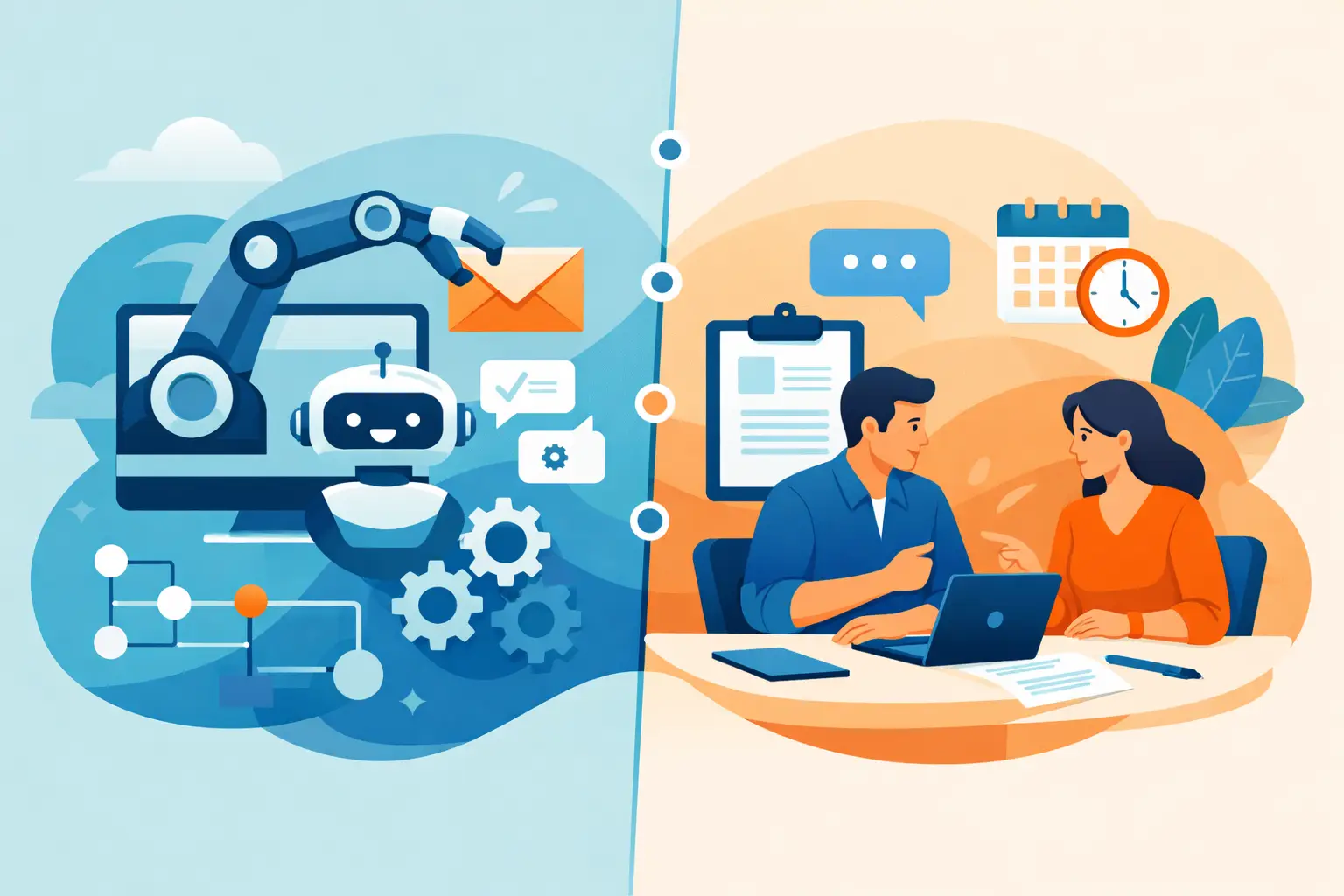
If you manage Google reviews for one or more locations, it's not a theoretical question. Automatic reply or manual management It affects team time, brand consistency, and the speed at which your business protects its local reputation. It also affects something more serious: how many conversion opportunities you miss by responding late, poorly or not at all.
Many businesses still treat reviews as a secondary task. The problem arises when the volume grows, several people start responding, each location uses a different tone, and no one knows which comments are being repeated or what is being said about the operation. That's where the decision stops being a preference and becomes a performance issue.
Automatic response or manual management, the real difference
Manual management offers something valuable: case-by-case control. A manager can read the context, detect nuances, and respond sensitively when there are delicate incidents. For businesses with few reviews per month, a single location, and a team very focused on the customer, this can work well.
But manual management has a clear operational cost. Consuming time, it depends on specific people and scales poorly. When a chain receives tens or hundreds of reviews per week, quality begins to fall. Generic responses are repeated, some opinions are left unaddressed, and the criteria change depending on who responds. This damages brand perception and complicates oversight.
A properly configured automated response system solves precisely that bottleneck. It allows you to respond quickly, maintain a consistent tone and handle the day-to-day workload without overburdening the team. The key lies in the phrase “properly configured”. Automation does not mean responding like a robot or leaving your reputation to chance. It means Set rules, tone, filters, and levels of intervention so that automation does the repetitive work and the team only steps in where it adds real value.
When manual management still makes sense
Not everything should be automated. That's the part that is sometimes omitted. If your business receives few reviews, if you work on a very premium offering, or if the opinions often include complex incidents that require context, manual management may still be valid. It is also useful in the initial phases, when you are still defining the tone and response criteria.
Even so, even in those cases, it's worth asking a simple question: is the team responding on time and consistently? If the answer is no, manual management is no longer an advantage. It's a hindrance.
In sectors such as hospitality, gyms, Automotive In retail, the volume and repetition of patterns are too high to rely solely on artisanal processes. Most positive reviews praise the same things. Many criticisms highlight recurring incidents. Continuing to answer one by one without technological support does not add quality in itself.. In many cases, it only adds delay.
Where does the autoresponder earn
Automation delivers immediate value on four fronts: speed, coverage, consistency, and data interpretation. Responding quickly conveys attentiveness. Responding to all reviews avoids silences that harm business perception. Maintaining a uniform tone protects the brand. And classifying what customers say turns reputation into useful information for operations, marketing, and customer experience.
This is especially relevant in multi-site companies. If each location responds in its own way, it's impossible to compare reputational performance between sales points. Nor can you detect if the same complaint is recurring in an area, during a specific time slot, or with a particular type of service. The automated response not only saves time, it also organises the system..
When artificial intelligence is also incorporated, the leap is greater. It's no longer just about publishing a pre-defined phrase. It's about adapting the response to the sentiment, the type of comment, the rating, and the business context. This reduces the robotic tone and improves relevance without requiring manual input in each case.
The risk isn't in automating, it's in automating badly.
There's a common objection: “If I automate, I'll sound impersonal.” It's a legitimate concern, but it usually points to the wrong problem. The risk isn't automation. The risk is using poor automation, without oversight, without rules, and without brand or location-specific personalisation.
A basic system that responds the same way to everything can indeed lead to rejection. A well-designed system, however, will not. In fact, in many businesses, automation improves quality compared to the current reality, where manual responses are late, inconsistent, or directly copy and paste the same text.
The solution isn't to choose between machine or person as if they were mutually exclusive options. It's about designing a mixed operating model. Automate the recurring, scale the sensitive and measure everything. This approach protects efficiency without losing judgment.
How to decide between automatic response or manual management
The correct decision depends less on philosophy and more on three variables: volume, risk, and structure.
If you receive few reviews, have a single location, and can respond within the timeframe with a trained individual, manual management might suffice. If you operate multiple branches, require brand consistency, and the volume already necessitates sharing the task among different teams, automation is no longer optional.
The level of risk also matters. There are comments that must go for human review: serious accusations, legal disputes, health incidents, situations of discrimination or cases of high public sensitivity. These types of reviews should not be resolved with a closed automatic response. However, they represent a small portion of the total for most businesses.
The third variable is structure. If marketing, operations, and customer service work separately, manual management usually generates more noise. No one sees the big picture. No one detects patterns. No one knows if the reputation is improving or worsening by location, by manager, or by campaign. Automate with centralised analytics convert the reviews into a decision-making source, not just in a response task.

What works best in local businesses and chains
In practice, the most efficient model is neither the manual 100% nor the automatic 100%. It is a hybrid system. Positive and neutral reviews, which follow predictable patterns, can be responded to automatically with a configurable tone and brand control. Negative or ambiguous reviews can be placed in a review queue. And all reviews must be categorised to identify trends.
This point is key for sectors with high local traffic. A restaurant doesn't just need to reply “thank you”. It needs to know if several customers mention slowness on the terrace, if a hotel accumulates complaints about cleanliness at a specific branch, or if a dealership stands out for its commercial dealings in a particular province. Serves, but doesn't teach, without semantic and comparative analysis between locations..
That's why the most useful platforms don't stop at text automation. They add benchmarking, sentiment analysis, centralised control and traceability in acquiring new reviews. That's where a solution like wiReply fits particularly well for chains and businesses with multiple locations: it not only reduces operational load but also turns reputation into a measurable lever for local positioning and service improvement.
What questions should you ask yourself before choosing
Before proceeding with a manual model out of habit or activating automatic responses without consideration, it's advisable to review some basic data. How long does your team take to respond? What percentage of reviews are left unanswered? Do all locations maintain the same tone? Can you detect recurring themes without reading them one by one? Do you know which employees or points of sale are generating the most new reviews?
If you don't have those answers, the problem isn't just time. It's visibility. And without visibility, reputation is managed blind.
It's also worth looking at the full cost. Manual management may seem cheap until you add up hours, supervision, errors, lack of consistency, and missed opportunities. Automation may seem like a bigger shift at first, but it often generates a quick return when volume grows or when reputation directly influences local visits, bookings, and sales.
The correct decision is not the most humane, it is the most useful
Certain businesses still advocate for manual responses as if they are, by definition, more personal. This is not always true. A helpful, quick, and consistent response usually offers more to the customer than a well-intentioned but late reply. And an operation that learns from its reviews improves more than one that simply addresses them.
The best strategy isn't about picking a side. It's about to reserve human time for what truly needs judgement and let automation absorb repetitive work with control, precision, and scale. That's where reputation stops being a burden and starts to work as a growth asset.
If your reviews already influence the map, purchasing decisions, and the perception of each establishment, you don't need to respond anymore. You need to respond better, with a system that can keep pace with your business.