
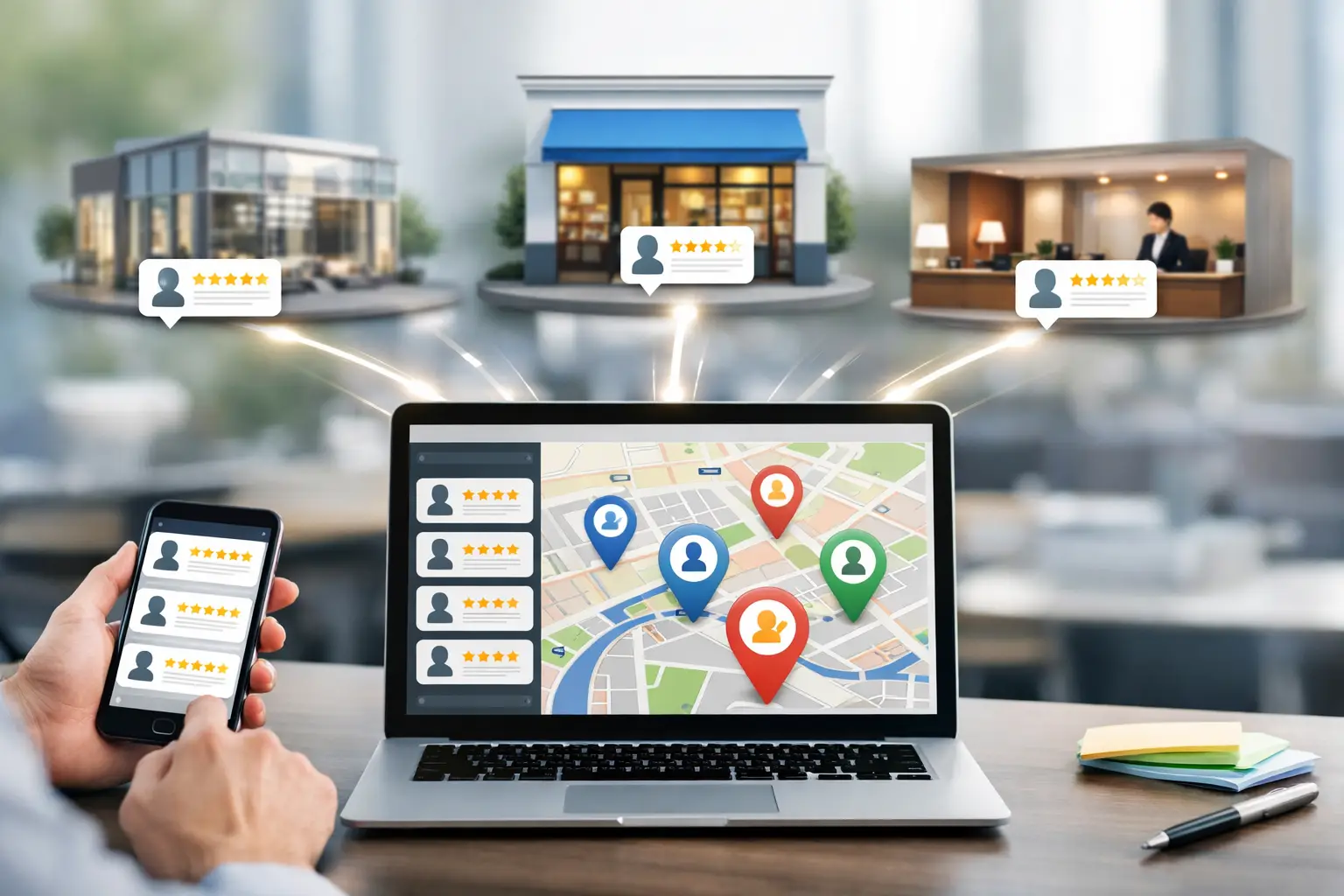
When a chain manages 5, 20 or 200 locations, responding to reviews stops being a simple task. Centralise Google reviews for multiple locations allows you to maintain control, speed up responses, and understand what is happening at each establishment.
The objective is not just to gather feedback into a common inbox. It is about creating a system that allows for work with shared criteria, comparable data, and a global view of the entire network.
Most multi-site businesses start the same way. Each location responds as best it can, with different timings, different styles, and sometimes, not responding at all. The result is quickly noticeable: inconsistent experiences, low traceability, managers without a global vision, and missed opportunities to improve local SEO, reputation, and in-store conversion.
Centralisation does not mean removing autonomy from each site. It means organising work, standardising what adds value, and identifying exceptions before they escalate. In businesses where a review can affect bookings, visits, or calls, that difference becomes a direct impact on revenue.
Centralising Google reviews across multiple locations implies that you will have a single system or platform to manage, monitor, and analyse all reviews submitted for each of your branches or offices. This allows for a unified overview of customer feedback, making it easier to identify trends, respond to comments, and implement improvements consistently across all your sites. It also enables a more cohesive management of your online reputation.
For centralise Google reviews multiple locations, the company needs to bring together all the listings, reviews and responses into a single environment. It seems basic, but many companies still operate with scattered access, local managers without a common process, and hand-written reports.
That model can cope with a few branches. Beyond a certain volume, it breaks. The central team wastes time chasing information, area managers can't compare performance between locations, and the brand loses control of something that customers see every day on Google Maps.
A well-thought-out centralisation resolves four fronts at once. Firstly, it reduces manual workload. Secondly, it speeds up response times. Thirdly, it maintains brand consistency. Fourthly, it turns each comment into a source of operational information.
Not all companies require the same level of control. A franchise might need centrally approved templates with local execution. A hotel chain may require automated responses for certain scenarios and human review for sensitive incidents. A restaurant group, on the other hand, typically prioritises speed and comparison between branches. It depends on volume, sector, and reputational risk.
Why centralising Google reviews across multiple locations improves reputation
Responding to reviews isn’t just a customer service task. It’s a local performance lever. Each listing vies for visibility, trust, and clicks. When a business responds consistently, quickly, and in alignment with its brand, it improves user perception and reinforces its profile activity.
The main benefit of centralise Google reviews multiple locations is to be able to compare the performance of the entire network without losing the detail of each location.
But the most profitable effect is usually within the business. By centralising, you start to see patterns. Which branches concentrate complaints about waiting times. Which stores stand out for staff treatment. Which manager generates more positive reviews. Which locations respond late or never respond. Without that comparative layer, each branch seems like an isolated case. With it, concrete decisions emerge.
This changes the conversation in marketing, operations, and customer experience. We're no longer talking about isolated opinions. We're talking about recurring issues, training opportunities, service deviations, and reputational performance by point of sale.
The most common mistakes when managing reviews in a multi-site company
Without a tool ready for centralise Google reviews multiple locations, processes end up depending on personal access, spreadsheets and manual reviews.
The first mistake is decentralising without rules. Giving access to each local branch may seem practical, but without clear guidelines, it ends up generating irregular responses, long silences, and messages that don't align with the brand.
The second is to centralise only the reading, not the action. There are companies that receive all reviews in a dashboard, but still respond manually, on a local-by-local basis, without automation or workflows. This reduces some of the chaos, but doesn't scale.
The third is to measure volume, not quality. Having many reviews helps, but it's not enough. If you don't analyse sentiment, recurring themes or evolution by branch, you're only looking at the surface.
The fourth point is to treat all opinions equally. A five-star review without text does not require the same treatment as a detailed critique on hygiene, timings or service. Prioritising well saves time and protects your reputation.
How to centralise Google reviews across multiple locations without losing agility
The starting point is to unify management onto a single platform. Everything must enter the same system: new reviews, response status, alerts, performance by location, and historical metrics. If part of the process remains on spreadsheets, internal emails, or personal access, you will continue working blind.
Afterwards, it is necessary to define a clear operational logic. What kind of reviews are respond automatically. Which ones require review. What tone does the brand use. Who are the responsible parties involved per location, per region or from headquarters. Without that framework, technology accelerates, but also multiplies errors.
Automation facilitates centralise Google reviews multiple locations without increasing the team's workload as the number of locations grows. Automation makes sense when applied judiciously. For positive and repetitive feedback, it allows for quick responses and maintaining an active presence without dedicating team hours. For sensitive comments, it's useful for classifying, escalating, and suggesting a coherent response for human review. The key is not to automate everything. It's about automating the repeatable and reserving time for what truly requires context.
Artificial intelligence adds real value here when it stops being a gimmick and starts solving a specific task. It can adapt the tone of the response, interpret intent, detect reputational risk, and group common themes among hundreds of comments. This allows for rapid operation without sacrificing control.
Which data is best to view on a central dashboard
A useful dashboard isn't limited to just showing stars and a review count. A good dashboard for centralise Google reviews multiple locations It should show both the overall performance and the individual results of each establishment. It should display response times, response rates per site, average rating trends, recurring themes, feeling, a comparison between local and incidence signals. It is also advisable to identify which actions generate new opinions and from which point of sale or employee.
When that information is ordered, reviews stop being just visible reputation and become a source of operational intelligence. That's where a specialised platform makes a difference.
What each team gains when management is centralised
Marketing gains consistency and a clear vision of local impact. It can detect which locations need reputational reinforcement and which are best capitalising on their Google presence.
Operations gains visibility on repeated failures. If multiple locations receive criticism for the same reason, it's no longer a perception. It's a documented pattern.
Customer experience teams gain responsiveness. They can prioritise real issues, respond faster, and escalate sensitive cases without relying on internal message chains.
Management gains control. You can compare performance between sites, set objectives, and measure whether the reputation strategy is improving traffic, trust, and execution.
Where to centralise Google reviews across multiple locations to generate more impact.
In food service, speed matters. A negative comment about service or timings can affect the decision of the next customer the very same day. Responding quickly and detecting repetitions prevents wear and tear.
In hotels and tourism, the volume of reviews and the variety of case studies make manual management without a central system unfeasible. Furthermore, the nuances of the comment matter much more than the simple score.
In retail, comparison between stores is especially valuable. It allows for the swift identification and correction of differences in customer experience.
In the automotive, gym, and franchise sectors, the challenge is often maintaining a common brand voice without losing local appeal. A centralised operation with configurable automation works particularly well here.
If, furthermore, the business wants to increase the number of reviews, it is advisable to connect centralised management with actions of Point of sale capture. It's not enough to respond better. We also need to generate more volume of verifiable opinion at each location to strengthen positioning and trust.
wiReply fits precisely at that point: it centralises review management, automates responses with configurable AI, and converts Google feedback into actionable data by location, team, or chain.
What you should demand from a solution to avoid being left halfway
The first thing is real visibility by location and at chain level. The second is flexible automation, not generic, uncontrolled responses. The third is analytics that go beyond the average star rating. The fourth is the ability to scale without adding manual workload.
It is also worth reviewing permissions, traceability and benchmarking between locations. If you cannot know who responded, how each record is evolving or which branch is below standard, centralisation will be partial.
And there's a practical issue that many companies overlook: implementation. If activating the system requires weeks of manual work or constant technical dependency, internal adoption plummets. The best solution is one that sets up quickly, gives control from day one, and allows for growth without operational friction.
Centralising reviews across multiple locations isn't about having everything on one screen. It's about responding faster, deciding better, and protecting local performance with less effort. When every review stops being noise and becomes signal, reputation starts working for the business.
Ultimately, centralise Google reviews multiple locations allows responding sooner, detecting common issues, and turning reviews into actionable decisions.