
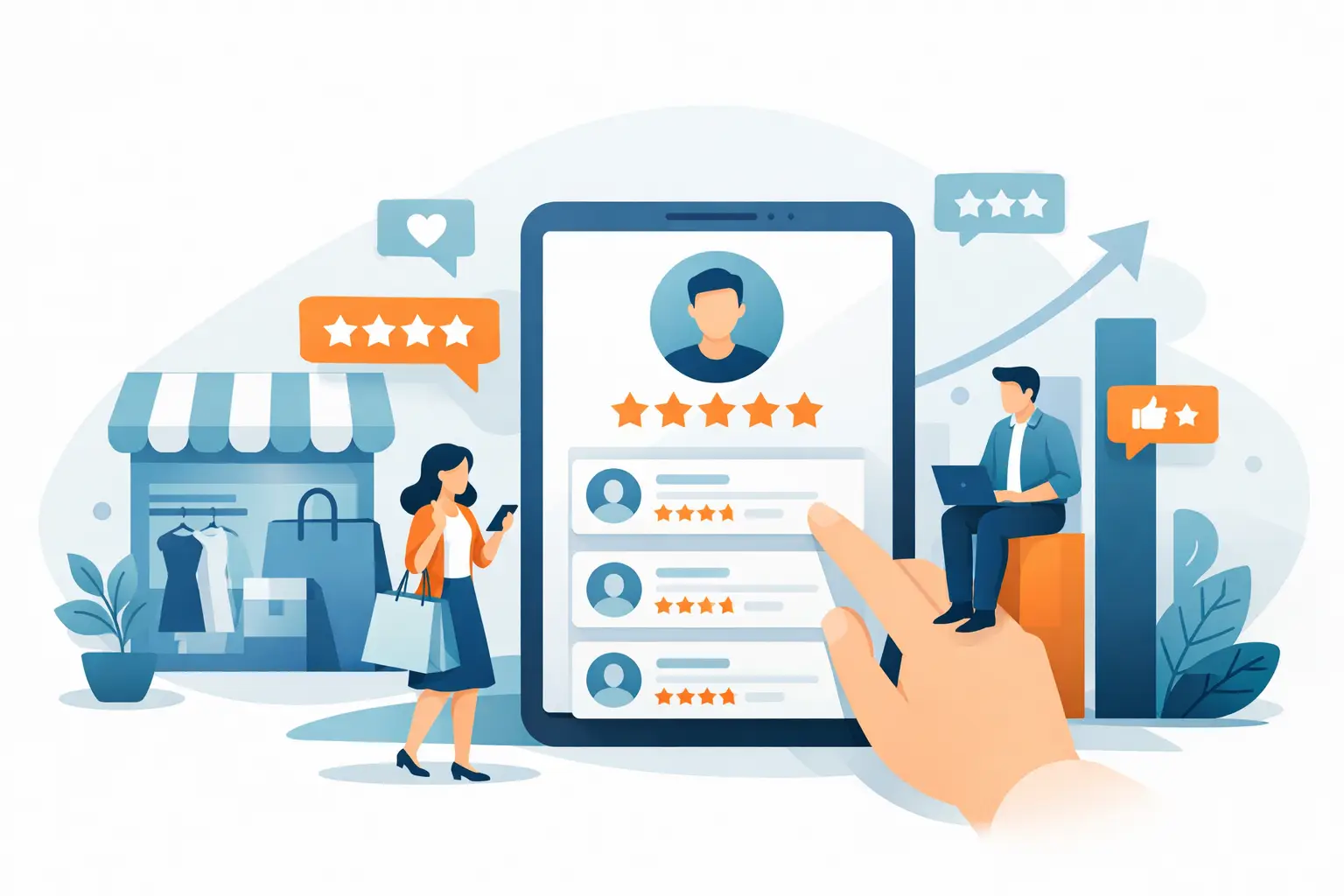
A regional manager summed it up for us in one sentence that any chain with local traffic understands instantly: they had satisfied customers every day, but very few reviews ended up on Google. That's the starting point for this real case of increased reviews In retail. There wasn't a major service issue. There was an execution issue. They solicited feedback irregularly, relied on the willingness of the in-store team, and couldn't measure which store, shift, or employee generated the most impact.
What's relevant isn't just that the volume went up. What's relevant is how slipped in, without adding operational friction and without turning the request for reviews into another task for already overloaded teams. That's where many strategies fail. They design campaigns that are correct in theory, but impossible to sustain at the point of sale.
The starting point, good sales and little social proof
The business was a specialist retail chain with several locations. Good customer flow. Stable average transaction value. Acceptable Google rating, but with an uneven distribution between sites. Some shops accumulated reviews at a steady pace, while others barely progressed. This generated two problems.
The first was commercial. Fewer reviews imply less local credibility. In searches with high intent, the comparison isn't just made by distance or price. It's made by volume, average rating, and freshness of reviews.
The second was operational. There was no reliable way of knowing if the problem lay at the point of requesting the review, in the customer experience, or in the team's discipline. Without traceability, everything becomes intuition.
What was holding back the increase in reviews
When the actual in-store process was analysed, three very common brakes appeared. None were technological in themselves, but all had a direct impact on results.
The first was reliance on the human factor. Staff would ask for reviews when they remembered, when they had time, or when the customer seemed particularly satisfied. That misses out on a great many valid opportunities.
The second was the channel. In some shops, generic signs were used or it was mentioned verbally, “If you can, leave us a review.” The intention was good, but the next step wasn't sorted. If the customer has to look for the listing, postpone the action or remember the exact name of the business, the conversion drops..
The third point was the lack of follow-up. No one could answer basic questions with data: which shops generate the most reviews per 100 tickets, which employees generate more engagement, or which hours and times of service produce the best ratings.
Real case of increased reviews, what was changed
The solution wasn't asking for the same thing more often. It was about redesigning the process so it would work in real shop conditions. Fast. Measurable. Scalable.
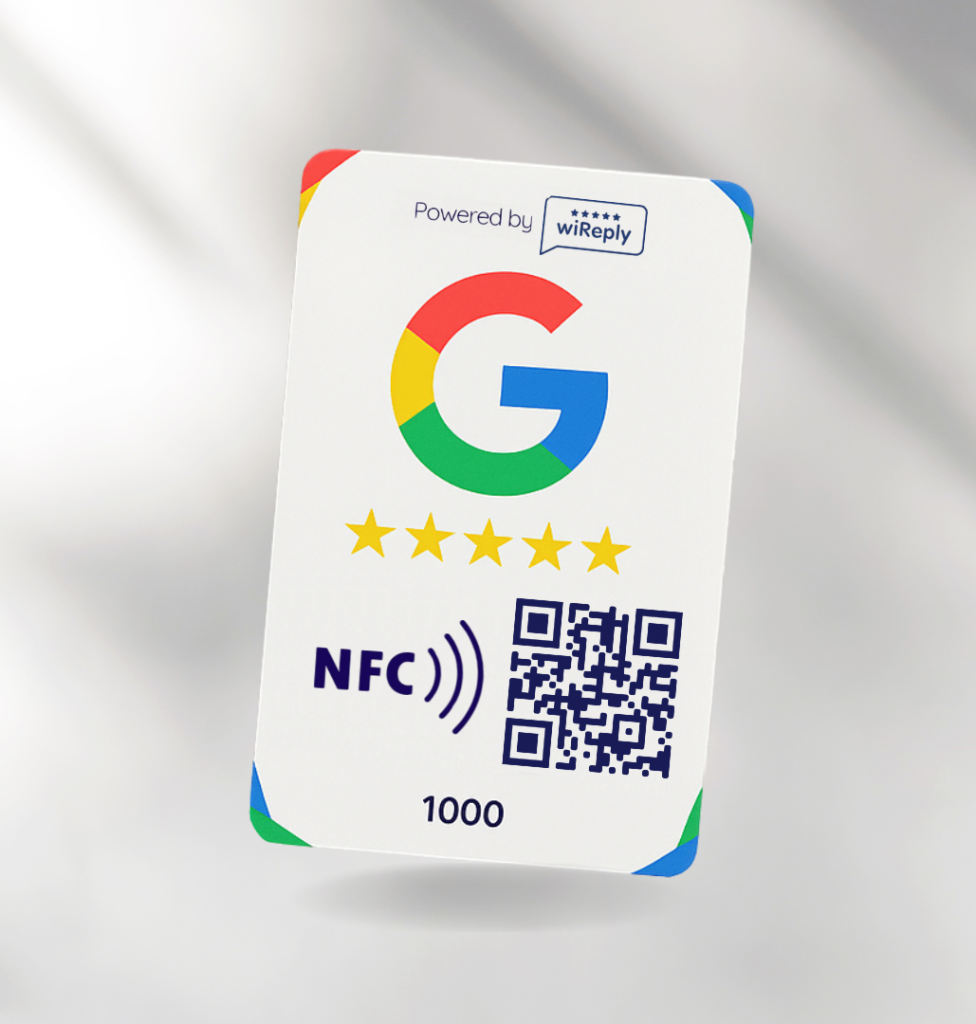
A simple dynamic was implemented at the end of the consultation. When the experience was positive, the team invited the client to leave their feedback via a physical, immediately accessible medium. In this case, NFC cards tailored and visible points at the counter. The change seems small, but it isn't. Removing steps increases the conversion rate.
At the same time, the timing of the request was standardised. It was not left to each salesperson's discretion. Clear situations were defined in which asking for the review made sense: after a successfully completed purchase, following an incident that was resolved on the spot, or at the end of a service that was particularly valued by the customer.
The third change was measurement. Each location started to record the generation of new reviews with traceability by point of sale and by employee. That transformed the project. What was previously a vague action became a manageable process.
Results, more reviews and better pace per venue
In the first few weeks, the desired pattern already appeared: increased the volume of reviews without increasing manual workload. The improvement was not uniform across all locations, and that was also useful. Some points of sale rapidly increased their acquisition rate. Others advanced less, but revealed where adjustments were needed in terms of messaging, media visibility, or sales discipline.
The most valuable learning was this: it's not enough to have satisfied customers. It's also not enough to “ask for reviews”. You have to design a repeatable system so that the request occurs at the right time, with the least possible effort, and with the capacity for follow-up.
In addition to the increase in volume, the freshness of opinions has improved. This matters a great deal in Local SEO. A profile with recent reviews conveys activity, trust, and relevance. For businesses with close competition, that signal can make a difference in visibility and conversion.
What this real case of increasing reviews demonstrates
This case doesn't prove a magic formula exists. It proves something more useful: Review generation improves when it stops relying on improvisation.
Some businesses try to solve it with internal reminders, others with posters and others with one-off campaigns. All of that can work for a while. The problem arises when there are multiple branches, staff turnover or peaks in workload. That's when consistency breaks down.
This is why the correct approach is not usually to “run a campaign.” It's usually to build a system with four well-aligned pieces: point-of-sale activation, ease of access, traceability, and quick reply to new opinions. If one fails, performance suffers.
Which variables make the difference
Not all local businesses achieve the same results with the same mechanics. It depends on the sector, the type of service, and the moment of contact with the customer. In retail, for example, it works better when the request comes just after a specific need has been met. In hospitality, it might make more sense at the end of the experience. In automotive, after delivery or the resolution of an issue.
The team also has a big influence. When employees understand that reviews aren't an abstract favour, but a lever for store visibility, their engagement changes. And it changes even more when you can measure what's working.
Another key factor is the ability to respond. Generating more reviews without subsequent agile management creates a bottleneck. If the volume grows, the response must scale with the same level of consistency. Otherwise, you gain uptake but lose brand control and operating time.
From review to operational data
This is where a reputation project stops being just marketing. When a company centralises reviews and Analyse patterns By location, category or sentiment, a second layer of value appears. It's no longer just about having more opinions. It's about understanding what customers are saying and what impact that has on operations.
In this case, the increase in reviews also allowed us to detect differences in experience between shops. Some locations received recurring mentions of speed, customer service, and clarity. Others showed repeated friction with waiting times or attention. Without sufficient volume, these patterns take much longer to emerge. More well-managed reviews mean more signal and better decision-making.
For chains and franchises, this point is especially relevant. Local reputation is not managed well with an aggregated and superficial view. It is necessary to compare branches, identify deviations, and act where customer experience or visibility is lost.
How to replicate this model without complicating the operation
The practical lesson is simple. If you want to increase reviews, don't start with creativity. Start with friction. Ask yourself how many steps a satisfied customer has to take to get to your listing and how many times your team consistently asks for a review.
Then, measure. Without data per location or per employee, it's difficult to truly scale. What appears to be a reputation problem might actually be a business process problem. And what looks like a good location could be missing out on many opportunities due to a lack of activation.
Finally, connect acquisition and management. Requesting more reviews, responding quickly, analysing sentiment, and comparing performance across locations shouldn't be separate tasks. In a multi-site operation, that fragmentation costs time and reduces control. Platforms like wiReply they solve precisely that point, because they turn reputation into a centralised, measurable and actionable flow.
This real case of increased reviews Leave any business with a physical presence with a clear idea: local reputation grows better when treated as an operational process, not a one-off initiative. And when that happens, Google stops being just a shop window. It becomes a growth channel that you can actually manage.