
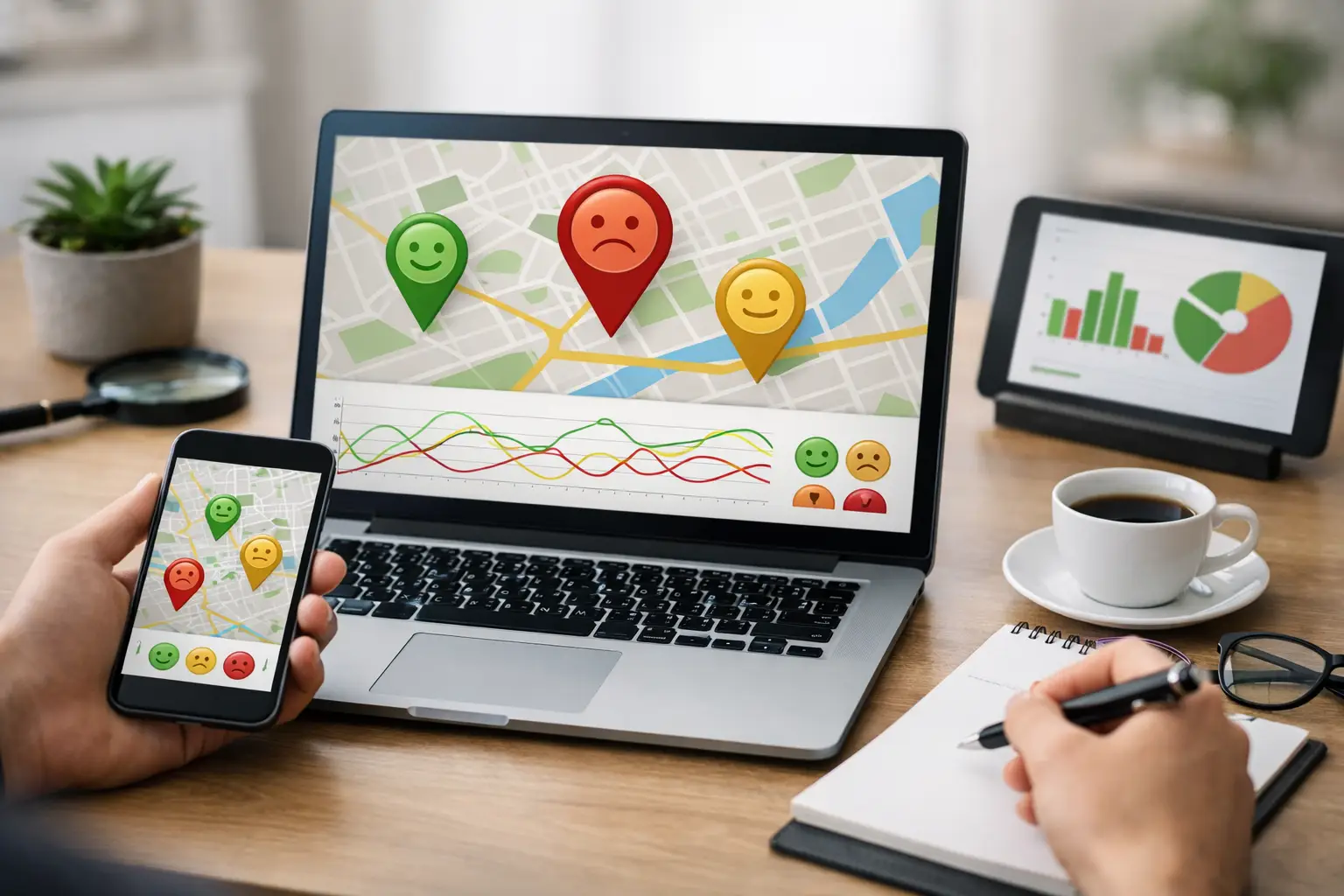
A three-star review isn't always a product issue. It can hide excessive queues, poor booking management, or a different experience between two branches of the same chain. Therefore, choosing the best tools for local sentiment analysis isn't just about knowing whether a review is positive or negative. It's about detecting what's affecting footfall, bookings, and brand perception at each location.
For a local business, Google reviews are a continuous source of operational information. The challenge arises when there are tens, hundreds, or thousands of comments spread across listings, teams, and cities. Reading them manually isn't scalable. Responding without context isn't either. A useful platform must convert that volume of text into clear priorities for taking swift action.
What should a local sentiment tool solve
Sentiment analysis applied to local reputation goes beyond assigning a positive, negative, or neutral label. That initial classification is useful, but it is insufficient if it does not identify the specific reason for the assessment. A restaurant needs to distinguish whether the reviews are concentrated on the service, the temperature of the dishes, the waiting time, or the cleanliness. A garage needs to separate issues regarding price, punctuality, diagnosis, and reception service.
The right tool should analyse the natural language of reviews and group the Comments by topic, attributes and satisfaction levels. This means that a manager does not receive an endless list of opinions: they receive an actionable insight. For example, they may see that the average rating remains stable, but that negative comments regarding staff availability have increased by 28 % in a specific area.
It should also work at the local level. A brand's global average can hide a specific drop in a shop, hotel, or franchise. When the analysis allows for comparison between locations, periods, and comment categories, decisions stop being based on gut feelings.
The best tools for local sentiment analysis
There isn't a single valid option for all businesses. The best platform depends on the number of locations, the channels to be controlled, the level of automation required, and who will be using the data. These are the categories worth evaluating before making a decision.
Platforms specialising in reviews and local SEO
They are the most straightforward solution for businesses that rely on Google Maps, local visibility and attracting customers through local searches. They centralise Google Business Profile reviews, allow you to respond via a single dashboard and analyse trends by venue. Their value lies in linking reputation, operations and local search rankings.
wiReply fits into this approach by combining the centralised review management, automated responses with artificial intelligence, semantic analysis and comparisons between locations. It is especially relevant for chains and multi-site companies that need to maintain a consistent brand tone without losing visibility on what is happening at each point of sale.
The difference lies in the operational detail. It's not enough to know that a location has more negative reviews. You need to understand if it's due to a recurring issue, when it started, which team is involved, and if the trend is improving after a measure has been applied. Solutions focused on local reputation make this monitoring easier without forcing the team to work with spreadsheets.
Customer experience and business reputation suites
Tools like Birdeye, Reputation, or ReviewTrackers usually cover a broad spectrum: reviews, surveys, messaging, local listings, and channel monitoring. They are suitable for organisations with mature customer experience processes and teams that need to consolidate information from different touchpoints.
Its main advantage is its functional breadth. It can bring together reviews, satisfaction forms and other indicators in a single view. The trade-off is clear: a more extensive suite may require a longer implementation, greater configuration and a higher investment. For a company looking to primarily address Google review management and per-location analysis, it's worth checking whether the added complexity brings real value.
Solutions for hotels, catering and tourism
In hospitality and tourism, platforms like ReviewPro or TrustYou have developed analysis models highly focused on specific attributes: room, breakfast, reception, cleanliness, location, or value for money. This is useful when reputation depends on multiple moments of the stay and on industry-specific portals as well as Google.
The advantage is its vertical depth. They allow for precise tracking of the aspects that most influence guest satisfaction. However, a hotel group with a strategy highly focused on local acquisition will need to review how they integrate Google reviews, response operations, and comparisons between establishments. Sector specialisation works best when it aligns with the primary source of demand.
Social listening and brand analytics platforms
Brandwatch, Talkwalker and other social listening platforms provide context on public conversations, trends, and brand perception across social media, news, and forums. They are valuable for companies with national campaigns, a high volume of mentions, or a need for broad reputational analysis.
For the daily management of a chain of premises, they are generally less practical as a primary tool. A social media conversation does not replace the signal of intent left by a person when reviewing a business on Google. Furthermore, these solutions may offer fewer specific capabilities for responding to reviews, managing listings, or measuring progress per point of sale.
How to compare tools without getting stuck on a slick demo
The demo usually shows clean graphics and automatic summaries. The decision should be based on whether that data helps a team work better the following Monday. Start by uploading or reviewing real reviews from various locations. Check if the platform understands common Spanish expressions, spelling errors, sarcasm, and comments with mixed feelings. A review might praise the staff and harshly criticise the wait time. Classifying it as purely positive generates a misinterpretation.
Next, review the taxonomy of topics. You should be able to identify categories relevant to your business and, when necessary, adapt them. In retail, stock, queues, changes, and advice may be important. In a gym, cleanliness, machines, classes, and commercial support. Generic topics provide a superficial view; categories connected to operations allow for intervention.
Comparing locations is another crucial requirement. A chain needs to see which branches are performing above average, which are underperforming, and where the same issues are recurring. It also needs to filter by dates to measure the effect of shift changes, training, or a campaign. Without a historical record, there can be no measurable improvement.
Finally, assess the ability to convert information into workflow. Alerts must reach the right person. Critical reviews require follow-up. Responses must retain the brand tone and, at the same time, avoid repetitive phrases that sound automatic. Artificial intelligence saves time when configured with rules, approvals and context. If it only generates quick texts, but does not provide control, it creates a different problem.
Indicators that connect sentiment and business
The average score remains important, but it shouldn't be the only indicator. A rating of 4.4 can conceal a drop in service mentions. It can also improve due to the arrival of many five-star reviews while a critical incident remains unresolved. Sentiment analysis allows us to look beneath the average.
Measure trends in positive and negative mentions by attribute, response time, the percentage of reviews addressed, and differences between outlets. Add the volume of new reviews generated by each branch, employee or campaign, where the platform allows this. This enables you to distinguish between a branch with a poor reputation and one that simply receives fewer reviews.
The goal is not to fill a dashboard. It's about prioritising. If the dominant problem is waiting times, operations must act. If criticism centres on poorly communicated expectations, marketing must revise the message. If a specific branch achieves better results with the same model, that team can contribute replicable practices to the rest of the network.
The right decision depends on what happens next
A local sentiment tool adds value when it reduces the distance between what the customer writes and what the business changes. For an independent shop, this might mean spotting a recurring complaint before it impacts the score. For a franchise, it could be comparing a hundred locations without turning reputation management into an impossible manual task.
Choose a platform that accurately analyses reviews, ranks them by impact and allows you to take action directly within the platform. Customer feedback is already telling you what needs improving. The competitive advantage lies in listening sooner, responding better and turning every trend into a decision that’s visible in-store.