
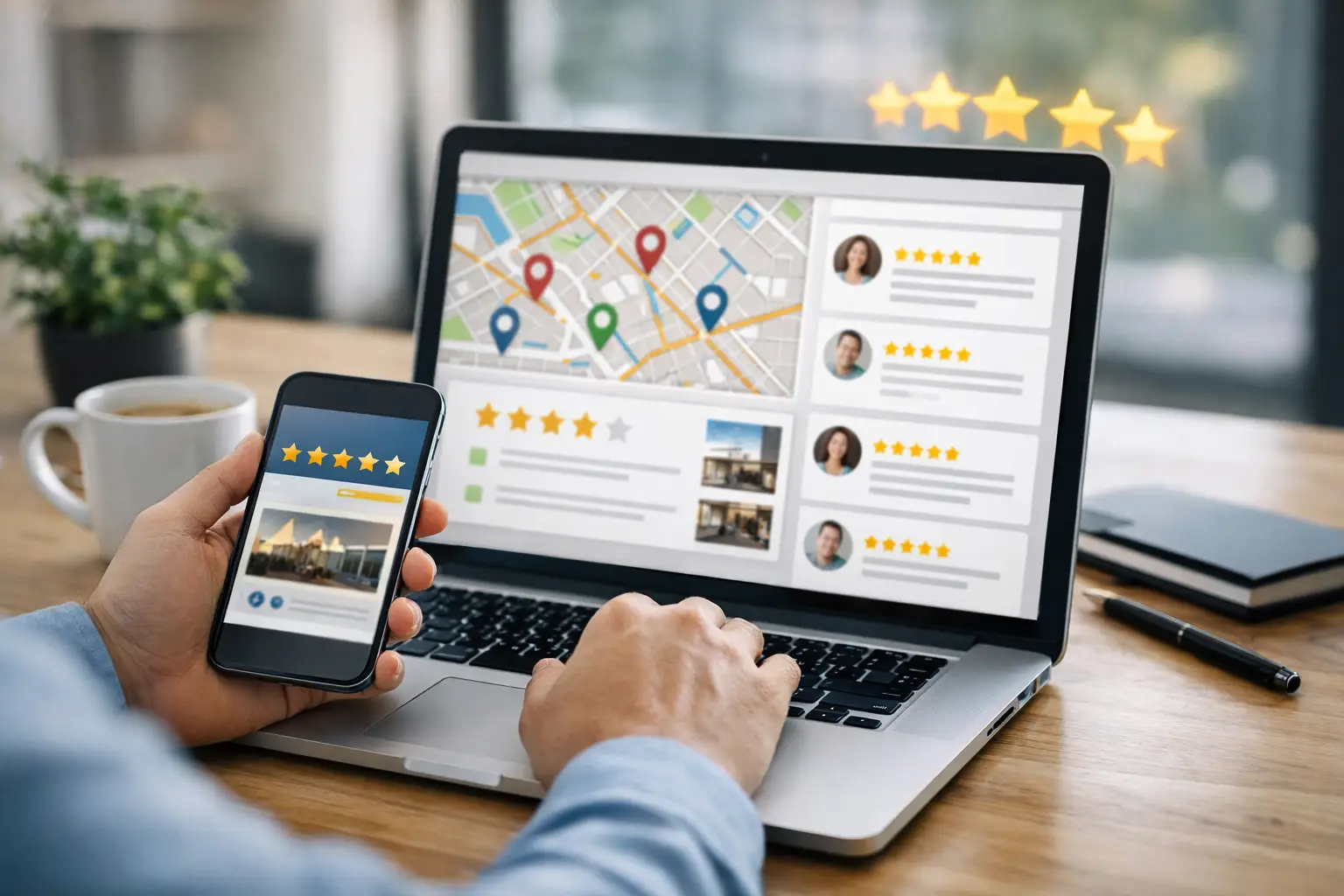
An unanswered review is not just a pending comment. It is a public conversation that can influence a booking, a store visit or a call. Google reviews management software makes it possible to manage that volume without turning marketing, operations or customer service teams into manual inbox managers.
For a local business with a single location, responding to reviews already requires discipline. For a chain with ten, fifty or a hundred sites, the problem changes scale: there are inconsistent responses, issues that are detected late and little visibility over which site is generating the most satisfaction or friction. The right software turns reviews into a controlled, measurable operation useful for local growth.
Why reviews require structured management
Google Business Profile reviews have two simultaneous effects. They affect the perception of anyone comparing options on Google Maps and provide signals about the actual experience at each point of sale. A low rating can indicate poor expectation management, a service issue, excessive waiting time or a recurring incident. A high rating also contains valuable information about what a team is doing well.
The problem is that reading comments one by one does not scale. Nor is it enough to reply with a generic template. A “thanks for your feedback” repeated across all profiles conveys little attention and wastes data that could help with decision-making.
Effective management requires speed, brand consistency and context. If a customer complains about cleanliness in a hotel, a delay in a garage or the wait in a restaurant, the response must acknowledge the specific reason. At the same time, the regional manager needs to know whether that issue is happening in an isolated location or is being repeated across the entire network.
What Google review management software should do
The first function is to centralise. Those responsible must be able to consult and manage reviews from all locations from a single environment, without switching accounts or relying on spreadsheets. This reduces times and allows you to maintain a clear view of the reputation by city, region, brand or type of establishment.
The second is to automate with judgement. Artificial intelligence can generate responses in seconds, but it shouldn't do so without rules. A good system makes it possible to configure the tone, define brand messages and differentiate how a positive review, a moderate criticism or a serious issue are handled. Automation should save repetitive work, not publish messages that look interchangeable.
It must also offer supervision. There are businesses that prefer to approve each response before publishing it. Others need to automatically publish certain positive messages and send negative reviews for review. There is no single correct configuration. It depends on the volume, the level of reputational risk and the autonomy of the local team.
Semantic analysis is another key piece. It is not enough to know that a location has an average of 4.2 stars. You have to understand what is behind this: price, service, cleanliness, stock, speed, product, parking or punctuality. When the software groups these topics and analyses the sentiment of the reviews, management can prioritise actions with evidence.
Comparing locations completes the picture. Two stores can have the same average score, but different problems. One might receive criticism for queues and another for a lack of product availability. Benchmarking makes it possible to identify both the sites that require intervention and the practices that are worth replicating.
Automating does not mean losing control
The most common mistake is thinking that every response must be automatic. In sensitive sectors, such as healthcare, premium hospitality, the automotive industry or tourism, some situations need human review. Reviews that mention a serious incident, an open complaint, personal data or specific accusations should not receive a standard reply.
The automation works better when applied by tier. Short positive reviews can receive a prompt personalised response. Neutral ratings can trigger a request for more context. Negative criticism should be classified by topic, urgency and location so that the appropriate team can take action.
This model avoids two extremes: the manual response that arrives late and the indiscriminate automation that generates rejection. Technology should provide speed, while the organisation maintains judgment.
How to evaluate a platform before subscribing to it
The question is not just whether the tool replies to reviews. The question is whether it helps improve the reputational performance of each location. Before choosing, it is worth reviewing how it handles daily management, analysis, and the generation of new reviews.
First, check the centralisation capability. The platform must allow access to all records, filtering by branch and assigning responsibilities without losing traceability. For franchises and chains, defining permissions is also relevant: central management does not need the same view as a store manager.
Next, evaluate the quality of the generated responses. Ask for examples with different tones and use cases. A helpful response mentions real elements from the comment, maintains the brand's style, and proposes a next step when there is a problem. If the responses sound identical, the tool is not solving the main risk of automation.
Review the level of analytics too. A dashboard with the number of reviews and average score is insufficient. It must show trends, recurring topics, evolution by location, sentiment distribution, and comparisons between centres. The data must be able to answer operational questions: which venue has improved? Where are criticisms about customer service concentrated? Which team generates the most positive mentions?
Finally, analyse how it drives review volume. A local reputation is not just strengthened by replying. It also needs a steady flow of recent and authentic reviews. Solutions such as personalised NFC cards make it easy for the customer to share their experience at the right time and allow new reviews to be attributed to employees, campaigns or points of sale.
The impact varies depending on the sector
In hospitality, response speed and the analysis of mentions regarding service, food or waiting times can detect issues before they affect further shifts. In hotels and tourism, reading reviews makes it possible to separate problems concerning rooms, reception, breakfast or location, and pass them on to the responsible teams.
In retail, reviews provide signals regarding customer service, availability and in-store experience. In the automotive sector, they help monitor the perception of the sales process, the workshop and vehicle handover. In gyms, mentions of cleanliness, classes, equipment or overcrowding reveal opportunities for improvement that an internal survey might take longer to show.
The common need is the same: to transform scattered feedback into concrete decisions. That is why a platform like wiReply has value when it centralises the conversation, automates repetitive tasks and turns reputation into a source of intelligence for operations.
It measures higher than the average score
The average score matters, but it should not be the sole indicator. One location might maintain a good rating while accumulating recent reviews about a new problem. Another might start with a lower average and be steadily improving thanks to operational changes.
It is advisable to monitor the evolution of review volume, response time, percentage of reviews addressed, sentiment trend and most cited topics. In multi-site networks, add the comparison between locations and the attribution of new reviews generated by each team.
When this data is reviewed periodically, reputation ceases to be a reactive matter. It becomes part of business management. The objective is not simply to respond more for the sake of it, but to detect earlier, correct better and make the experience that truly deserves to be recommended visible.
The best software does not replace customer service. It ensures that every piece of feedback reaches the person who can act on it faster and that every location learns from what its customers are already saying.