
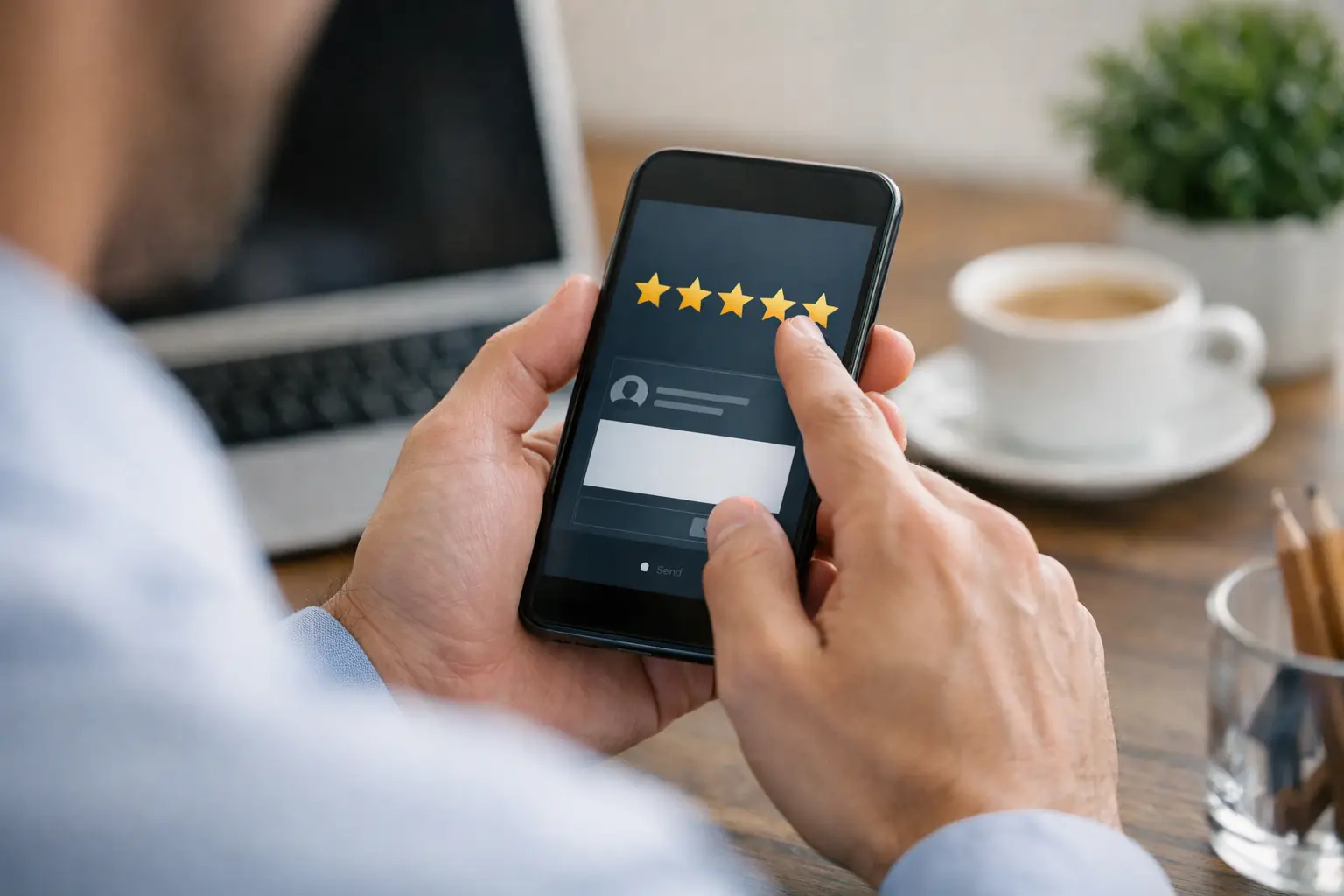
A bad practice is still very much alive in local businesses: trying to buy reviews with coupons, prize draws or discounts. It works in the short term, but it also distorts the quality of feedback, reduces credibility and complicates policy compliance. If you're looking for how to increase reviews without discounts, the profitable way isn't by incentivising comments, but by making it easy, timely, and consistent to ask for them.
How to increase reviews without discounts, without friction, and with a method
The problem isn't usually a lack of satisfied customers. The problem is usually a lack of system. In most establishments, the experience has been correct, even very good, but nobody asks for a review at the right moment, nobody follows up, and nobody measures which employee, shift, or point of contact generates the most feedback.
When this happens, the volume of reviews depends on chance. And chance doesn't scale. Even less so in chains, franchises or businesses with multiple locations where each team operates differently.
Increasing reviews without resorting to discounts requires three things: identifying the point of greatest satisfaction, minimising the steps to leave feedback, and standardising the request so that it doesn't depend on the individual motivation of each employee. It's not a creative issue. It's an operational issue.
The best time to ask for a review
Asking too soon lowers conversion. Asking too late does too. The best time appears right after a clear signal of satisfaction: an account closed without issues, a delivery completed, a positive checkout, a repair finished on time, or an interaction in which the customer verbalises that everything went well.
This point varies depending on the sector. In the restaurant industry, it usually works at the end of the service. In automotive, after the vehicle collection. In gyms, after an onboarding session or after the first month. In retail, straight after payment if the service was outstanding. In hotels, after check-out or in the hours following, while the experience is still fresh.
The rule is simple: don't ask for a review when the customer is still resolving something. Ask for it when they have already received value.
Friction kills more reviews than lack of interest
Many businesses ask for opinions, but they do it badly. They say “if you want to, leave us a review on Google” and expect the customer to look for it. Almost everything gets lost there. Every extra step reduces conversions.
If you want more volume, access must be direct. A visible QR code, an NFC card on the counter, a post-service SMS, or an automated message with immediate access to the profile. The less the customer has to think, the more likely they are to leave a review.
This is especially important in environments with high staff turnover or physical traffic. In a restaurant, clinic, workshop or retail chain, you can't rely on the customer remembering the exact name of the listing, finding it, and completing the process later. You need to capture their intent at the moment.
What does work to increase reviews without discounts
The most effective approach combines brief training, automation, and measurement. There's no need to turn the team into review salespeople. All that's needed is to give them a simple sentence, visible support, and a repeatable process.
Your opinion on Google helps us a lot. If you had a good experience, you can leave it here. It's direct, doesn't pressure, and fits any operation. If the business has a more friendly tone, it can be adapted. The important thing is to maintain consistency.
Automation then comes into play. A business with a single site can survive with manual processes for a while. A multi-site company cannot. If you manage several locations, you need to trigger requests based on real events, centralise results, and know which location converts best. That's where a specialised platform brings real control: less manual work, more traceability, and more stable growth.
It is also appropriate to separate two objectives that are often mixed up. One is to get more reviews. Another is to respond to them well. Both influence reputation and Local SEO, but require different workflows. If you combine them in the same operation, you gain speed and consistency.
The role of the frontline team
Reception, the sales floor, the till, advisors, customer service staff and store managers have more impact on review generation than any brand campaign. They are the ones who spot the moment to ask and trigger that final gesture.
That's why training shouldn't be theoretical or lengthy. It should answer three questions: when to ask, how to ask, and with what support. If you can also measure which people or shifts generate the most feedback, you turn a vague task into a performance lever.
This has an added advantage. When you compare locations, you quickly see where there is an execution problem. It's not always a lack of satisfied customers. Sometimes it's a lack of operational discipline. And that can be corrected.
Errors that hinder reviews, even if the service is good
The first mistake is asking for reviews irregularly. One day yes, one week no, only when there's time. That generates peaks, but not a constant flow. Google and users value recurrence more than one-off bursts.
The second is to ask everyone the same thing, without reading the context. If a customer has had an incident, the correct approach is to resolve it before requesting a public opinion. Forcing this request can worsen the rating and damage the experience.
The third is no reply to the reviews received. When a profile accumulates unanswered reviews, it transmits inattention. Furthermore, it wastes a direct source of operational information. Patterns related to waiting times, service, cleanliness, product, or delivery times, which should be communicated to operations, marketing, or zone management, appear there.
The fourth is not to analyse by location. In businesses with multiple branches, a global average masks local problems. What matters is knowing which point of sale is growing, which is stagnating, and where the experience generates more positive comments or more friction.
How to increase reviews without discounts across multiple locations
Improving review capture in a single location already yields returns. In a network of branches, this return is multiplied or lost depending on the level of control. If each branch uses its own method, the brand becomes fragmented. If all branches work with the same process, performance can be compared and optimised.
Here the focus shifts. It is no longer enough to “ask for more”. We need to standardise messages, activate requests by channel, measure by establishment and read the content of reviews to detect real patterns. Not all reviews are equally valuable. One opinion might boost the average score. Another might highlight a repeated fault within a specific time frame. The second is worth its weight in gold for operations.
Therefore, advanced review management isn't just about reputation. It's also about operational intelligence. If a chain notices similar comments about waiting times appearing in three locations, it doesn't have a marketing problem. It has a process problem. And the sooner they see it, the sooner they fix it.
At this point, a solution like wiReply makes sense for teams that need to scale without adding manual work. It allows for automated requests and responses, centralisation of locations, measurement of results by location or employee, and transformation of feedback into actionable business insights. That's the relevant change: moving from “we have more reviews” to “we know why we're getting them and what to do with what they say.”.
What indicators should one look at?
If you only look at the total number of reviews, you're missing context. What's useful is to track the conversion rate per request, volume per location, the evolution of the average rating, response speed, and the most frequently recurring positive and negative themes.
It also helps to measure which channel converts best. In some businesses, a QR code on the counter works better. In others, an SMS post-service. In others, an NFC card handed over by staff. There is no single formula. It depends on the type of experience, the customer's age, and the moment of use.
That “it depends” is not a weakness. It's the reason why it's worth testing, measuring, and adjusting. The important thing is that the decision comes from data and not intuition.
More reviews, yes, but better processes too
When a company understands how to increase reviews without discounts, it stops chasing shortcuts and starts building a system. This improves local visibility, reinforces trust, and provides a more accurate reading of what's happening at each point of sale.
Reviews aren't just social proof. They are a layer of information about experience, execution, and brand consistency. If you generate them methodically, respond to them with agility, and analyse their content judiciously, you can turn a seemingly simple task into a real competitive advantage.
The opportunity is there, in every satisfied customer who walks out the door. There's no need to pay them for their opinion. What's needed is to make it easy for them, ask at the right moment, and not lose a single piece of useful data along the way.