
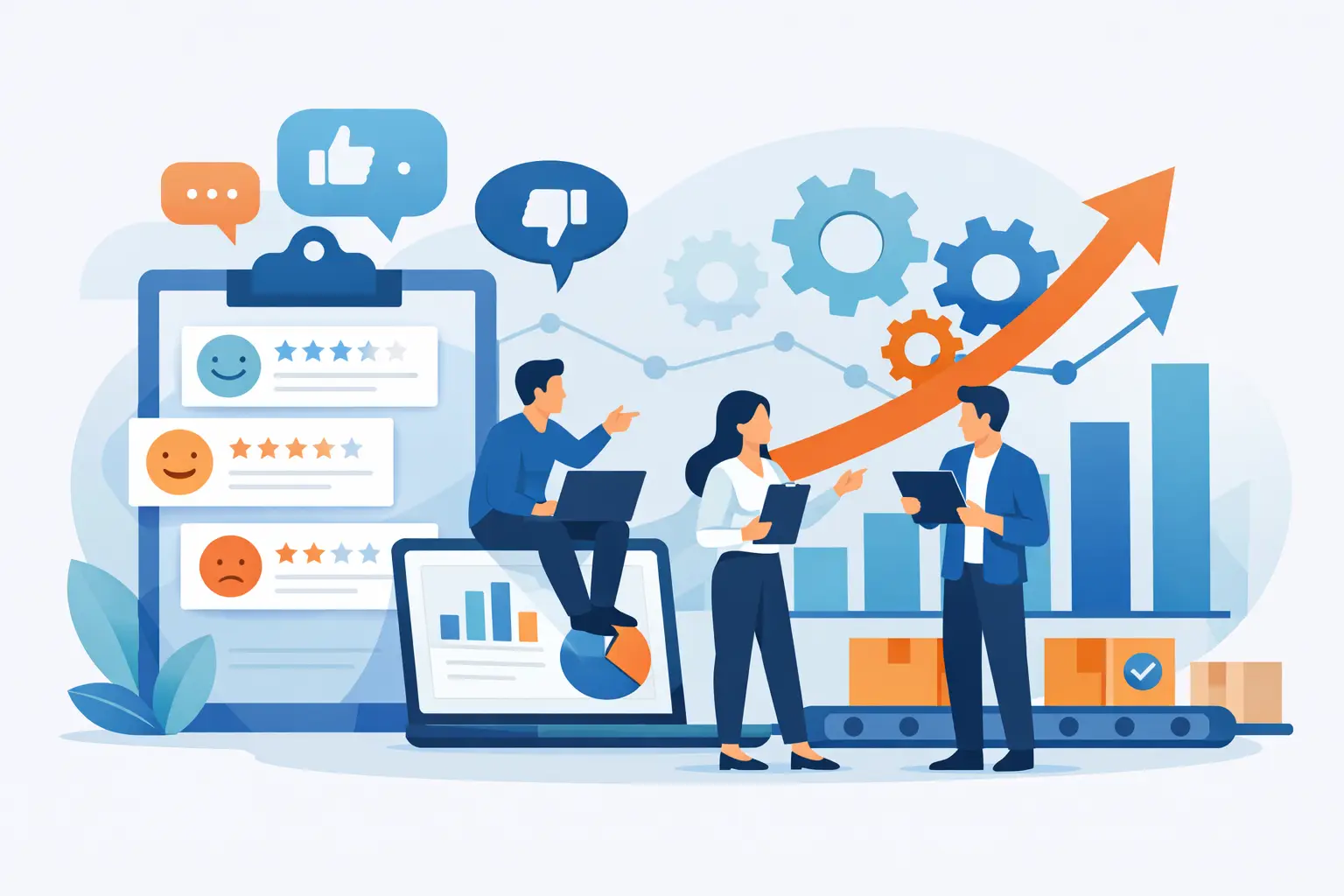
A customer leaves your establishment, leaves a three-star review, and writes something very specific: "They took a while to serve me, but the product was worth it." There's more than just one opinion there. There is an operational fact. If you know How to convert opinions into operational improvements, That review ceases to be an isolated comment and becomes a useful signal for correcting processes, protecting your reputation and recovering margin.
Most businesses already respond to reviews. The problem is that few use them to make decisions. The comment is appreciated, an apology is offered if necessary, and then everything stays the same. Meanwhile, the same mistakes are repeated by shift, by location, or by team. Responding without taking action is losing value. And when you're managing multiple locations, that cost multiplies.
How to convert opinions into operational improvements without improvising
To do it well, you need a system. It's not enough to read comments now and then. Nor is it useful to only review the negative feedback. Operational improvement begins when the voice of the customer becomes a measurable workflow..
The first step is to separate perception from cause. A client may say the experience was bad, but the real problem might have been excessive wait times, a stockout, poor coordination at the till, or mismanaged expectations. If you stay on the surface, you react. If you get to the underlying pattern, you correct it.
This is where technology makes a difference. When opinions are centralised, sorted by theme and analysing by sentiment, ...can you detect what is repeated, where it occurs most, and since when. This allows us to move from intuition to evidence.
From a loose comment to an operating pattern
A single review shouldn't change a process. Ten reviews with the same complaint in two weeks, yes. The criterion isn't emotional. It's statistical and operational.
For example, if in a restaurant chain, recurring comments about slowness on the terrace between 2 PM and 4 PM appear, you're not just looking at a reputation issue. You're seeing a potential staffing mismatch, poor table allocation, or a bottleneck in the kitchen. In retail, several mentions of long queues can signal a staffing problem. In the automotive sector, comments about a lack of follow-up can reveal a weakness in reception or after-sales service.
Well-analysed reviews help to pinpoint specific bottlenecks., not just to measure general satisfaction. That is the change in focus that generates the most impact.
What data should you extract from reviews
Not all feedback provides the same value. To turn it into real improvements, it's worth reading with an operational logic. The question isn't whether the customer was happy or not. The question is what part of the service is affecting that perception.
The most useful data is typically grouped into five blocks: timings, attention, product or service, expectation fulfilment and point-of-sale status. If a review mentions waiting times, friendliness, cleanliness, availability, price or incidents, you already have actionable raw material.
Afterwards, context is needed. A one-off complaint in a busy venue isn't the same as a recurring trend across several outlets.. Nor does a criticism about facilities weigh the same as one about staff treatment, because the solutions, timescales, and costs are different.
Prioritise impact, not noise
Some businesses react more quickly to a very harsh review than to twenty moderate comments about the same failing. It's a common mistake. The urgent is not always the important.
Good prioritisation combines frequency, impact on experience, and ease of correction. If many opinions mention disruption during peak hours, that deserves more attention than an isolated criticism about loud music. The key is to rank problems according to their effect on operations, reputation, and local conversion..
How to convert opinions into operational improvements across multiple locations
When you manage a single location, you can still spot patterns at a glance. When you manage five, twenty, or a hundred, you need to standardise. Otherwise, each manager interprets reviews in their own way, and the organisation loses consistency.
In multi-site environments, what works is comparison. Comparing recurring themes across locations, temporal evolution, review volume, average rating, and reasons for satisfaction or criticism. Internal benchmarking turns reputation into a management tool, not just marketing.
If one establishment receives better comments on speed and another stands out for staff service, you already have a clear basis for replicating good practices. If a franchise accumulates criticism for cleanliness while the rest maintain good levels, you can intervene before the problem escalates.
The public response also provides information
Respond to reviews It's not just a reputational gesture. It also helps gather more context, demonstrate responsiveness, and detect if the problem has been resolved. A quick, coherent, and tailored response to the reason for the review improves brand perception, but also leaves a traceable record.
That said, automate responses It shouldn't mean responding the same way to everything. Efficiency matters, but accuracy more so. If a platform identifies themes, tone, and urgency, automation stops being generic text and becomes a useful extension of the operational process.
From insight to action, the point where many fail
The bottleneck isn't usually in getting opinions. It's in doing something with them. Many companies have plenty of data and little execution. That's why it's worth defining a simple process.
First, detect the pattern. Then, assign it to the responsible area. Next, apply a concrete correction and check if the perception changes in the following weeks. If you can't measure before and after, you're not improving, you're just reacting.
Imagine a gym that detects repeated comments about overcrowding in changing rooms at certain times. The improvement isn't about responding better. It involves adjusting cleaning schedules, reallocating staff shifts, or redesigning customer flow. In a hotel, if reviews consistently mention slow check-in times, the solution might lie with the reception staff, training, or technology. In both cases, the review is the trigger. Real improvement happens in operations.
It is advisable to work with closed categories and human review
Automation speeds things up considerably, but it doesn't replace judgement. Classifying reviews by themes such as waiting times, service, cleanliness, stock or incidents helps to order decisions. Even so, there are always nuances. The same word can mean different things depending on the sector or context.
Therefore, the most effective model combines automated reading, semantic analysis, and validation by area managers. AI reduces manual workload. The team decides on priorities and corrects processes.. That combination is what generates sustainable results.
What does the business gain when it does well
The benefit isn't limited to improving the average score. That comes as a consequence. What the business really gains is control.
Control over what's failing at each point of sale. Control over response speed. Control over brand consistency across locations. And control over the ability to act before an operational issue becomes a visible problem on Google Maps.
Additionally, there is a direct effect on local recruitment. A better experience generates better reviews, and better reviews improve visibility, trust, and conversion.. It's not just reputation. It's commercial performance.
At this point, solutions like wiReply are especially useful because they allow for the centralization of reviews, automated responses with criteria, detection of patterns by location, and the conversion of comments into actionable signals for operations and customer experience. This union between reputation and execution is the part that adds the most value as volume increases.
Errors hindering operational improvement
There are three very common mistakes. The first is treating all reviews the same. Not all of them require the same attention or the same action. The second is working only with the average score, because a rating without context says little. The third is not closing the loop, that is, detecting the problem but not verifying if the correction worked.
It's also advisable to avoid obsessing over a perfect response while the problem is still ongoing. Reputation isn't just protected through communication. It's protected by fixing what generates friction..
Leveraging opinions for a competitive advantage
When a business learns to listen in a structured way, it gains speed. It detects earlier. It corrects earlier. It scales better. And that, in competitive local markets, carries a lot of weight.
Opinions aren't a passive channel. They are a continuous source of information about real in-store experience. If you connect them to operations, they stop being a thermometer and become a lever for improvement. That's where the result changes. Not when you respond more. When You use each review to operate better, in less time and with more precision.
The opportunity is quite clear: your customers are already telling you what to adjust. The difference is made by what you do with that information tomorrow, in every store and on every shift.