
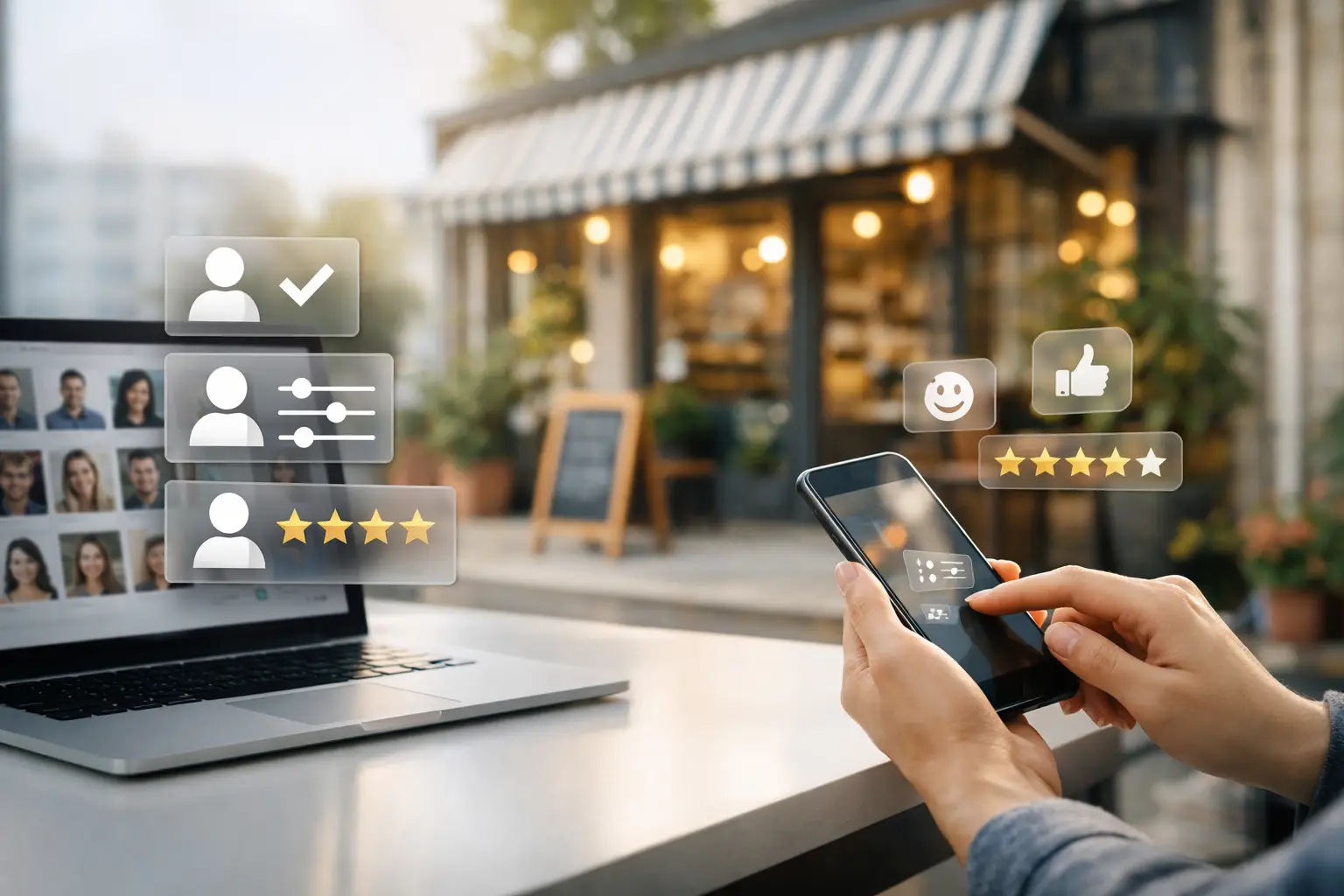
An unanswered review, incorrect opening hours or an outdated photo can make a customer choose another business before reaching your door. When a brand manages multiple locations, these small errors multiply. A profile manager makes it possible to turn a dispersed, manual task into a centralised, measurable process aligned with the objectives of each location.
It is not just about editing a Google listing. It is about protecting the local presence of each centre, responding to the customer's voice swiftly and detecting what is affecting the experience before it is reflected in sales, bookings or visits.
What a profile manager does
A profile manager brings together the operations of Google Business Profile listings for one or more businesses in a single environment. From there, teams can monitor basic data, reviews, ratings, questions and local performance signals without having to log into each account or rely on spreadsheets.
For an independent business, it can be a way to save time and keep the listing up to date. For a chain, a franchise or a multi-site company, it is a layer of operational control. It makes it possible to know which location has received recent reviews, where ratings have dropped, which centres take too long to respond and what patterns repeat across cities.
The Google listing is a business asset. It appears when someone searches for a nearby restaurant, garage, gym or hotel. If the information is unreliable or the reputation conveys neglect, the impact arrives even before the first contact with the team.
Centralisation does not mean taking away autonomy
One of the common mistakes is to think that centralising management forces all locations to be treated in the same way. It is not like that. Centralisation serves to define common rules and, at the same time, preserve the context of each point of sale.
Headquarters can set permissions, templates, brand tone and protocols for sensitive incidents. The local manager can provide specific information about a booking, visit, repair or order. This combination avoids two frequent problems: generic responses that irritate the customer and improvised responses that do not respect the brand.
The best model depends on the business structure. A coffee shop with two branches can concentrate all management in a single person. A restaurant chain with fifty establishments will need approval workflows, alerts and segmentation by area, brand or franchisee. A profile manager must adapt to that reality, not force the team to work in an artificial way.
Reviews: speed with judgement
Responding to all reviews does not mean repeating the same message with the customer's name. A helpful response shows listening, reinforces the positive aspects and opens up a channel for a solution when there is an issue. Furthermore, it keeps the public conversation around the listing active.
Speed matters. An unanswered negative review for days can convey a lack of attention. However, responding quickly does not justify replying without context. Complaints related to safety, discrimination, billing, privacy or serious conflicts require human review. Automation should speed up everyday work and escalate sensitive cases, not replace the team's judgement.
Artificial intelligence brings value when it understands the content of the review, the rating given and the tone defined by the brand. It can suggest coherent responses, detect mentions of excessive waiting times, cleanliness, staff treatment or product quality. Afterwards, each business decides what is published automatically, what requires validation and what should be escalated to a manager.
Less manual work. More consistency.
The goal is not to reply just for the sake of it. It is to maintain a high frequency, reduce the time spent on repetitive tasks and ensure that every customer receives an appropriate response.
Data that helps improve the premises
Stars summarise a perception, but they do not explain what is happening. Two sites can have a similar average rating and very different operational problems. One might receive criticism for slowness during peak hours; another, for a lack of stock or parking difficulties. Without semantic analysis, these signals remain buried among dozens or hundreds of comments.
An effective profile manager turns reviews into operational categories. It allows you to identify the most mentioned topics, track their evolution and compare results across locations. If several stores accumulate comments about checkout service, the operations area can investigate shifts, training or processes. If a hotel consistently stands out for the friendliness of its staff, that practice can serve as an internal benchmark.
The Benchmarking between locations it must not be used to point fingers at teams, but to make evidence-based decisions. Comparing review volume, average score, response time, sentiment and reasons for criticism helps with prioritisation. It also makes it possible to assess whether a specific action has had an effect: a change of supplier, training, an increase in staff or a new customer acquisition campaign.
What a profile manager should offer for a multi-site company
The choice of a tool should not be based solely on the number of responses it can generate. It is worth checking whether it handles the full scope of local reputation operations.
First of all, you need a unified view of all centres, with clear filters by location, region, brand and period. The manager should not take hours to locate which listings require attention.
It also needs configurable automation. Responses to positive reviews can follow more agile rules, whereas negative reviews or mentions of sensitive issues must trigger alerts and reviews. The tone must be able to adapt to the brand's personality without resorting to rigid phrasing.
Analytics must go beyond counting reviews. It is useful to measure sentiment, topics, score trends, response speed and differences between establishments. This data has to be understandable for marketing, operations and management, not just for a reputation specialist.
Finally, collecting new reviews must be integrated into the strategy. Asking for feedback at the right time, with simple processes in-store or after the service, helps to increase the volume of authentic feedback. If, furthermore, the generation of reviews can be attributed to an employee, a campaign or a point of sale, the organisation understands which actions work and which do not.
The impact on local visibility
Google values relevance, distance and prominence to show local results. The company cannot control where the user is located, but it can work on the quality and consistency of its presence. A complete, up-to-date and active listing makes it easier for Google and customers to better understand the business.
Reviews are not a magic formula for appearing first on Google Maps. They influence rankings alongside many other factors, and results vary by sector, competition, and area. Even so, a strong reputation reduces friction in the decision-making process. Someone comparing four options usually looks at the rating, the number of recent reviews, and how the business responds when something goes wrong.
Because of this, managing profiles is not an isolated marketing task. It affects customer acquisition, customer service, operations and brand. A comment about a bad experience can reveal an internal problem. A sequence of positive reviews about a specific service can become a commercial argument.
How to implement orderly management
The first step is to audit the existing listings. Access, duplicate data, opening hours, categories, phone numbers, booking links and information consistency must be reviewed. Without a reliable foundation, automation only accelerates errors.
Afterwards, it is advisable to define a Response policy. You must establish who responds, within what timeframe, what tone is used, which cases are escalated, and how to act in the event of an unfair review or a real incident. This framework provides security for teams and prevents each location from improvising.
The next step is to set up data collection. There is no need to measure everything. It is better to select metrics connected to operations: average rating, new reviews, response time, sentiment, main reasons for criticism and performance per venue. From there, follow-up meetings can focus on decisions, not on gathering information.
Platforms like wiReply allow you to bring together response automation, sentiment analysis, benchmarking and review acquisition in a single operation. The value lies in reducing the manual workload without losing visibility over what is happening in each location.
Local reputation is built review by review, but it is managed with processes. When every profile is up to date, every opinion receives attention and every pattern is turned into an action, Google Maps stops being a passive shop window and becomes a constant source of growth and improvement.