
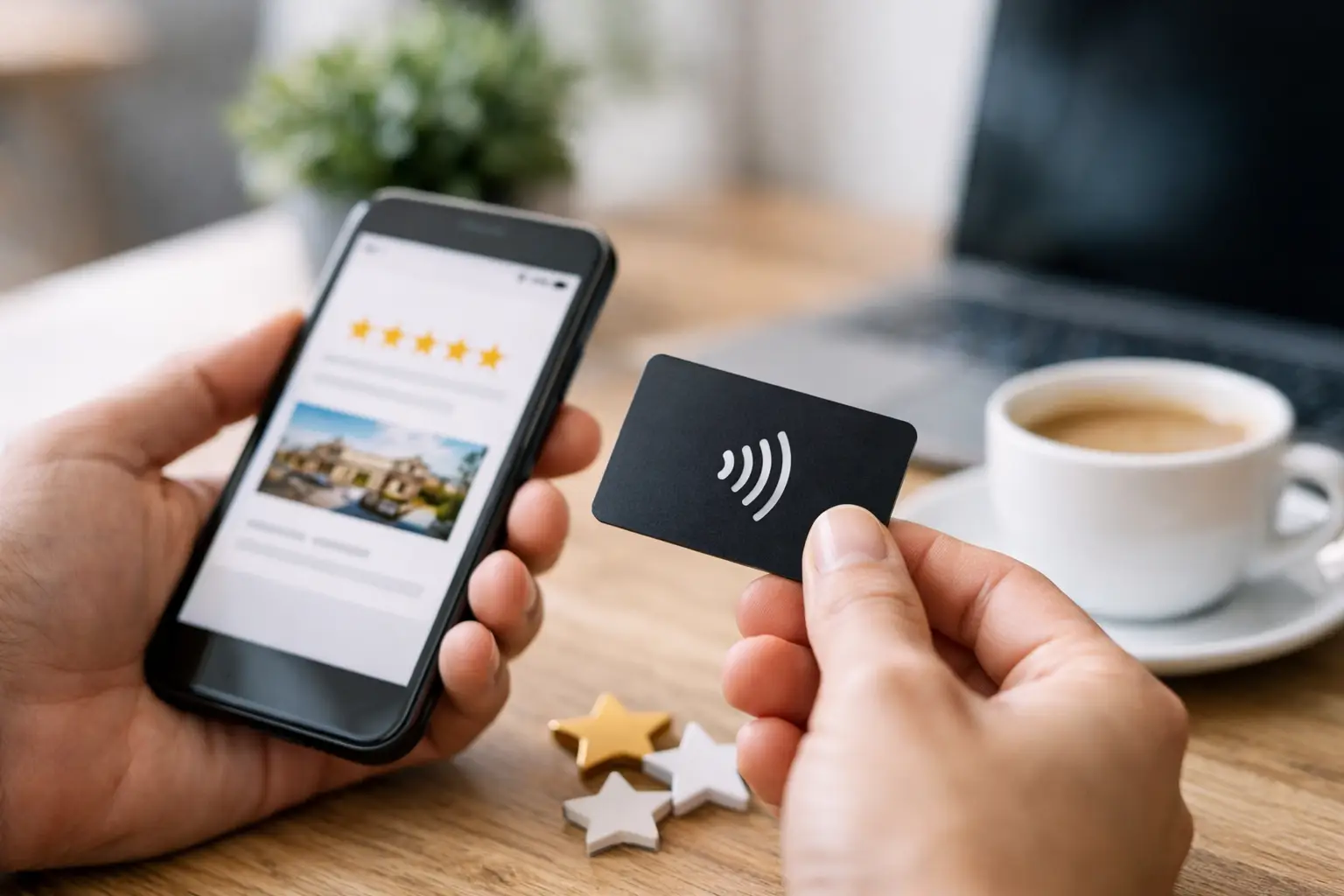
A review is not lost because a customer is unhappy. Often it is lost because no one asks for it at the exact right moment. NFC cards solve that friction point: tapping the phone, opening the Google listing and leaving a review in a few seconds. For a local business, that speed can make the difference between relying on a few reviews a month or building a reputation that drives visits, bookings and sales.
But a card on its own does not create a strategy. It works when it is integrated into the venue's operations, handed over in the right context and makes it possible to measure which team, employee or establishment is generating results. The goal is not to accumulate reviews without criteria. It is to increase the volume of authentic reviews and turn their feedback into useful decisions.
What NFC cards are and how they work
NFC cards are physical media, usually in card format, that incorporate a short-range communication chip. When a customer brings a compatible smartphone close, the mobile phone opens a pre-configured action. In this case, the shortcut to the screen for posting a review on the business's Google Business Profile.
It does not require downloading an app, typing a web address or searching for the establishment on Google Maps. The customer simply taps their phone against the card and follows the process. The fewer steps there are, the more likely a positive experience is to result in a published review.
Technology is simple. Its impact depends on its use. A card placed next to the till, on a table or at reception can work well, but it does not replace a timely human request. The best moment is usually right after a need has been met: at the end of a meal, following a successful delivery, after a repair or upon completing a visit to the centre.
Why NFC cards improve review collection
The main benefit is reducing friction. Asking for a review via a sign with a long URL or a hard-to-scan code forces the customer to make more effort. With NFC, access is just a tap away. That reduction seems small, but it has a direct effect on the participation rate.
It also improves consistency. In chains, franchises and multi-site businesses, each location needs to request reviews in the same way and direct the customer to the correct profile. A card configured for each location prevents frequent errors, such as linking to another branch or sending traffic to a page that does not allow reviews.
In addition, the cards make visible a practice that many teams leave until later. If support is present at the point of contact, asking for feedback becomes a natural part of the service. There is no need to remember a subsequent campaign or rely on the customer opening an email hours later, when the memory of the experience has already lost its intensity.
Local reputation is built with frequency and credibility. Google values an updated, helpful and active profile for users comparing options on Maps. A steady stream of recent reviews conveys that the business is still serving customers and offers more relevant information to anyone deciding where to buy, book or visit.
The right time is worth more than the card
The card must not be given automatically to every person, without context. Asking for a review while a customer is waiting for a solution, has experienced an issue or has not yet received the service can be counterproductive. The request must respond to a clear sign of satisfaction.
In a restaurant, it might be after checking that the table has enjoyed the experience. In a workshop, when the vehicle is handed over and the work carried out is explained. In a gym, after a good induction session. In retail, when concluding a particularly helpful customer service interaction. The rule is simple: first you earn satisfaction, then you make leaving a review easy.
The team needs a short, natural phrase. For example: “If you liked the service, you can leave us your feedback by bringing your phone close here”. There is no need to push or promise incentives. In fact, offer discounts, gifts or benefits in exchange for reviews can compromise the authenticity of the collection and create compliance issues with Google's policies.
It is also advisable to avoid artificially filtering who is asked for their opinion depending on whether a positive or negative comment is expected. The goal must be to gather real feedback. If a criticism appears, it is an opportunity to detect an issue, respond in time and improve the operation.
How to implement NFC cards in a network of premises
Before printing cards, you need to define which Google profile will receive each review. It seems obvious, but in organisations with multiple locations it is common for there to be duplicate listings, unverified profiles or misconfigured links. The foundations must be organised so that each interaction reaches the correct establishment.
Then, decide where each card will be. A hotel might place one at reception during check-out and in the breakfast area. A restaurant can use a table tent and another next to the payment area. A clinic can use it after the appointment, at a point that respects patient privacy. There is no universal location: it depends on the customer journey and the moment when satisfaction is highest.
The training must be brief, specific and repeatable. Staff need to know when to ask for the review, how to present the card and what not to say. If the request sounds forced or is made without listening to the customer, the support becomes mere decoration. If it is integrated with judgement, it becomes a constant channel for acquisition.
On a wide network, allocate cards per employee, shift or area allows us to identify which practices generate the most engagement. This traceability provides something more valuable than a global counter: it enables results to be compared, teams that execute the process best to be recognised and sales outlets with low activation to be corrected.
What to measure to know if it works
The total number of reviews is the first indicator, but not the only one. One must look at the monthly trend per location, the average score, the proportion of recent opinions and the volume generated by each card or employee when identification exists. This avoids attributing growth to a campaign that may not be working.
You also need to read the content. If the new reviews repeat praise about speed, customer service or a specific product, there is an operational strength that should be reinforced. If complaints appear about waiting times, lack of stock or cleanliness, the listing is fulfilling another function: bringing the voice of the customer to those in charge who can take action.
A platform like wiReply makes it possible to centralise this monitoring, link the collection of reviews to each venue and analyse the themes and the sentiment that appear in the comments. This reduces manual work and helps move from a reactive reputation to data-driven management.
Errors that reduce the performance of NFC cards
The first is thinking that simply placing a card on the counter is enough. Without a clear invitation, many customers won't know what to do or why they should tap their phone. The design must explain the action in a single sentence and staff should incorporate it into the conversation when appropriate.
The second is using an incorrect destination. A card must lead directly to the review flow of the corresponding location. If it opens the main page, a wrong listing or a generic search result, conversions are lost and frustration is generated.
The third is to measure quantity alone. A rapid surge in reviews may look like a success, but robust reputation management requires consistent responses, issue tracking, and analysis of the patterns left by customers. More reviews without the capacity to respond can increase the team's workload.
Finally, it is advisable to provide alternatives. Although most modern mobile phones feature NFC, not all customers use it or know how to activate it. Including a QR code as a backup on the same medium broadens the reach without complicating the process.
From asking for reviews to improving each establishment
NFC cards are a lead-generation tool. Their real value appears when the business uses the reviews to improve. Each comment can reveal a difference between locations, pending training, a recurring problem, or a competitive advantage that deserves visibility.
For an operations manager, this makes it possible to compare the experience offered by each point of sale. For marketing, it makes it easier to spot the messages that customers themselves use when describing the brand. For management, it creates a continuous signal regarding on-the-ground execution, without waiting for lengthy surveys or quarterly reports.
The best NFC card is not the flashiest one. It is the one that reaches the right customer at the right time, directs them to the correct listing and leaves a useful piece of data behind. When that process is well designed, every face-to-face interaction can reinforce local visibility and give the business a more precise reading of what happens in its establishments.