
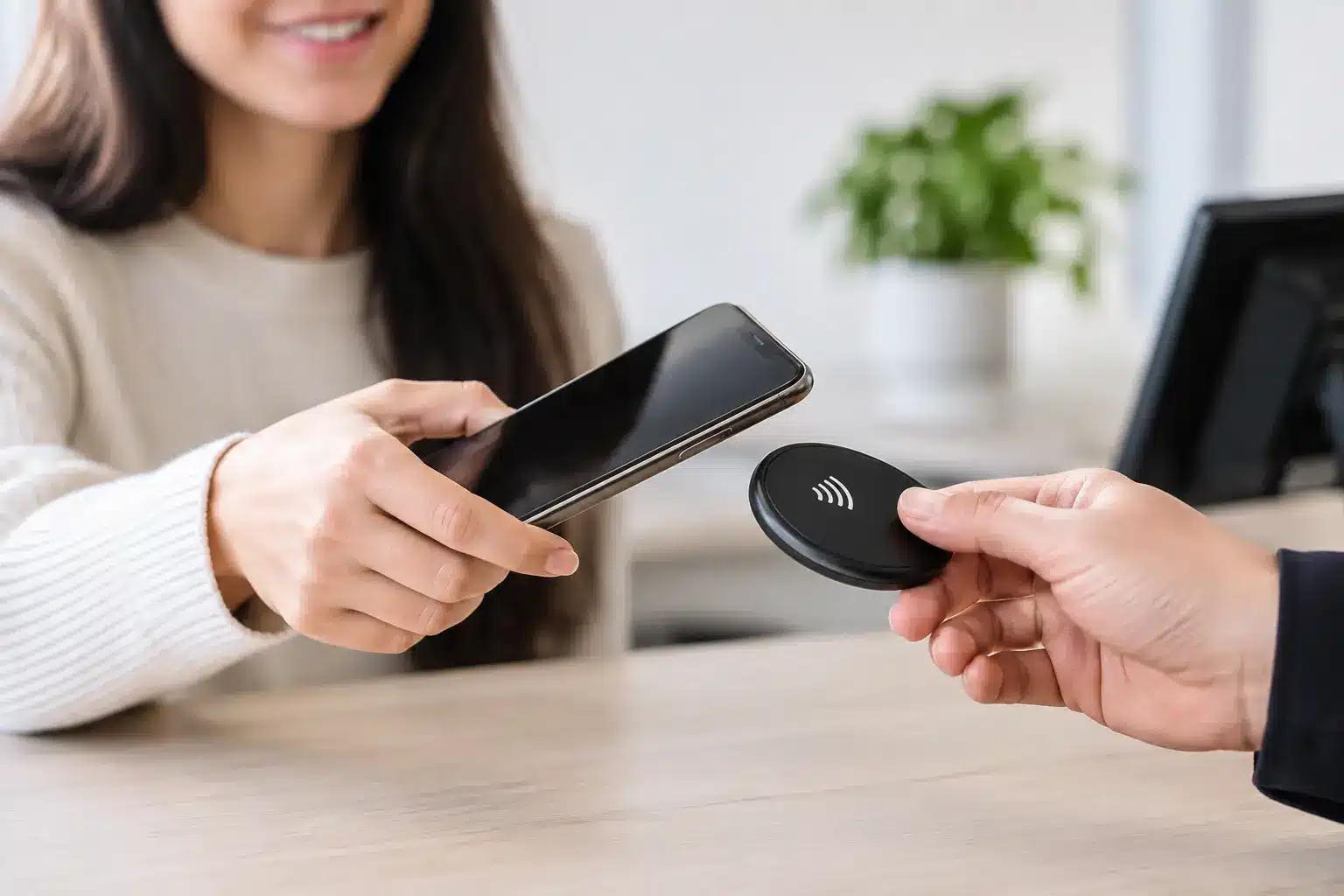
A freshly picked up table, a satisfied customer leaving the gym, or the delivery of a vehicle are moments with high potential to ask for a review. The question is clear: do NFC cards work? Yes, when they reduce friction, they are used at the right time and are part of a measurable process. They are not a magic shortcut to improve a Google listing, but they can turn a request that was previously lost into a published review.
For a local business, each review influences more than just the average rating. It affects the trust of those who compare options on Google Maps, reveals operational flaws, and provides continuous feedback on the real experience at each location. Therefore, the NFC card should be seen as a reputation-building tool, not as a simple physical support.
What an NFC card does and why it facilitates action
An NFC card incorporates a chip that transmits a command when a compatible mobile device is brought close. In this case, it directly opens the screen to leave a review on the Google Business Profile. The customer does not have to search for the business, locate the correct listing, or copy a link. Just turn the phone around, tap the notification, and write your review.
That savings in steps matters. Asking for a review via a generic phrase, a long URL, or a code that forces you to open the camera adds friction. The more steps the process has, the fewer people will get to the end. NFC technology eliminates that barrier, especially in face-to-face environments where the customer already has their mobile phone in hand.
It also conveys a more polished image. A well-designed card at the reception desk, at the table, at the counter or next to the ticket turns the request into part of the experience. It doesn't interrupt. It is available when the customer decides to take action.
But the card by itself does not create a good review.
The most common mistake is to attribute a result to the card that depends on the entire operation. If the service was slow, the room did not meet expectations, or the store service failed, bringing the mobile phone closer to a card will not solve the problem. In fact, it can speed up a negative review if you ask for feedback at a time of frustration.
NFC cards work best when the request comes after a clear point of satisfaction. In a restaurant, after checking that everything went well. In a workshop, after explaining the repair and handing over the vehicle. In a gym, after finishing a welcome session. In retail, after resolving a query with agility.
The key is that the team doesn’t recite a mechanical script. A brief, contextual request is more effective: “We’re glad it went well. If you have a minute, your opinion on Google helps us a lot.” The card sets the easy path; the team provides the human context.
When do NFC cards work best for reviews?
They work especially well in businesses with frequent physical traffic and moments of direct interaction. Hotels, restaurants, clinics, dealerships, retail stores, entertainment centers, gyms and academies have an advantage: they can request the review when the experience is recent.
In a multi-location company, the benefit is even greater if each location has its own access and its results are recorded separately. It’s not enough to distribute cards. You need to know which establishment generates the most reviews, which shift achieves the highest conversion rate, and what practices can be replicated.
There is also a difference between placing a card and activating it. A passive card in a corner can generate some opinions. An integrated card in the care process, With trained staff and a clear proposal, it generates a more consistent flow. The goal is not to pressure the customer, but to offer them an immediate way to share an authentic experience.
NFC vs QR: it's not an absolute choice
QR codes remain useful. They are inexpensive, printed on tickets, signage and promotional materials, and work on virtually any smartphone with a camera. NFC provides speed and a more direct experience, as it doesn't require focusing or opening the camera.
The best decision depends on the context. At a restaurant table, an NFC card may be more convenient than a small QR code. On a sign visible from a certain distance, the QR code makes more sense. In many cases, combining both systems on the same medium avoids missing opportunities: NFC for those who use it and QR as a universal alternative.
What matters is not the technology chosen, but the destination of the link and the subsequent measurement. If the card opens an incorrect page, stops working, or does not allow the origin of the reviews to be distinguished, the business loses control over the investment.
How to use them without compromising trust
Asking for reviews must respect Google's policies. It is not advisable to offer discounts, gifts, or benefits in exchange for a review, nor to request only positive reviews. This practice undermines credibility, can generate distrust, and does not build a sustainable reputation.
The request must be open and honest. All customers are invited to share their experience, regardless of the outcome. This does not mean giving up on improvement. If a customer expresses an issue at the location, it is appropriate to address it and resolve it before requesting a review. The card does not replace a conversation with the customer or a service recovery protocol.
In addition, it is advisable to check that the device is connected to the correct link and that the staff knows how to explain its use without insisting. A damaged support, a poorly configured link or an invasive request produce the opposite effect to the intended one.
From the card to the operational data
The real value comes when the review capture is connected to reputation management. A new review should receive a consistent, quick response aligned with the brand. It should also feed useful analysis: what citations are repeated, What local highlights, where a recurring complaint appears, and what factor is driving up satisfaction.
For a chain, manually responding to each review and comparing results between locations consumes time that teams do not have. A platform like wiReply allows them to centralize this work, automate responses With a configurable tone and the ability to measure the performance of recruitment efforts by location or employee, the NFC card no longer remains an isolated element but becomes a traceable source of data.
This allows for concrete decisions to be made. If a location generates many reviews but receives criticism about wait times, operations can take action. If another location accumulates positive mentions about an employee or service, that behavior can become standard. Reputation is better managed when it is connected to everyday experience, not when it is reviewed once a month.
Errors that reduce conversion
The first is asking for the review too early. If the customer hasn’t yet received the full service, they don’t have a formed opinion. The second is placing the card where no one can see it or where the mobile can’t get close comfortably. The third is relying solely on support without training the team.
Lack of follow-up also fails. A card can attract more reviews, but if no one responds to the negative ones, thank the positive ones or identify patterns, the business misses out on much of its value. The speed of capture must be accompanied by a speed of management.
Finally, it’s not a good idea to obsess over volume. More reviews help, but a healthy strategy looks for recent, authentic, representative opinions of the experience. Consistency matters more than a one-time campaign that peaks and then disappears.
The correct way to measure whether they work
Measure before and after implementing the cards: number of new reviews per location, evolution of the average rating, percentage of responses, response time, and most mentioned topics. If possible, assign different cards or links per point of sale, campaign, or responsible person. This way you can identify which channel produces real results.
Don't expect an NFC card to transform local positioning in a week. Google values multiple signals, and reputation builds over time. However, a simpler and better-positioned request can sustainably increase the engagement of customers who were already satisfied and never found the moment to write.
NFC cards work when they are used to make something simple that the customer already wanted to do: recognize a good experience. The next step is to turn every review into actionable feedback, learning, and visible improvement in every location.