
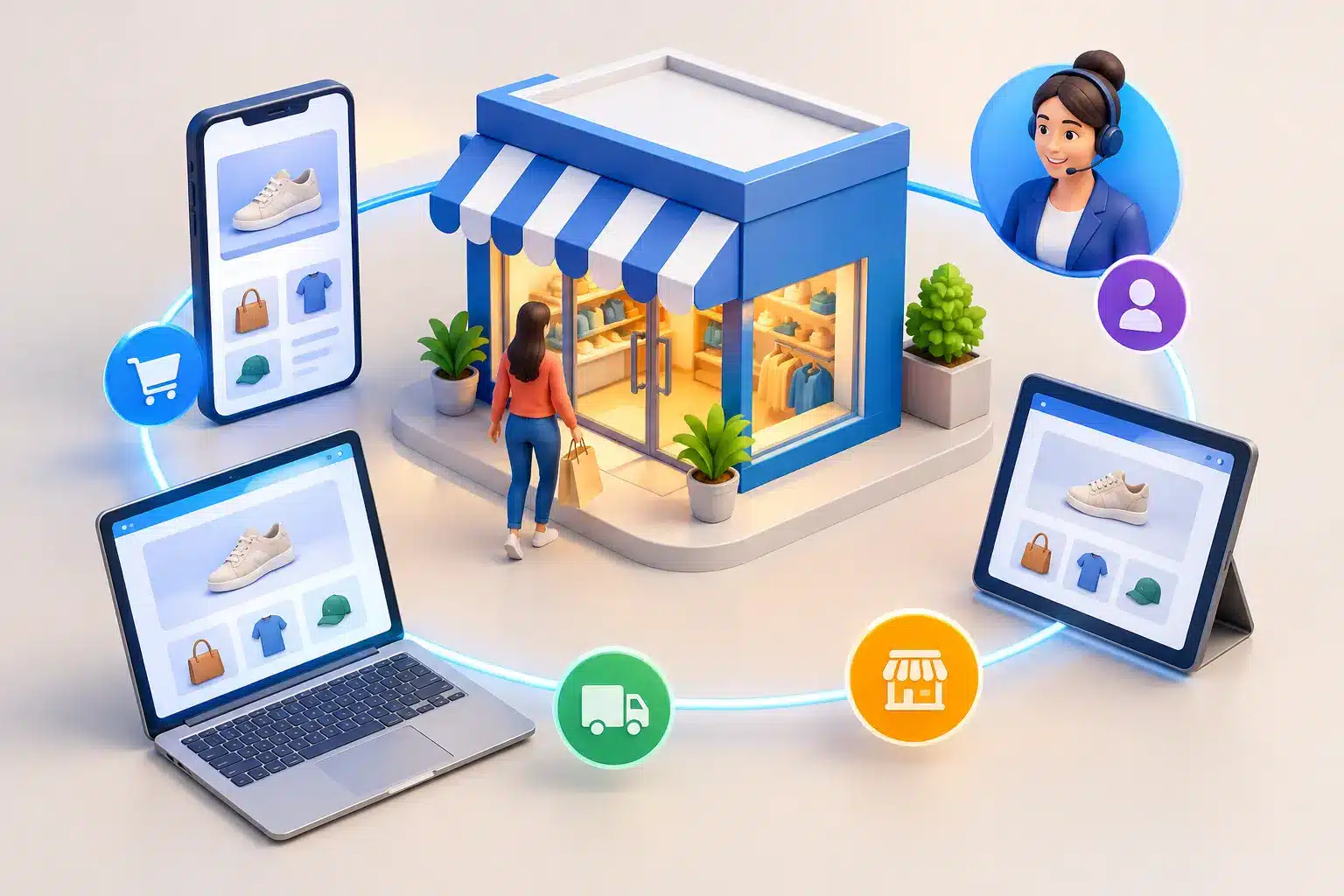
A customer books through Google, asks via WhatsApp, visits the location, and leaves a review upon departure. If each interaction is isolated, the business loses context, time, and opportunities for improvement. This omnichannel experience guide explains how to connect these touchpoints to deliver consistent service and turn the customer voice into operational decisions.
Omnichannelity isn’t about being present on many channels. It’s about all of them working as one operation. The customer shouldn’t have to repeat their problem, receive conflicting messages, or notice differences between one location and another. For a restaurant chain, gym, hotel, or dealership, that consistency directly affects visits, bookings, repeat purchases, and reputation on Google Maps.
What is an omnichannel experience and why it generates results
An omnichannel experience integrates digital and physical channels to ensure the customer’s progress is continuous. The web, calls, messaging, social media, Google Business Profile, point of sale, email, and in-person service should share useful information, response criteria, and common goals.
The difference compared to a multichannel strategy is operational. A multichannel company responds through various means, but each team can work with different data. A omnichannel company connects the data and coordinates actions. If a customer reports an incident by phone and then posts a negative review, the responsible person must be able to understand what happened before responding. Without that traceability, the response arrives late or is limited to a generic formula.
For local businesses, Google is a central piece of this journey. Many decisions start with a search for proximity: schedules, photos, route, availability, reviews, and responses from the business. The listing is not just a showcase. It is a channel for attraction, information, attention, and public reputation.
The goal isn't to digitize every conversation. It's to reduce friction and increase control. When teams see the same data, they can act faster, respond more accurately, and detect recurring issues among locations.
The real map of the local customer
Most companies design processes from their internal structure: marketing captures, operations execute, and customer service resolves. The customer does not see that division. They only perceive whether their experience was easy or complicated.
That’s why the first step is to map the journey from the outside in. In hospitality, it can start with a Google search, continue with a reservation, continue at the establishment and end with a review. In automotive, the process is usually longer: online consultation, call, visit to the dealership, test drive, purchase, maintenance and review. Each sector has its nuances, but there is one constant: the moments that generate satisfaction or frustration determine what the customer will recount later.
It is important to identify what the customer expects at each stage, what channel they use, what information the team needs and what signal they leave available. A cancellation, a complaint about waiting time, a repeated query or a review mentioning an employee are operational data. They should not be locked in a single inbox.
It is also important to distinguish between critical moments and secondary contacts. A mistake in a promotional message can be corrected. A slow response to an incident, a poor payment experience, or unanswered feedback for days can affect the trust of future customers.
How to build an omnichannel experience that works
The omnichannel experience guide should start with a clear decision: what data is needed to better serve customers and who can act on it. Collecting information without a usage process only adds complexity.
Centralize the conversation and reputation
Each local can receive comments on Google, Direct messages, forms, calls, and face-to-face consultations. If these channels are managed separately, the responsible party loses visibility and the brand loses consistency.
Centralization does not mean that one person should answer for everything. It means that the organization must have a common view of what is happening. Local teams need agility. Chain managers need to compare results, detect deviations, and ensure that brand standards are met.
Reviews deserve special attention because they are public, influence the decision of other users and often summarize the most visible aspects of the experience. A quick and contextualized response can restore a relationship. An automatic, impersonal or off-tone response can worsen the situation.
Define response rules, not rigid texts
Automation brings speed, especially when managing dozens or hundreds of locations. However, automating does not mean publishing the same response for everyone. The key is to set criteria: brand tone, type of incident, level of satisfaction, sensitive words, need to scale the case, and person responsible for follow-up.
Positive reviews can receive a quick, close, and aligned response with the business’s identity. Negative reviews require more context. If a serious accusation, a security issue, or an especially poor experience arises, the system should escalate the case to a person. Speed is valuable, but priority is to respond with discretion.
A platform like wiReply allows automate responses Google Business Profile reviews with configurable tone, without losing oversight over cases that require intervention. The result is less manual workload and greater capacity to maintain an active presence on each profile.
Link feedback with operations
Responding to a review is necessary. Fixing the pattern that caused it has a greater impact. If several reviews mention slow checkout, lack of cleaning, stock issues, or poor service during a certain time slot, the data should be sent to the appropriate person with sufficient context.
This is where semantic and sentiment analysis changes the conversation. It’s not enough to look at the average rating. Two places with 4.3 stars can have very different situations: one accumulates praise for the team and occasional criticism of the parking; the other maintains the average thanks to many old reviews, while the recent ones denounce a deterioration in the service.
Analyzing issues, temporal evolution and sentiment allows prioritization. Operations can review shifts or processes. Marketing can adjust expectations in communication. Human resources can recognize good practices or reinforce training. Management can compare locations and allocate resources where they are truly needed.
Measure performance by location and by process
Omnichannel experience requires metrics that connect activity and outcome. Review volume, average rating, and response time are useful indicators, but not sufficient. It is also worth observing the evolution of sentiment, recurring themes, response rate, the number of escalated cases, and the difference between locations.
In chains, the internal benchmarking It is especially useful. It allows to identify why one establishment receives more positive mentions regarding attention, speed, or cleanliness than another with similar conditions. It is not about pointing out the location with the worst results, but about turning the best processes into replicable standards.
The measurement must reach the point of sale. If the team understands that reviews translate into local visibility, traffic, and recognition of their work, reputation ceases to be an administrative task. It becomes part of the daily operation.
Increase the reviews without forcing the relationship
Asking for reviews works when it’s done at the right time and with a simple process. The satisfied customer shouldn’t have to search for a link, download an app, or complete several steps. A physical support with NFC technology, a visible code, or a well-thought-out follow-up request can reduce that friction.
The approach depends on the sector. A restaurant can request feedback after payment. A hotel, after check-out. A workshop, when the vehicle is delivered. What matters is to avoid indiscriminate or insistent requests. The quality of the experience should be the basis for generating reviews, not pressure on the customer.
In addition, there is an operational advantage: if each new review can be attributed to an employee, campaign, or point of sale, the company obtains data to recognize good practices and optimize local activation.
Errors that hinder omnichannel capabilities
The first mistake is buying tools without defining the process. A new channel does not solve the lack of coordination. The second is measuring only overall results. The average across the entire chain can hide serious problems in specific locations.
Automation also fails without quality control. Customers detect when the response seems copied, when it does not address their comment, or when it uses an inappropriate tone. Technology should speed up management, not eliminate human judgment.
Finally, many organizations separate reputation and customer experience. It’s a costly mistake. Reviews don’t appear at the end of the process: they are a public sign of everything that happened before. Managing them well requires listening, responding, and acting on what we learn.
A mature omnichannel operation doesn’t seek to be present on every channel out of fashion. It seeks to ensure that every interaction provides context, reduces friction, and helps improve the next service. When reviews, teams, and data work in sync, each visit ceases to be an isolated contact and becomes a measurable opportunity for growth.