
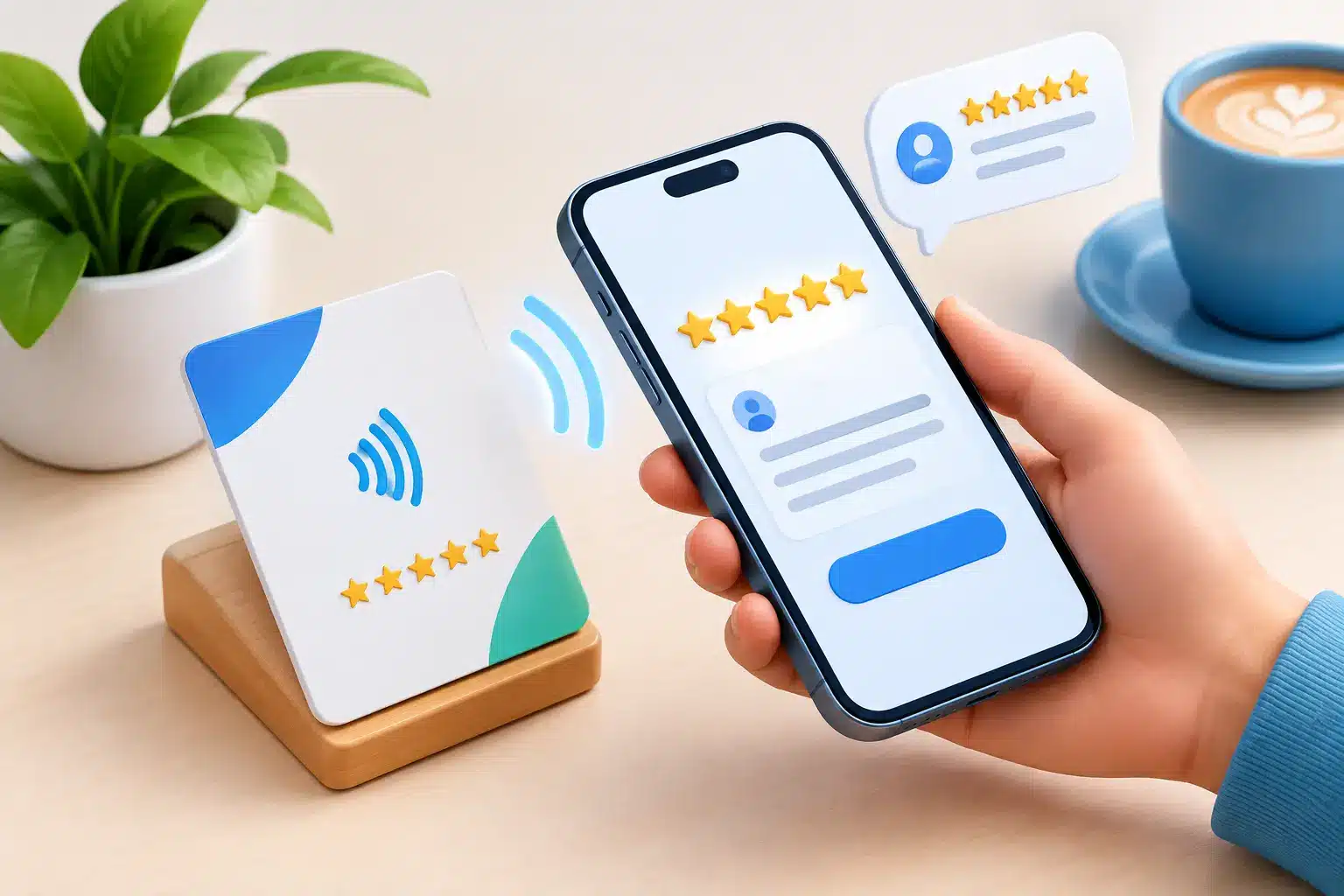
A customer has just finished their meal, closed a purchase or picked up their car from the workshop. They are satisfied, have their mobile phone in hand and still remember the details of the experience. That is the moment when personalized NFC cards turn good service into a Google review.
It’s not about asking for opinions insistently. It’s about eliminating steps. When the customer brings their mobile device close to a card, they’ll be taken directly to the review link for the correct location. Fewer searches, fewer errors, and a higher chance of completing the action.
Why reviews need a physical point of contact
Many businesses offer an excellent experience and receive few reviews. The problem is usually not the satisfaction. It is the time of the request and the difficulty of the process. If the customer has to search for the business on Google, locate the correct tab, log in, and remember what they wanted to order, a relevant part is lost.
An NFC card reduces that journey to a gesture. The mobile device recognizes the technology, opens the configured link and directs the user to the evaluation screen. It works especially well when the device presents it at the end of a positive interaction: after payment at a restaurant, when handing over a vehicle, after a personal training session or during check-out at a hotel.
The advantage is not just technological. It is operational. The card gives the team a concrete, quick, and consistent way to request a review, without improvisation or generic posters with hard-to-scan codes.
How personalized NFC cards work
NFC stands for Near Field Communication, a short-range technology that allows information to be exchanged by bringing two compatible devices together. In this case, the card incorporates a chip programmed with a URL. When a smartphone is brought close, the configured destination is opened, typically the Google Business Profile review form.
Personalization has two layers. The first is visual: design, logo, corporate colors, message, and call to action. The second is functional: each card can carry a unique link for a location, a campaign, a department, or even an employee.
This second layer makes a difference for businesses with multiple locations. A chain doesn’t need to hand out identical cards and wait for overall results. It can know which location generates the most reviews, which shift has the highest engagement rate, or which business dynamics work best.
A well-configured card should also include a visible alternative, such as a QR code. Although most current mobile devices support NFC, the QR code maintains accessibility for users who prefer to scan it or have the feature disabled.
When to offer the card to get more answers
The best support loses effectiveness if it is delivered at the wrong time. The request must arrive after a moment of clear value, not before. In restoration, it is usually after confirming that everything went well or upon presenting the invoice. In a gym, after a satisfactory session. In automotive, upon delivering the vehicle and explaining the work performed.
The message should be brief and natural. For example: “If you liked the attention, would you like to You leave a review ”Bringing the mobile device close to this card?”. The staff does not need to justify the technology or request a specific assessment. Their function is to facilitate access.
Asking for reviews from real customers is allowed, but the practice must be transparent. It is not advisable to offer rewards in exchange for a review, to filter out customers to request opinions only from those who seem satisfied, or to condition the content. A sustainable reputation is built with authentic, positive or critical comments, and with the ability to respond to both.
Measuring what each card generates
An NFC card should not be a decorative element on the counter. It should be integrated into a measurable process. If each support incorporates an identifiable link, the business can attribute the generated reviews to a location, team, campaign, or person responsible.
This traceability allows us to answer business questions. Which restaurant in the chain requests the best reviews? Does the table service card work better than the one carried by the front desk manager? Does the hotel’s front desk team consistently request reviews? Which dealership has improved its volume of reviews this month?
The data prevents decisions based on intuition. If a point of sale receives little traffic from reviews despite having a high rating, it may not be displaying the card at the right time. If a location receives many reviews but its average rating is low, the problem is no longer a matter of attracting customers: you need to analyze the comments to detect a recurring incidence.
For multi-site networks, In measuring this, the measurement must combine volume, average valuation, temporal evolution and the content of the opinions. An additional review helps to strengthen the local presence, but one hundred comments repeating the same failure are an operational warning that requires a response.
Customized NFC cards in each sector
In the hospitality industry, cards work best when they are available on a tabletop holder, alongside the ticket or in the hands of the room staff. The design should be discreet and the message should be direct. The customer experience remains the first priority.
In retail, they can be located next to the checkout, at the returns desk, or in advice areas. If a salesperson has resolved a relevant query, they can present the card when closing the sale. The goal is to capture the customer’s opinion while the interaction is still ongoing.
In workshops and dealerships, the most useful moment is usually the delivery of the vehicle. The customer has checked the result and can assess the clarity of the explanation, the compliance with the deadline and the attention received. A card associated with the advisor allows measuring which equipment generates the most comments.
In hotels and tourist accommodations, reception, concierge services and the time after check-out are suitable points. In this sector, speed matters: many guests are moving on to the next destination and the chance to leave a review decreases with each passing day.
In gyms, beauty clinics, leisure centers and personal services, the card can accompany a specific interaction. After a class, treatment or activity, asking for an opinion is more natural than doing so through a generic message days later.
Errors that reduce performance
The first is to program all the cards with a generic or incorrect link. In a company with multiple locations, sending a customer to another Google listing generates frustration and loses an opportunity. Each location needs its destination validated.
The second mistake is leaving the card without context. A customer may not know what to do with it or why they should use it. A clear phrase, such as “Turn your phone on and share your experience on Google,” resolves the doubt without prolonging the interaction.
Lack of training also fails. Delivering cards to staff without explaining when to use them often ends up in them being forgotten behind the counter. All that is needed is to define the moment, the recommended phrase, and the person responsible for reviewing the results.
Finally, it is not advisable to separate the acquisition from reputation management. Generating more reviews increases visibility, but it also increases the volume of responses required. If the business takes weeks to respond, it loses part of the value of the conversation.
From the card to a measurable reputation strategy
Customized NFC cards have more impact when they work within a management system. They capture new reviews at the point of sale, while the central platform centralizes the reviews, speeds up responses, and analyzes what customers repeat.
wiReply allows to connect that data collection with operational data. The company can identify the origin of new reviews, compare the performance between locations and detect issues that affect the experience, such as waiting times, team attention, cleanliness or product availability. Thus, a card no longer becomes an accessory but becomes a source of actionable information.
The goal is not to accumulate stars without context. It’s about getting more real reviews, responding quickly, and using the customer voice to improve each location. When asking for a review is easy for the customer and measurable for the business, local reputation starts growing methodically.