
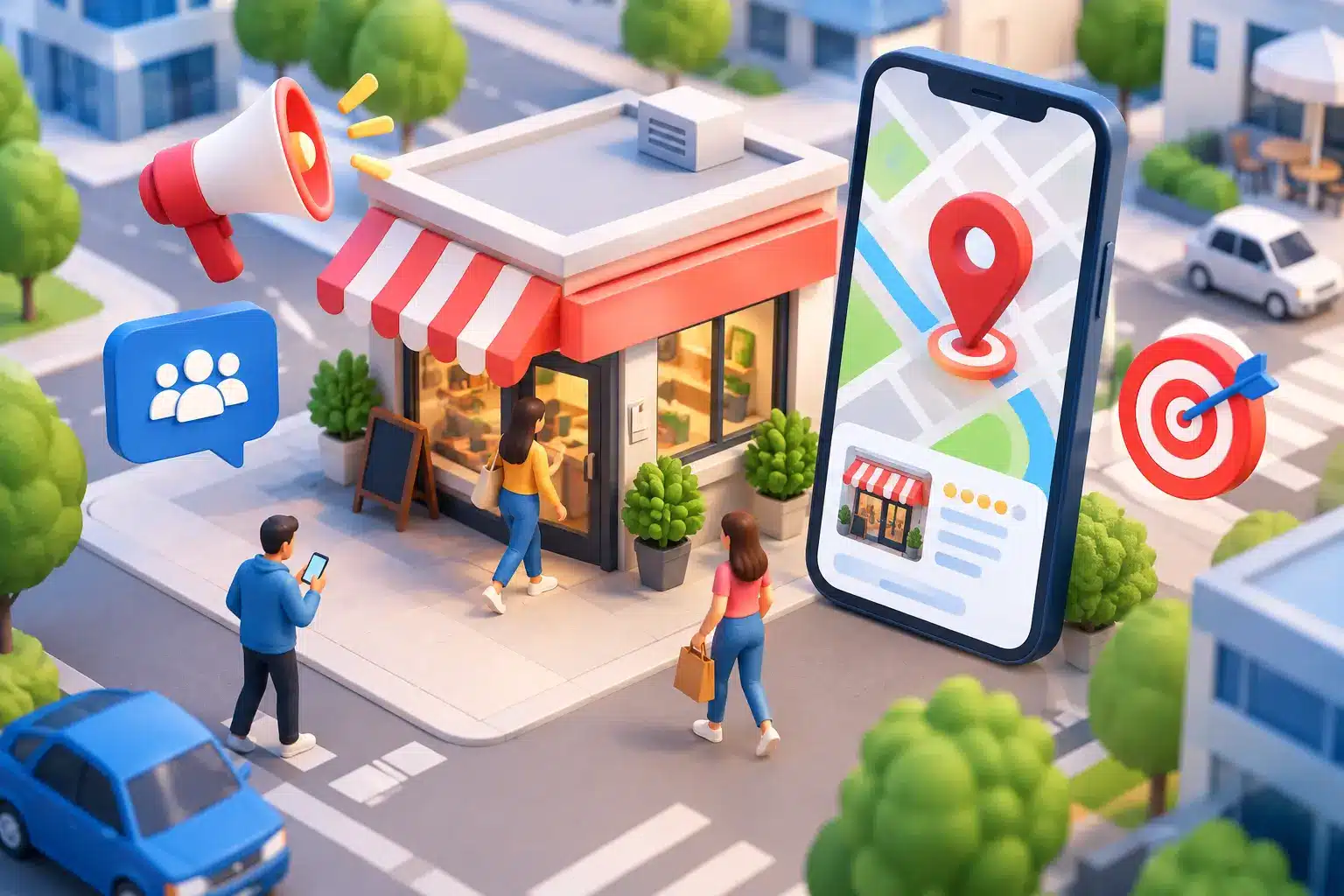
A customer searches for “gym near me,” compares three Google Maps listings, and decides in less than a minute. They read the latest reviews, look at the photos, check the schedule, and see if the business is open. This hyperlocal marketing guide is designed to win that decision before the customer even arrives at the door.
Hyperlocal marketing isn’t about appearing in an entire city. It’s about being the most visible, credible, and convenient option within a specific area. It can be a neighborhood, a district, a shopping area, or a few-kilometer radius around each location. For restaurants, hotels, workshops, clinics, stores, and chains, that precision turns local searches into visits, reservations, and sales.
What changes when the strategy is hyperlocal
A national campaign can build awareness, but it does not solve a key operational problem: each location has a distinct competitive advantage, a reputation of its own, and customers with different expectations. A chain restaurant can stand out for its fast service, while another receives recurring criticism for long wait times. Treating both locations as if they were the same is a waste of information and budget.
The hyperlocal strategy connects three layers. The first is visibility: having every point of sale appear when a user searches for a nearby category or service. The second is trust: recent reviews, helpful responses, current photos, and accurate data. The third is conversion: making it easy for the user to call, plot a route, book, visit, or purchase.
Google Maps It is usually the meeting point for these layers. It is not enough to have a created profile. Each location must compete for attention against businesses with better ratings, more reviews, more comprehensive information, or more consistent recent activity.
How to build a local base that generates visits
The first step is to define the actual catchment area of each establishment. It is not advisable to use the same radius for everyone. An urban café may attract people who walk five minutes. A dealership or a hotel can compete in a much larger area. Distance matters, but so do the type of purchase, the density of supply, accessibility, and search behavior.
From there, identify queries with local intent. Don’t think only in generic terms like “restaurant” or “sports store.” Analyze how customers search when they need to solve a problem: “dinner nearby,” “oil change,” “hotel with parking,” “gym open now,” or “optician in [neighborhood].” Those needs should guide the information on the profile, local content, and lead messages.
The Google Business Profile page is the central asset. The business name must be consistent with the real brand. The main category must accurately describe the activity. The hours, phone number, address, services, attributes, and action links must be up to date. An incorrect entry not only creates a bad experience: it can send traffic to the competition.
It is also advisable to continuously review the information. Special holiday schedules, menu changes, temporary services, and new openings require control. In a multi-location network, manually doing this from each location creates errors and inconsistencies. Centralizing the process allows maintaining speed without losing the context of each point of sale.
Reviews are a lever of positioning and trust
Reviews are not a decorative element at the end of the profile. They are social proof, a source of operational information and a sign of activity. A user who compares two similar businesses usually looks at three factors: average rating, volume of reviews, and the timeliness of the comments. A high score with old reviews can generate less trust than a slightly lower, but active and well-managed reputation.
The goal is not to solicit opinions indiscriminately. The goal is to create a system to request them at the right time, from real customers and from all possible points of contact. After a satisfactory purchase, a completed delivery, a check-out, or a repair, the team can invite the customer to share their experience with a simple process.
Customized NFC cards work well at checkouts, tables, receptions, and check-out areas because they reduce friction. The customer brings their mobile device and accesses the review flow directly. However, physical support alone is not enough. It must be accompanied by clear, personal, and consistent instructions based on the experience received. Asking for a review after poor service does not improve reputation: it amplifies the problem.
Responding matters too. Responses to positive feedback strengthen the relationship and show that the business is paying attention. Responses to criticism should be prompt, polite, and specific. A generic message can seem automatic, and a defensive response can worsen an already public incident.
Automation with artificial intelligence helps to respond on a scale, but it needs rules. The tone must adapt to the brand; the response must consider the actual content of the opinion, and sensitive cases must be escalated to a person. A review that denounces an incorrect charge, a security issue, or a possible violation requires operational management, not a courtesy formula.
Hyperlocal marketing guide for operating by location
The difference between a local strategy and a scaling strategy lies in the ability to compare, prioritize, and act. Each local must have its own goals, but all need a common vision. If a chain only measures the overall average valuation, it can hide locations with sustained declines in satisfaction.
It measures performance by establishment: volume of new reviews, average rating, response time, sentiment evolution, recurring mentions, and contribution from each employee or request channel. This data allows you to detect which locations generate the most recommendations, where friction occurs, and which practices are worth replicating.
The sentiment analysis it adds an extra layer. It’s not just about knowing whether a review has four or five stars. A five-star review can mention a long wait, and a three-star review can highly rate the staff while criticizing the product availability. Grouping these mentions allows you to move from intuition to concrete decisions.
If complaints about wait times arise in several locations, the solution is not to respond better. It may be necessary to adjust shifts, strengthen high-demand areas, or improve communication about deadlines. If customers repeatedly rate a specific team, that learning can become a service standard for the entire network.
The Comparison between premises It should be used to learn, not to punish. A business in a tourist area will have different patterns from one located in a residential neighborhood. Therefore, it is advisable to combine common indicators with context: seasonality, transaction volume, type of customer, and level of nearby competition.
How to activate capture without losing consistency
Local visibility improves when information, reputation, and customer experience work together. Publishing local content can help, but it does not replace a precise listing or compensate for poor attention. Similarly, investing in geotargeted ads can lead users to the listing, but poor ratings or no responses will slow down conversion.
Start with the locations with the most opportunity. It could be a new location that needs to generate social proof, a location with many visits but few reviews, or a retail location whose sentiment has worsened over the past few weeks. Prioritizing prevents resources from being distributed evenly and accelerates visible results.
Define a simple process for frontline teams. They should know when to invite people to leave a review, how to present the NFC support, and what to do if a customer raises an issue. The request should feel like a natural extension of the service, not as a pressure at the end of the purchase.
Then, automate the repetitive and retain control over the sensitive. A platform like wiReply allows you to centralize review management, configure responses with your brand tone, analyze sentiment patterns, and compare performance across locations. The value lies not in responding faster without judgment, but in turning every opinion into a useful signal for marketing, operations, and customer experience.
The opportunity is just a few meters away from each location. When every detail is taken care of, every review receives attention and every pattern becomes a concrete improvement, Google Maps stops being just a directory and becomes a measurable channel for attracting customers.