
Review requests are won in a few seconds
A customer finishes their meal, picks up their purchase or leaves a gym session. They are satisfied. That is the moment to ask for a review. If they have to look for a link, type out an address or open the camera without knowing what to do, the opportunity cools down. The comparison between NFC cards vs QR code is not just about technology: it is about reducing steps to turn a good experience into a published review on Google.
For a local business, every new review builds trust before a visit, reinforces the Google Maps presence and generates real information about what is happening in each establishment. However, requesting them manually, without clear support and without traceability, usually produces irregular results. The choice of format influences adoption by the team, the customer experience and the ability to measure which branch or employee is driving the most reviews.
NFC cards vs QR codes: the difference is in the gesture
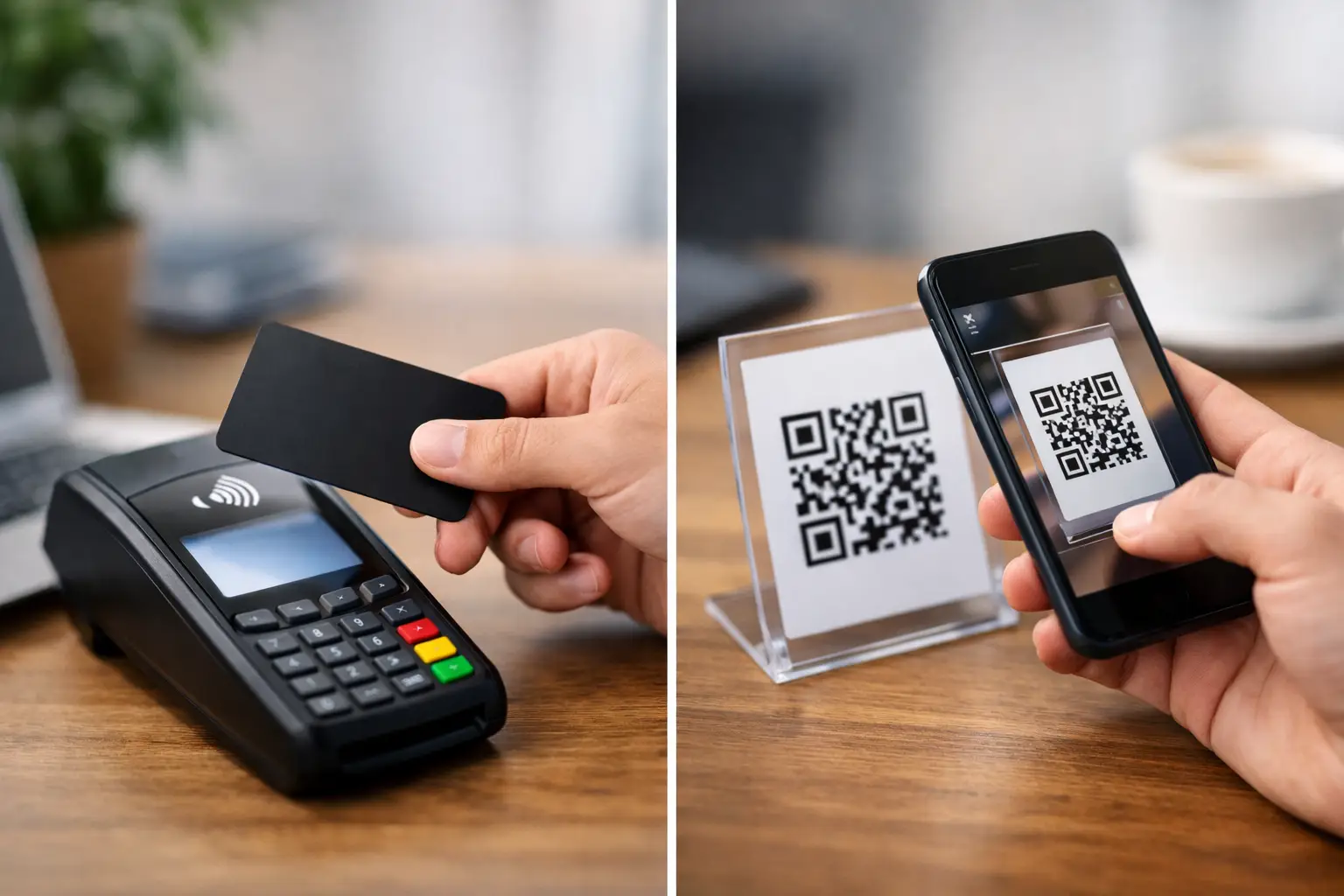
An NFC card incorporates a chip that triggers an action when the customer taps their mobile phone. In this case, it opens the direct link to leave a review. There is no need to scan an image or install an app. The gesture is simple: tap the phone against the card or display stand.
A QR code serves the same ultimate purpose, but requires opening the camera, pointing at the code and tapping the notification or link that appears on screen. It is a process known to almost all customers and works on any mobile phone with a camera. It can also be printed on receipts, posters, stickers, table talkers or packaging at a very low cost.
The difference seems small. In a point of sale with constant traffic, it isn't. Each additional step reduces the likelihood of the customer completing the action, especially when they are in a hurry or are wrapping up an in-person interaction. NFC eliminates the need to frame a code and usually conveys a more polished and modern feel. QR makes up for it with flexibility and visual reach.
There is no universal winner. The right option depends on the operating context, the customer profile and where the request originates.
When an NFC card usually converts better
The NFC card stands out when an employee can accompany the request. In a restaurant, the waiter can hand over the card reader and show a card at the end of the payment. In a dealership, the advisor can offer it after vehicle handover. In a clinic, reception can bring it closer to the client after a positive consultation.
In these scenarios, human contact already exists. The card makes the action immediate and avoids phrases like “scan this when you can”. The customer brings their mobile close, reaches the Google form and decides whether to leave their feedback while the experience is still fresh.
It is also a good choice when the brand is looking for a more polished physical presentation. A custom card with the logo, chain colours and a clear instruction works as a commercial tool at reception, the bar or the till. It is reusable, takes up little space and does not lose visual quality with use, unlike a poorly printed code.
The main limitation is operational. The card must be available at the right time, and staff need to know when to offer it without being pushy. Furthermore, although NFC compatibility is common in current mobile phones, there will always be customers who prefer to scan a code or who do not know where to tap their device. Therefore, an NFC card works best if it includes a QR code as a visible alternative.
When the QR code is the most efficient option
The QR code wins when the request must be present on many media or does not depend on an employee. It can be placed on a restaurant bill, a checkout sticker, an order's packaging, a hotel brochure or a garage invoice. Its reproduction cost is minimal and it adapts quickly to one-off campaigns.
It is especially useful for businesses that serve a high volume of customers and need to multiply touchpoints. A retail store with multiple tills, for example, can integrate the QR code into counter materials. A delivery service can include it with the order. An entertainment venue can place it in an exit area where the experience ends autonomously.
The problem arises when the QR code becomes decoration. A code that is too small, without a clear call to action or placed far from the moment of satisfaction, will generate barely any results. “Scan and tell us about your experience on Google” works better than a square without context. The design must explain what will happen next and why it is worth spending that minute.
A QR code also doesn't allow you to assume that every scan ends in a review. There can be accidental clicks, customers who abandon the flow or reading problems due to poor lighting. Therefore, it is advisable to associate each code with a venue, a campaign or a team to measure real results, not just the presence of the material.
What a chain should evaluate before choosing
The decision shouldn't be based solely on the unit price. An NFC card might cost more than a printed code, but generate more reviews if used consistently in an assisted moment. A QR code can be almost free, but bring in no volume if it's poorly placed or no one presents it to the customer.
First, evaluate the type of interaction. If there is an employee closing the sale or handling the farewell, NFC can offer a more direct experience. If the customer moves around autonomously or the business needs to reach many physical points, QR offers more coverage.
Then, analyse the number of locations. In one franchise network, it is not enough just to distribute materials. Each site must follow a common criterion: who requests the review, at what moment, with what phrase and through which medium. Without that consistency, it will be difficult to compare performance between establishments.
The measurement objective also matters. If you want to know which campaign, employee or point of sale is generating reviews, you need identified links and a system that centralises the data. Physical tools are the collection channel. Operational value appears when the results are linked to each location and cross-referenced with the sentiment of the reviews received.
Finally, think about durability. The QR code is easy to renew and reproduce. The NFC card is reusable and more suited to personal interaction. In many cases, the combination is more cost-effective than choosing a single format.
The strategy that works best: NFC to assist, QR to expand
For most businesses with a physical presence, NFC and QR are not mutually exclusive technologies. They address different situations within the same customer journey. The NFC card can be the main resource at the checkout, reception, or table. The QR code can reinforce the request on media where no staff are available.
A hotel can use NFC during checkout and a QR code in the welcome folder. A gym can employ a card at reception after a good conversation with the member and a QR code at the exit. A restaurant chain can incorporate QR codes on the receipt, while the staff uses NFC with regular customers or particularly satisfied groups.
This combination avoids depending on a single behaviour. Whoever prefers to bring their phone closer has a quick route. Whoever feels more comfortable with the camera can scan. The decisive factor is that both lead to the same correct destination: the review link on the Google listing of the corresponding establishment.
Measurement turns a scorecard into a reputation lever
Handing out cards or printing codes does not guarantee results. The difference lies in establishing a measurable process. Each medium should answer a specific question: how many reviews has this venue generated?, which employee gets the most engagement?, what moment of the visit works best?, do the reviews reflect the experience we want to offer?
A platform like wiReply makes it possible to centralise this traceability alongside the management of reviews received. Thus, the team not only sees how many opinions are coming in, but can also spot satisfaction patterns, compare establishments and respond with a consistent tone without increasing the manual workload.
It is advisable to train staff with a brief and natural message. It is not a matter of pressuring the customer or asking for a specific rating. It is about inviting them to share a real experience when they have shown satisfaction. Transparency protects the credibility of the listing and generates more useful reviews for future customers.
The best support will be the one your team uses every day and can measure by location. Start with the touchpoint where satisfaction already exists, test NFC and QR with differentiated links and let the data decide which format deserves to be scaled.