
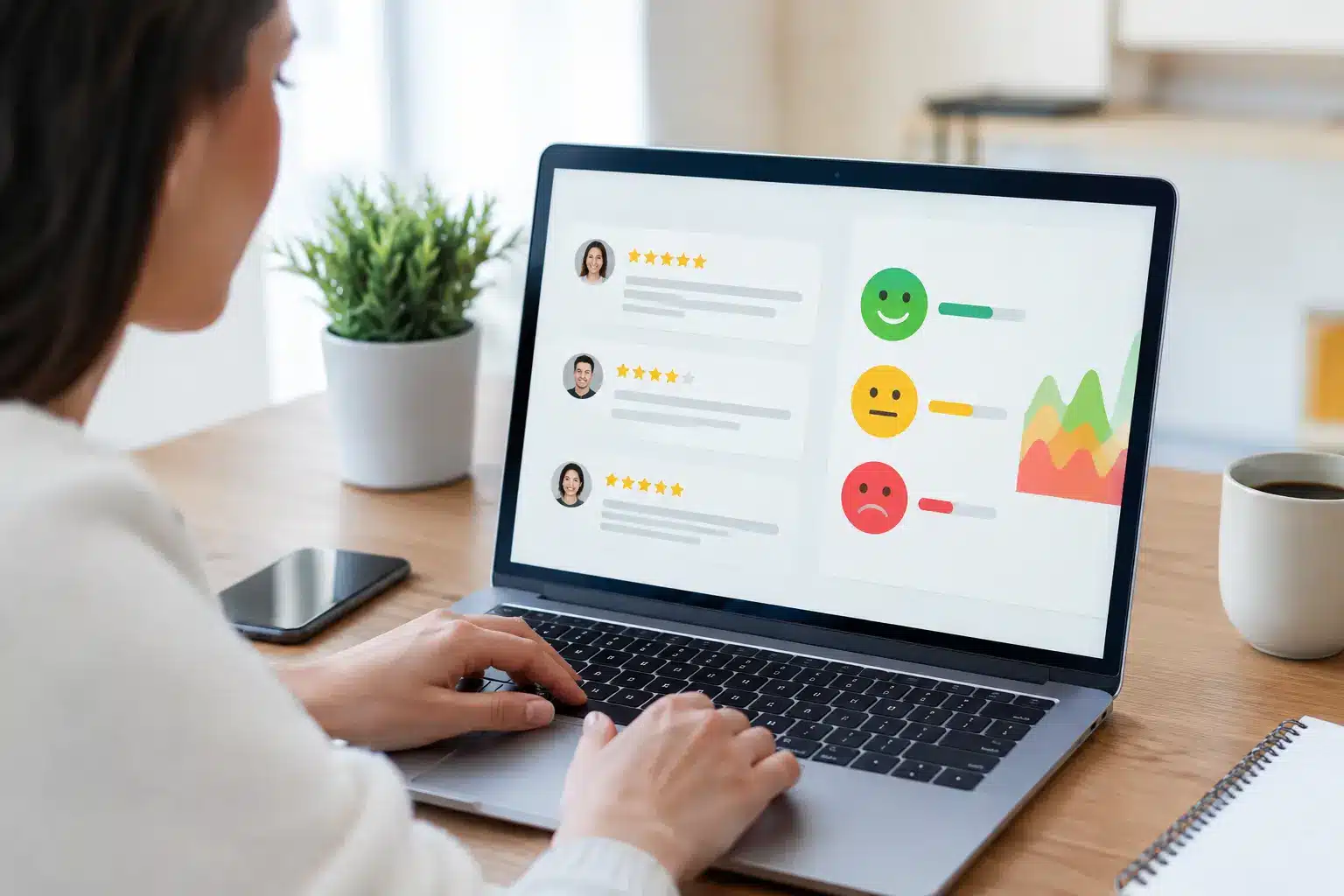
A one-star review doesn’t always speak of poor service. It can point to excessive waiting, a specific problem at the checkout, or poorly managed expectations. A five-star review also doesn’t by itself explain what’s working. Sentiment analysis allows you to read those signals on a scale and turn every comment into a concrete decision for the business.
For a local business with one or more locations, Google reviews are not just reputation. They affect a customer’s choice before visiting the location, booking a table, requesting an appointment, or requesting a quote. The challenge arises when dozens or hundreds of reviews arrive each month: reading them is possible; detecting useful patterns quickly is no longer possible.
What is sentiment analysis in reviews?
Sentiment analysis identifies the emotional load and the assessment contained in a text. In practice, it classifies opinions as positive, negative, or neutral, but its real value lies at the next level: recognizing what the customer is talking about and with what intensity.
It is not the same thing to detect that a review is negative as to know that the recurring reason is the cleanliness of the locker rooms, the slow service in the restaurant or the lack of stock for a specific item. The first reading describes the problem. The second allows for action.
A reputation-oriented solution analyzes the language of reviews, groups them by topic, and shows the evolution of each by establishment, period, or area. Thus, an operations manager can identify that team satisfaction rises across the entire chain while mentions of wait times worsen in three specific locations.
The key difference is simple: the stars show the result; the text explains the cause. When both data are interpreted together, the customer’s voice ceases to be an accumulation of isolated comments.
Why stars are not enough to manage reputation
The average rating is necessary, but it arrives too late and simplifies things too much. Two restaurants can have a score of 4.3. One can receive continuous praise for the product and criticism for the delay. The other can have very high-rated service but problems with the quality-price ratio. The rating is the same. The operational priority is not.
There is also a common effect in multi-site businesses: a drop in the overall score can hide a problem concentrated in one location. Without semantic analysis, the central team often reacts with general measures that consume time and do not solve the root cause of the incident.
Sentiment analysis provides context to answer questions that influence sales, experience, and local positioning: which aspects generate the most satisfaction, which friction leads to criticism, which locations improve, which deviate from the average, and what issues repeat after a campaign, an opening, or a team change.
This does not replace human reading of sensitive cases. It makes it more efficient. The team no longer reviews all opinions with the same level of attention and can focus on alerts that warrant immediate intervention.
How to turn feedback into operational decisions
The goal is not to create another report. It is to reduce the time between the customer's opinion and a visible improvement at the point of sale. To achieve this, the analysis must be organized by categories that are useful for the operation.
In restoration, the usual categories are service, waiting times, food quality, cleanliness, ambiance, and price. In a gym, they can include facilities, staff treatment, overcrowding, machinery, schedules, and cleaning. In automotive, they usually focus on commercial service, availability of appointments, transparency, delivery time, and after-sales service.
Each sector needs its own topic map. If the categories are too general, the data loses its value. If they are overly detailed, the information becomes fragmented and it becomes difficult to prioritize. It is advisable to start with the areas that the team can modify directly and measure their monthly evolution.
Next, sentiment needs to be crossed with three variables: the local, the volume of mentions, and the trend. A single criticism about parking may not require action. If negative mentions increase for six weeks at a location and coincide with a drop in reservations, the priority changes.
The correct approach is not to pursue every negative comment. It is to identify the patterns that repeatedly affect the experience and have the potential to damage the business's reputation.
Sentiment analysis for chains and multi-location businesses
The more locations a brand manages, the more difficult it is to maintain consistency. Each location has its own team, schedules, customers, and specificities. Without a centralized view, the information is scattered across Google Sheets, and the management only discovers problems when they have already affected the average rating.
A platform like wiReply allows you to centralize reviews and read sentiment at the point of sale. This makes it easy to compare similar locations, identify best practices, and take action before an issue turns into a problem. Negative trend.
The internal benchmarking It is especially useful. If two gyms in the same chain have a similar volume of reviews, but one gets very high scores for attention and cleanliness, there is a clear opportunity to review processes and shift practices. It’s not about competing between establishments; it’s about reducing differences that the customer perceives as inconsistencies in the brand.
In franchises, this visibility also improves the conversation with each manager. Instead of talking about impressions, you can work with data: 28% of the negative mentions over the last month relate to waiting time; the problem is concentrated on Saturdays and the evolution is worse compared to the previous quarter. The diagnosis is more accurate and the action is easier to follow.
The response to reviews also generates intelligence
Responding quickly and with a consistent tone protects the relationship with the customer. But an automated response should not be limited to simply thanking or apologizing. It should be part of a learning system.
When a negative opinion mentions a specific problem, the response should acknowledge it without arguing, apologize when appropriate, and open a follow-up channel. At the same time, the comment should feed the appropriate category within the analysis. Thus, each interaction contributes to identifying recurring issues.
In positive comments, reading is equally valuable. If customers consistently mention the friendliness of an employee, the speed of the workshop, or the quality of a dish, the business finds real arguments to strengthen its proposal. The best reviews show what the brand promise is already fulfilling.
Automation It helps maintain low response times, especially when there are multiple Google Business Profile tabs. Nevertheless, it is advisable to set up scaling rules. A serious complaint, a security incident, or a comment with personal data requires human review. Efficiency does not consist in responding the same way to all cases; it consists in assigning the correct level of attention to each case.
Errors that reduce the value of the data
The first mistake is to treat sentiment as a decorative metric. A panel with positive and negative percentages does nothing if no one has assigned an action. Every priority topic needs a responsible person, a review date, and an indicator to check if the change has worked.
The second is making decisions with a too small sample size. Five negative reviews in a month can be a warning sign in a clinic with low volume, but not necessarily in a chain that receives thousands of reviews. The reading should consider the total number of reviews and the evolution compared to previous periods.
The third is blindly relying on automatic classification. The language contains ironies, regional expressions, and ambiguous messages. Artificial intelligence speeds up the detection of patterns, but teams must review critical categories and adjust the system to their vocabulary, services, and context.
Finally, it is not advisable to separate reputation from operations. If marketing manages the responses but operations does not receive the findings, the reviews become an administrative task. The value appears when both teams share the same reading and act on it.
What to measure to demonstrate impact
A useful strategy combines reputational and operational metrics. The evolution of average valuation and the volume of reviews remain relevant, but they should be accompanied by the percentage of positive sentiment by category, the frequency of negative topics, the response time, and differences between locations.
It is also worth measuring the effect of actions. If the team in the room is strengthened during peak hours, negative mentions about waiting time should decrease in the following weeks. If a training area is renewed, positive references to facilities should increase. Without this connection, the analysis remains an observation.
The best sign is not just receiving more positive reviews. It is seeing that recurring problems are reduced, that the locations maintain similar standards, and that the team can intervene earlier. Each comment contains a part of the customer’s experience that they may not always communicate through another channel. Listening to it methodically allows you to improve the next service, not just respond to the previous one.